(Part 4 of 12)
Genesis 41:54 and the seven years of famine began to come, as Joseph had said. There was famine in all lands, but in all the land of Egypt there was bread.(ESV)
The famine was coming. Nobody could see it yet.
The fields were producing. The harvests were abundant. Egypt was entering seven years of extraordinary prosperity. If you looked around, there was no obvious reason to worry. But the famine was coming.
Long before the first field failed, God was already preparing for it. And His preparation was sitting in a prison.
Joseph Didn’t Know About the Famine
We know where Joseph’s story is going. That’s our problem when we read it.
We know about Pharaoh. We know about the dreams. We know about the seven years of plenty. We know about the seven years of famine. We know Joseph eventually becomes second only to Pharaoh.
Joseph didn’t know any of that. When his brothers threw him into a pit, Joseph didn’t know there was a famine coming. When they sold him to the Ishmaelites, he didn’t know. When Potiphar bought him, he didn’t know. When Potiphar’s wife falsely accused him, he didn’t know. When he was thrown into prison, he didn’t know. When Pharaoh’s cupbearer forgot him, he didn’t know. There was no sign hanging over the prison door: Preparation for future national leadership happens here.
It looked like prison. Because it was prison.
Start With the Famine and Work Backward
If we begin with the famine, the solution seems obvious. Egypt needs someone who can understand Pharaoh’s dreams.
That person needs enough wisdom to recognize that the dreams aren’t merely warnings. They require action.
He needs to understand administration. He needs to know how to manage resources. He needs to be trusted with enormous authority. He needs access to Pharaoh. He needs to be in Egypt before the famine begins. He needs to be there early enough to prepare during the years of abundance.
That’s a very specific person in a very specific place at a very specific time.
Joseph eventually becomes that person. But rewind the story.
How does a Hebrew shepherd from Canaan end up standing before Pharaoh?
That’s where things get uncomfortable.
There Was a Pit Before the Palace
Joseph’s brothers hated him. His father’s favoritism hadn’t helped. Neither had Joseph’s dreams.
Eventually his brothers saw him approaching and decided to kill him.
Reuben intervened. Judah suggested selling him instead. So Joseph was pulled from the pit and sold.
That doesn’t look like preparation. It looks like betrayal.
Then Joseph reaches Egypt and is sold to Potiphar. There, things begin improving.
Genesis 39:2 The Lord was with Joseph, and he became a successful man, and he was in the house of his Egyptian master.(ESV)
Maybe now we can see the story coming together.
Joseph gains responsibility. Potiphar trusts him. Joseph manages his household. Perhaps this is the training ground for what’s coming.
Then Potiphar’s wife lies about him. And Joseph goes to prison. The story seems to move backward again.
The Lord Was With Joseph
Genesis says something remarkable twice.
First, while Joseph is a slave:
Genesis 39:2 The Lord was with Joseph, and he became a successful man, and he was in the house of his Egyptian master.(ESV)
Then, after Joseph is falsely accused and imprisoned:
Genesis 39:21 But the Lord was with Joseph and showed him steadfast love and gave him favor in the sight of the keeper of the prison.(ESV)
His circumstances changed. That statement didn’t.
Slave: The LORD was with Joseph.
Prisoner: The LORD was with Joseph.
That matters because we often use circumstances as evidence of God’s presence.
Things are improving, so God must be working. Doors are opening, so God must be working. The plan is becoming clearer, so God must be working.
Joseph’s story doesn’t let us do that. Sometimes the next step in the story looks like everything just got worse.
Then Joseph Was Forgotten
In prison, Joseph meets two officials from Pharaoh’s court. The cupbearer and the baker both have dreams. Joseph interprets them. The cupbearer will be restored. The baker will die. Joseph asks the cupbearer for one thing: Remember me.
Genesis 40:14 Only remember me, when it is well with you, and please do me the kindness to mention me to Pharaoh, and so get me out of this house.(ESV)
The cupbearer is restored.
Then comes one of the coldest sentences in Joseph’s story:
Genesis 40:23 Yet the chief cupbearer did not remember Joseph, but forgot him.(ESV)
Forgotten. And Genesis 41 begins: “After two whole years…”
Two years.
Joseph had done the right thing. He’d helped the right person. He’d finally made contact with someone who had direct access to Pharaoh.
This looks like the door. Then nothing happens.
For two years.
From Joseph’s perspective, the story appears stalled. From ours, the timing is becoming exact. Because Pharaoh hasn’t dreamed yet.
The Delay Wasn’t Empty
Two years later, Pharaoh dreams. Now the cupbearer remembers.
Suddenly the forgotten prisoner is standing before the most powerful man in Egypt.
Joseph interprets Pharaoh’s dreams. Seven years of abundance are coming. Then seven years of devastating famine. Joseph doesn’t stop with the interpretation. He gives Pharaoh a plan. Appoint someone discerning and wise. Collect a fifth of the produce during the good years. Store grain throughout Egypt. Prepare now for what’s coming later.
Pharaoh listens and asks:
Genesis 41:38 And Pharaoh said to his servants, “Can we find a man like this, in whom is the Spirit of God?”(ESV)
Then he chooses Joseph. The prisoner wakes up that morning in prison.
By the end of the chapter, Pharaoh tells him:
Genesis 41:40 You shall be over my house, and all my people shall order themselves as you command. Only as regards the throne will I be greater than you.”(ESV)
The change is astonishing. But Joseph wasn’t created that morning. The man standing before Pharaoh had a history.
He’d managed Potiphar’s household. He’d been entrusted with responsibility in prison. He’d learned to serve while enslaved. He’d learned to serve while forgotten. He’d interpreted dreams when doing so offered him no immediate advantage.
The palace revealed what had already been developing elsewhere.
Then the Famine Came
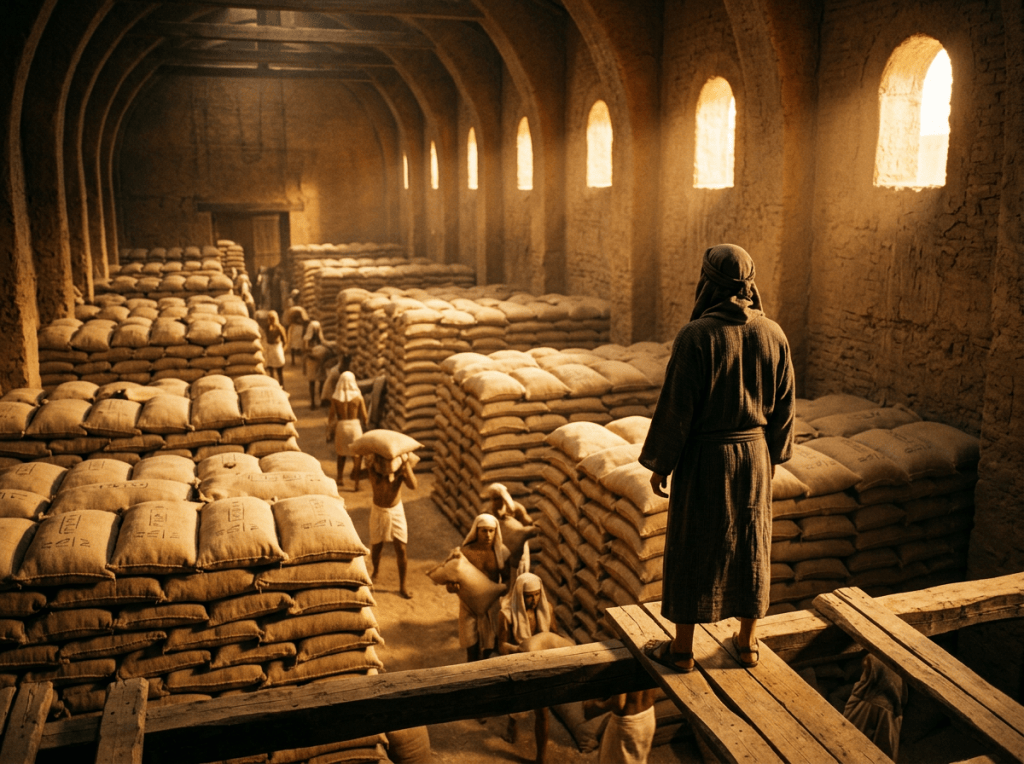
For seven years, Egypt gathered food.
Then: “The seven years of famine began to come.”
There it is. The fire on the stove. The crisis everybody can finally see. Now the reason for the preparation is obvious. But look how late in the story the famine appears.
Joseph has already dreamed. Already been hated. Already been betrayed. Already been sold. Already served Potiphar. Already been falsely accused. Already been imprisoned. Already met the cupbearer. Already been forgotten. Already interpreted Pharaoh’s dreams. Already been elevated. Already spent seven years storing grain.
Then the famine begins. If we call the famine the beginning of the story, we’ve missed almost the entire story.
Be Careful With This Story
There’s an easy mistake to make here. We can look at Joseph’s story and say: “See? Every terrible thing that happens to you is God preparing you for something better.”
Joseph’s story doesn’t give us permission to say that. Betrayal is still betrayal. False accusation is still false accusation. Slavery is still slavery. Prison is still prison. The evil done to Joseph doesn’t become good simply because God eventually brings good through it.
Joseph himself makes that distinction years later when speaking to his brothers:
Genesis 50:20 As for you, you meant evil against me, but God meant it for good, to bring it about that many people should be kept alive, as they are today.(ESV)
Notice what Joseph doesn’t say. He doesn’t say: “What you did wasn’t actually evil.”
He calls it exactly what it was. You meant evil.
God’s sovereignty doesn’t require us to rename evil. The extraordinary thing is that human evil was unable to prevent God’s purposes.
God could take a road Joseph never would’ve chosen and still bring him exactly where he needed to be.
Preparation Can Feel Like Destruction
That’s what makes Joseph different from David. David’s field makes sense as preparation once we see Goliath.
The lion. The bear. The sling. We can draw the lines pretty easily.
Joseph is harder. His preparation repeatedly looks like destruction. Every time his life begins stabilizing, something tears it apart again. The pit. Slavery. Prison. Being forgotten.
If Joseph had judged God’s activity only by whether his circumstances were improving, he would’ve had every reason to believe God had abandoned him. Yet Scripture keeps interrupting the disaster with the same truth: The LORD was with Joseph.
God’s presence wasn’t proven by Joseph avoiding the prison. God was with him in it.
Something Else Was Happening
There’s another story unfolding simultaneously. Jacob and Joseph’s brothers are back in Canaan.
They don’t know where Joseph is. They don’t know what’s happening in Egypt. They don’t know about Pharaoh’s dreams. They don’t know about the grain being stored. They certainly don’t know that the brother they sold is overseeing it. Then the famine reaches Canaan.
Jacob hears that Egypt has grain. So he sends his sons there to buy food. Think about that.
They believe they’re traveling to Egypt because they’re hungry. They have no idea they’re walking into a story that began decades earlier.
The man they need is already there. The grain they need is already there. The preparation began before they knew there would be a famine. Before they knew they would need Egypt. Before they knew they would need Joseph. And certainly before they knew the brother they discarded would become part of their survival.
Before the Famine
We like preparation when it looks like preparation.
Education. Training. Practice. Opportunity. Growth. Open doors. Those make sense.
Joseph gives us another category.
Sometimes we can’t identify what God’s doing from the shape of the circumstances around us. Sometimes we won’t understand it while we’re living through it. Sometimes we may never understand it completely.
That doesn’t mean we call evil good. It doesn’t mean we pretend suffering doesn’t hurt. It doesn’t mean every prison eventually comes with a palace.
It means something much simpler. We don’t know enough of the story to declare that God has stopped working.
Joseph didn’t know about the famine. His brothers didn’t know. Jacob didn’t know. Egypt didn’t know.
For years, nobody could see the crisis coming. But long before the fields stopped producing, God was already at work.
The famine hadn’t started. The hunger hadn’t started. The desperate journeys to Egypt hadn’t started. Nobody was asking where they would find bread. But the grain was already being gathered. The storehouses were already being filled. And the man God would use was already in place.
Years earlier, Joseph could only see the pit. Then the slave’s house. Then the prison. Then the waiting.
He couldn’t see hungry brothers walking toward Egypt. He couldn’t see his father needing food. He couldn’t see nations coming for grain. He couldn’t see the famine.
But God could.
Before anyone knew they would need bread, God was already preparing for the hunger.






Leave a comment