(Part 15 of 16)
Luke 23:18–25 (18)But they all cried out together, “Away with this man, and release to us Barabbas”—(19) a man who had been thrown into prison for an insurrection started in the city and for murder. (20)Pilate addressed them once more, desiring to release Jesus, (21)but they kept shouting, “Crucify, crucify him!” (22)A third time he said to them, “Why? What evil has he done? I have found in him no guilt deserving death. I will therefore punish and release him.” (23)But they were urgent, demanding with loud cries that he should be crucified. And their voices prevailed. (24)So Pilate decided that their demand should be granted. (25)He released the man who had been thrown into prison for insurrection and murder, for whom they asked, but he delivered Jesus over to their will.(ESV)
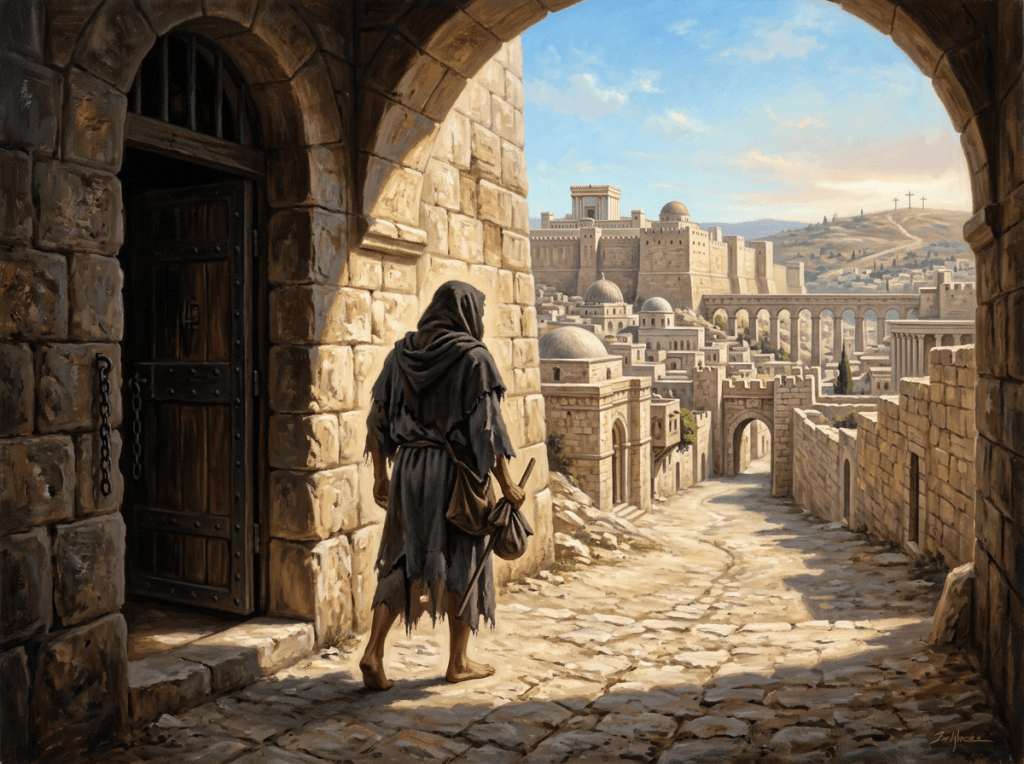
There were two men. One was guilty. The other was innocent. One was released. The other was crucified. And somewhere in the midst of the most significant event in human history, a man named Barabbas received a future he hadn’t earned.
All four Gospel writers record his release. Matthew describes him as a notorious prisoner. Mark and Luke associate him with an insurrection in which murder had been committed. John describes him as a robber. None of them presents him as an innocent man unjustly imprisoned. Yet when Pilate presented the crowd with a choice, they demanded the release of Barabbas.
Pilate eventually surrendered to their demands. Barabbas was released. Jesus was delivered over to be crucified. And that’s the last we hear of Barabbas.
A Tomorrow He Didn’t Earn
Consider what Barabbas received that day. He received more than freedom from confinement. He received the opportunity to live a life beyond the consequences he was facing. There would be another morning. There would be decisions to make. There would be places to go, people to encounter, and opportunities that hadn’t been available to him while imprisoned.
His future had been returned to him. And nothing in the Gospel accounts suggests that he’d done anything to deserve it. He hadn’t established his innocence. He hadn’t demonstrated a transformation of character. He hadn’t performed some extraordinary act of service that warranted his release.
The decision that changed his circumstances was made outside of anything Scripture records him doing. That’s an extraordinary position in which to find oneself. To receive something of immeasurable value without having established any claim to it.
Barabbas didn’t walk away because he was innocent. He walked away while an innocent man was condemned. The distinction matters.
His release didn’t rewrite his history. It gave him a future beyond it.
An undeserved opportunity isn’t a declaration that our past was acceptable. It’s an opportunity for our future to be different.
The Man Scripture Doesn’t Follow
What happened to Barabbas? It’s a question we can’t answer.
Did he return to the people with whom he’d been associated?
Did he continue pursuing the same objectives?
Did he witness the crucifixion?
Did he eventually hear the testimony of those who proclaimed that Jesus had risen?
Did he ever understand the significance of the events surrounding his release?
We don’t know. There are traditions, fictional accounts, and imaginative retellings that attempt to answer some of those questions. But Scripture doesn’t. And we should resist the temptation to give Barabbas a conversion story simply because it would make his account more satisfying.
We should equally resist the temptation to assume that he returned to his former ways. The opportunity was real. His response is unknown.
Perhaps that’s what makes this account so uncomfortable. We want the man who received such an extraordinary opportunity to recognize its value. We want him to do something meaningful with it. We want his release to become the beginning of a transformed life. But receiving an opportunity and recognizing its significance are two different things. And recognizing its significance and responding appropriately are two different things as well.
Barabbas was given a tomorrow. Scripture doesn’t tell us what he made of it.
The Difference Between Release and Transformation
There’s a distinction between being released from a circumstance and being transformed as a person. A prison door can be opened without changing the character of the person walking through it. A debt can be forgiven without changing the habits that produced it. A relationship can be restored without correcting the behavior that damaged it. An opportunity can be given without developing the wisdom necessary to use it.
The external circumstances may change dramatically while the internal circumstances remain exactly as they were. That’s not an accusation against Barabbas. We don’t know enough about his subsequent life to make one. It’s an observation about the nature of opportunity.
His release established that he was free to leave. It didn’t establish what kind of man he’d become. And that distinction should cause us to examine our own lives.
How many times have we received another opportunity?
How many times have we been spared consequences that could’ve been considerably worse?
How many times has someone extended forgiveness, patience, or mercy beyond what we could reasonably have demanded?
What did we do with what we received?
Did we merely enjoy the removal of the consequence?
Or did we recognize the opportunity to become something different?
Sometimes we’re so grateful that a door has opened that we never consider where we’re going once we walk through it.
The Greater Exchange
It’s nearly impossible to read the account of Barabbas without recognizing the extraordinary picture it presents. The guilty man walks free while the innocent man’s condemned. But what happened at the cross was considerably greater than the exchange that took place before Pilate.
Jesus wasn’t merely dying because Barabbas had been released. He was giving His life for sinners. All sinners.
The physical release of Barabbas illustrates something of that greater reality, but it shouldn’t be confused with the spiritual salvation Christ accomplished. Scripture doesn’t tell us that Barabbas received salvation through faith. It tells us that he was released from prison. The distinction is important because the Christian message isn’t merely that Jesus provides an escape from consequences. It’s that through Him we receive reconciliation with God and the opportunity to walk in newness of life.
Paul addresses this beautifully in Romans 6. Having established the extraordinary nature of grace, he confronts the possibility that someone might misunderstand it as permission to continue living as before. His response is emphatic. Grace isn’t an invitation to remain enslaved to the very thing from which Christ came to free us. And Ephesians 2 establishes the proper relationship between salvation and the life that follows.
We aren’t saved by our works. We’re saved by grace through faith. But we are created in Christ Jesus for good works. The order matters.
Our response doesn’t purchase the gift. It follows the gift.
We don’t live faithfully to make Christ’s sacrifice sufficient. We live faithfully because of what Christ has done.
The life that follows grace isn’t the payment for grace. It’s the life grace has made possible.
What Will You Do With Tomorrow?
There’s something particularly sobering about the silence surrounding Barabbas. His name has been preserved for generations. His release is read in churches throughout the world. Countless people have recognized the significance of the exchange that took place before Pilate. Yet we can’t say whether Barabbas himself ever recognized that significance.
Imagine being remembered throughout history for receiving something extraordinary while leaving no recorded testimony of what you did with it.
Perhaps he understood. Perhaps he didn’t.
Perhaps his life changed completely. Perhaps it didn’t.
Those questions belong to a man whose subsequent story Scripture hasn’t preserved. But there’s another question that belongs to us.
What are we doing with what we’ve received?
Not what are we doing to deserve it. Not what are we doing to repay it. Not what are we doing to establish that we were worthy of receiving it. What are we doing with it?
It’s possible to spend so much time celebrating the grace of God that we give remarkably little attention to the life that grace calls us to live.
We can speak eloquently about forgiveness while refusing to forgive. We can celebrate freedom while continuing to pursue the things that once enslaved us. We can rejoice in reconciliation with God while neglecting the relationships and responsibilities He’s placed before us. We can become so occupied with the extraordinary nature of the gift that we overlook the extraordinary possibilities it’s placed within our reach.
Barabbas received his freedom. We don’t know what he did with it. But we aren’t confined to asking questions about a man who lived two thousand years ago. We have decisions of our own to make.
The Man Who Walked Away
Barabbas walked away. Jesus went to the cross. The Gospel writers followed Jesus. They recorded His crucifixion, His burial, and His resurrection. They told us what happened to the disciples. They preserved the testimony of those who encountered the risen Christ. But they never returned to Barabbas.
His release is recorded. His response isn’t. And perhaps we should leave his story exactly where Scripture leaves it. Because the question that matters most isn’t one we can answer on his behalf. It’s one we must answer for ourselves.
Christ has given us something far greater than another day outside a prison. He has offered us reconciliation with God, freedom from the dominion of sin, and eternal life.
We can’t earn those things. We can’t repay them. But we can respond to them.
We can live differently because of them. And we can recognize that the grace we’ve received has opened possibilities that would never have existed apart from Christ.
Barabbas was given a tomorrow. We don’t know what he did with it.
What are you doing with yours?






Leave a Reply