2 Corinthians 12:9 But he said to me, “My grace is sufficient for you, for my power is made perfect in weakness.” Therefore I will boast all the more gladly of my weaknesses, so that the power of Christ may rest upon me.(ESV)
When everything falls apart, one of the first things we want is restoration. We want life back. We want our strength back. We want our confidence back. We want our plans back. We want the version of ourselves that existed before everything went wrong.
That desire makes sense. But restoration in Scripture doesn’t always mean returning to the way things were. Sometimes God restores. Sometimes He rebuilds. Sometimes He replaces. Sometimes He leaves scars. Sometimes He allows us to walk forward carrying evidence that something happened here.
Jacob walked away from his encounter with God blessed, but limping. Peter was restored after denying Jesus, but he could never unknow what he’d learned about himself in that courtyard. David received forgiveness, but forgiveness didn’t erase every consequence of his choices. Paul prayed repeatedly for the thorn in his flesh to be removed.
God didn’t remove it. Instead, God told him: “My grace is sufficient for you.”
That’s not the answer Paul originally wanted. He wanted the weakness gone. God gave him grace inside the weakness. There’s a difference.
Sometimes we spend so much time asking God to restore what was lost that we fail to notice what He’s building in the space that loss created.
That doesn’t make the loss good. It doesn’t mean we should celebrate pain simply because something useful eventually came from it.
Pain is still pain. Loss is still loss. Failure is still failure. But none of those things prevent God from working.
That matters because after everything falls apart, we can become obsessed with reconstructing the old version of life.
We gather the pieces. We try to remember where everything went. We attempt to put every relationship, every plan, every expectation, and every part of ourselves back into its original place.
But sometimes the old structure can’t be rebuilt. Sometimes it shouldn’t be.
There are parts of me that existed before my own life came apart that I would never want back. There are also parts I deeply miss. Both can be true.
I can grieve what was lost and still recognize what God produced afterward. I can wish the road had been different without pretending the road taught me nothing. I can still have unanswered questions and trust God at the same time.
That may be one of the hardest lessons in the aftermath.
You don’t have to call destruction good in order to believe God can redeem what remains. You don’t have to pretend the wound never happened. You don’t have to erase the scar. You don’t have to become the person you were before.
Maybe you can’t. Maybe you’re not supposed to.
We tend to think strength means becoming difficult to break. Paul learned something different.
He learned that weakness could become the place where the power of Christ rested upon him. That doesn’t mean weakness became pleasant. It means weakness no longer had the final word.
There are things I still don’t understand about the path my own life took. There are lessons I learned far too early. There are lessons I somehow skipped entirely. There are things I can see clearly now that I probably never would’ve understood otherwise. And there are still pieces that don’t fit anywhere yet.
I don’t know what all of it is building toward. But I don’t need to know that today.
Neither do you.
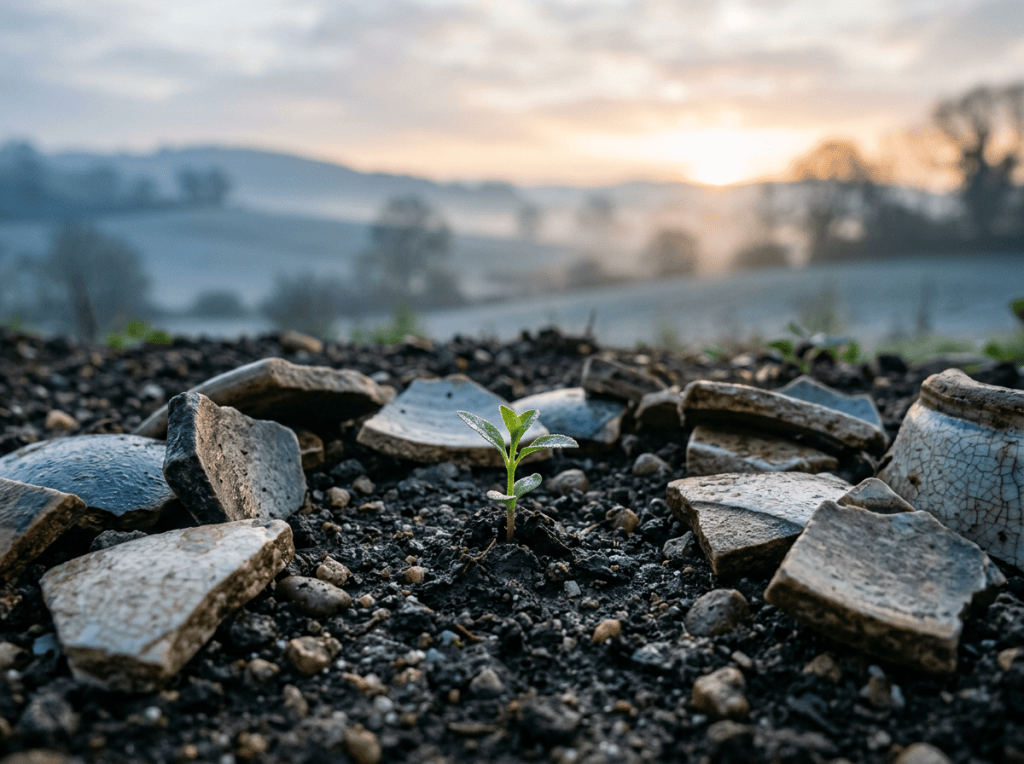
When everything falls apart, there’s a temptation to believe the wreckage is all that remains. It isn’t.
Your faith may remain. Your character may remain. Your relationships may remain. Your calling may remain.
Sometimes only the smallest piece survives. But God has never required much material to begin working.
The question after everything falls apart isn’t always: “How do I get my old life back?”
Sometimes the better question is: “God, what do You want to do with what remains?”
Maybe some things will be restored. Maybe some things will be replaced. Maybe some things will never return. Maybe some wounds will become scars you carry for the rest of your life. And maybe some of those scars will eventually become evidence that the thing which nearly destroyed you didn’t get the final word.
You came apart. You discovered the limits of your own strength. Now you stand among the pieces. And the God who raises the dead is still here.
So don’t rush to rebuild everything exactly as it was. Don’t assume every lost piece belongs in the next version of your life. Don’t measure God’s faithfulness only by whether He restores the past.
Bring Him what remains. That’s enough material for Him to work with.






Leave a comment