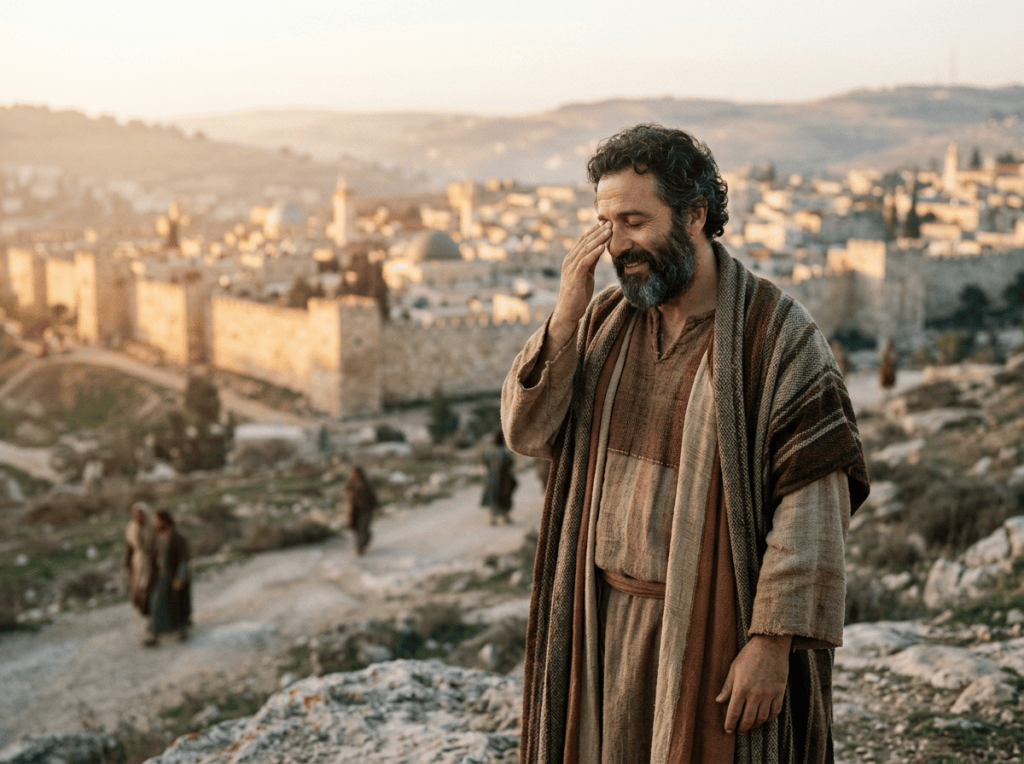
(Part 14 of 16)
John 9:35–41 (35)Jesus heard that they had cast him out, and having found him he said, “Do you believe in the Son of Man?” (36)He answered, “And who is he, sir, that I may believe in him?” (37)Jesus said to him, “You have seen him, and it is he who is speaking to you.” (38)He said, “Lord, I believe,” and he worshiped him. (39)Jesus said, “For judgment I came into this world, that those who do not see may see, and those who see may become blind.” (40)Some of the Pharisees near him heard these things, and said to him, “Are we also blind?” (41)Jesus said to them, “If you were blind, you would have no guilt; but now that you say, ‘We see,’ your guilt remains.(ESV)
The man could see before he knew whom he was looking for. That’s one of the more fascinating details in John 9. Jesus had encountered a man who’d been blind from birth. His disciples had asked a question about the relationship between the man’s condition and sin.
Jesus redirected their attention. He made mud, applied it to the man’s eyes, and instructed him to wash in the pool of Siloam. The man went. He washed. And he came back seeing.
The miracle itself occupies remarkably little of the chapter. By verse seven, the man’s physical condition has already changed. But John devotes another thirty-four verses to what follows. Why?
Because receiving his sight wasn’t the same thing as understanding what had happened to him. And it certainly wasn’t the same thing as understanding who’d given it to him.
The Man Called Jesus
When his neighbors began questioning him, the man explained what had happened. He identified the person responsible as the man called Jesus. He described the mud. He described the instruction to wash. He described the result. When they asked where Jesus was, he admitted that he didn’t know.
There was no elaborate theological explanation. There was no attempt to answer questions beyond his understanding. He knew what had happened. He knew the name of the man responsible. And he knew that he could now see. That was the extent of what he could confidently explain at that moment.
There’s something refreshing about the simplicity of his response. He didn’t pretend to understand everything about the person who’d changed his life. He didn’t embellish his experience to make it more convincing. He didn’t manufacture answers to questions he couldn’t answer. He simply told the truth about what he knew.
An incomplete understanding honestly expressed is worth more than a comprehensive explanation built on assumptions.
The man had encountered Jesus. But there was still much about Jesus that he didn’t know.
He’s a Prophet
When the Pharisees questioned the man, they discovered that Jesus had performed the healing on the Sabbath. Some concluded that Jesus couldn’t be from God because He hadn’t observed the Sabbath according to their understanding. Others questioned how a sinner could perform such signs.
There was division among them. Then they asked the man what he thought about Jesus. His answer was different from the one he’d given his neighbors.
He identified Jesus as a prophet. Something had developed in his understanding. Jesus was no longer merely the man whose name he knew. He recognized something significant about the person responsible for his healing.
Scripture doesn’t tell us precisely when he reached that conclusion or what reasoning led him there. But it does preserve the progression.
The man was beginning to understand the significance of what had happened. And his understanding was developing in the middle of an interrogation.
That’s an interesting environment in which to learn. He wasn’t sitting among the disciples listening to Jesus teach. He was answering questions from people who were divided over whether Jesus could possibly be from God. Their questions forced him to consider what he believed about the man who had given him sight. Sometimes the questions we encounter after an experience become part of the process through which we come to understand it.
One Thing I Do Know
The questioning continued. The religious authorities summoned the man’s parents to establish whether he’d actually been born blind. His parents confirmed his identity and his former condition, but they declined to explain how he’d received his sight. John tells us they were afraid of being put out of the synagogue.
So the authorities returned to the man. This time, they presented him with their conclusion. Jesus was a sinner. The man responded with one of the most remarkable statements in the chapter. He didn’t claim to know everything about Jesus. But there was one thing he knew. He’d been blind, and now he could see. He refused to surrender what he knew simply because he couldn’t answer everything he was being asked. That’s an important distinction.
There are questions about Christianity that I can’ answer. There are passages of Scripture that I don’t fully understand. There are theological discussions in which I recognize that my understanding is incomplete. There are experiences in my own life for which I don’t have a satisfactory explanation. But acknowledging the limitations of my understanding doesn’t require me to abandon everything I do understand. Nor does it give me permission to stop examining what I believe.
The man didn’t need to choose between pretending to know everything and admitting that he knew nothing. There was room between those extremes. He could acknowledge uncertainty without surrendering certainty where it was warranted.
Faith doesn’t require us to pretend that every question has already been answered.
And intellectual honesty doesn’t require us to pretend that every question remains unanswered.
If This Man Weren’t From God
As the conversation continued, something remarkable happened. The man who’d initially offered a simple description of his healing began making an argument. He pointed out the extraordinary nature of what had happened. He questioned how the authorities could claim not to know where Jesus came from. And he concluded that Jesus couldn’t have done what He’d done unless He were from God.
The man was no longer merely describing an event. He was examining its implications. There’s a difference between knowing that something happened and understanding what that event reveals.
The man had received his sight. That was the event. Now he was considering what the event revealed about Jesus. His conclusion wasn’t yet the fullness of what he would eventually confess. But he was moving toward it.
Meanwhile, the authorities were becoming increasingly hostile. They insulted him. They questioned his qualifications to teach them. And they cast him out.
Consider the irony. The man who’d spent his entire life without physical sight was demonstrating an increasing willingness to examine what was before him. The people who considered themselves qualified to guide others were becoming increasingly resistant to the implications of the evidence.
One was learning. The others were defending. And the difference wasn’t simply a matter of education. It was a matter of what each was willing to reconsider.
The Question Jesus Asked
Jesus heard that the man had been cast out. And He found him. That detail deserves our attention.
The man had already received his healing. He’d already testified about what Jesus had done. He’d already defended the conclusion that Jesus was from God. And he’d already experienced the consequences of that conclusion. But Jesus wasn’t finished with him.
Jesus asked whether he believed in the Son of Man. The man’s response revealed something important. He wanted to know who the Son of Man was so that he might believe in Him.
Even after everything he’d experienced, he recognized that there was something he didn’t yet know. He didn’t assume that his healing had given him a complete understanding of God. He didn’t assume that his ability to challenge the Pharisees meant that he’d reached the limits of what he could learn.
He was still willing to ask. And Jesus answered him.
The man who’d received his physical sight was now looking at the One who’d given it to him.
Jesus identified Himself as the Son of Man. And the man believed. He called Jesus Lord. He worshiped Him.
The progression had reached a remarkable conclusion. The man called Jesus. A prophet. A man from God. Lord.
His physical sight had been restored in a moment. His recognition of Jesus had developed through a series of encounters, questions, challenges, and, ultimately, the revelation Jesus gave him.
The Danger of Already Knowing
The chapter doesn’t end with the man’s worship. It ends with a conversation about blindness.
Some of the Pharisees heard Jesus speaking about those who see and those who become blind. They asked whether they were blind as well.
Jesus’ response exposed the danger of their claim to see. The problem wasn’t that they lacked education. It wasn’t that they hadn’t studied Scripture. It wasn’t that they were incapable of asking questions.
Throughout the chapter, they’d demonstrated considerable interest in investigating the circumstances surrounding the healing. They’d questioned the man. They’d questioned his parents. They’d established that he’d been born blind. But their investigation had encountered a conclusion they weren’t willing to accept. And rather than reconsider their understanding, they rejected the man whose experience challenged it.
That’s a danger for anyone who spends a considerable amount of time studying Scripture. The more we learn, the easier it can become to assume that we’ve already learned what matters.
We develop theological frameworks. We establish interpretations. We become familiar with arguments and counterarguments. Those things can be extraordinarily valuable. But familiarity can become a substitute for examination.
We can become so accustomed to recognizing what we believe that we stop recognizing what we haven’t considered. We can become so skilled at answering questions that we forget how to ask them. And we can become so concerned with defending our understanding of Scripture that we fail to allow Scripture to correct our understanding.
The solution isn’t to abandon conviction. The man born blind became increasingly convinced as the chapter progressed. The solution is to remain teachable.
The danger isn’t knowing something. The danger is believing that what we know leaves no room for what we have yet to learn.
Learning to See
There’s a difference between encountering Jesus and fully understanding Him. The man in John 9 encountered Jesus before he understood that Jesus was the Son of Man. He received something from Jesus before he recognized the fullness of the significance of the One who’d given it to him. And Jesus didn’t leave him with only the miracle. He found him again.
Perhaps that’s one of the most beautiful parts of the account. Jesus wasn’t merely interested in giving the man the ability to see the world. He revealed Himself to the man. The healing was extraordinary. But the man had received something greater than the ability to see his surroundings. He’d come to recognize the One standing before him.
We should never become so satisfied with what God’s done for us that we lose our desire to know Him more deeply. We should never assume that years of walking with Him have exhausted what there is to discover about Him. And we should never confuse confidence in our own understanding with the completeness of that understanding.
Paul, after years of ministry and extraordinary encounters with Christ, still expressed his desire to know Him more fully in Philippians 3. There was more to learn. There was more to understand. There was more to discover in the depths of his relationship with Christ. If Paul hadn’t exhausted that pursuit, I doubt any of us have.
The man born blind began his day unable to see. He received his sight. He answered questions. He examined what he knew. He acknowledged what he didn’t know. And when Jesus revealed Himself, the man worshiped. The Pharisees, meanwhile, were still convinced that they could see.
Perhaps the question we should carry away from this account isn’t simply whether we’ve received our sight. Perhaps it’s whether we’re still learning to see.
There’s a considerable difference between having our eyes opened and believing we’ve already seen everything there is to see.






Leave a Reply