(Part 16 of 16)
John 21:15–19 (15)When they had finished breakfast, Jesus said to Simon Peter, “Simon, son of John, do you love me more than these?” He said to him, “Yes, Lord; you know that I love you.” He said to him, “Feed my lambs.” (16)He said to him a second time, “Simon, son of John, do you love me?” He said to him, “Yes, Lord; you know that I love you.” He said to him, “Tend my sheep.” (17)He said to him the third time, “Simon, son of John, do you love me?” Peter was grieved because he said to him the third time, “Do you love me?” and he said to him, “Lord, you know everything; you know that I love you.” Jesus said to him, “Feed my sheep. (18)Truly, truly, I say to you, when you were young, you used to dress yourself and walk wherever you wanted, but when you are old, you will stretch out your hands, and another will dress you and carry you where you do not want to go.” (19)(This he said to show by what kind of death he was to glorify God.) And after saying this he said to him, “Follow me.”(ESV)
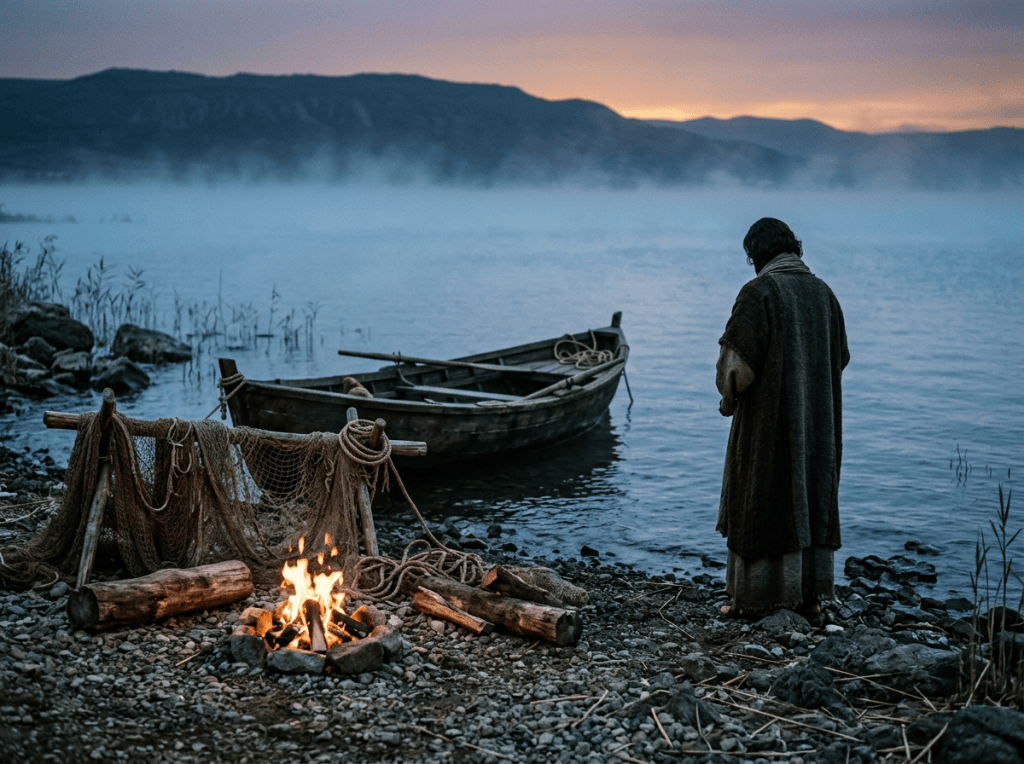
The last time Peter had stood near a charcoal fire, he’d denied knowing Jesus. Now Jesus had prepared breakfast over one. John records both fires.
The first appears in John 18, where Peter stands among the servants and officers warming themselves while Jesus is being questioned. The second appears in John 21, where the risen Christ stands on the shore of the Sea of Tiberias with fish and bread.
Between those two fires lies the crucifixion, the burial, and the resurrection of Jesus Christ. But there’s another story unfolding within those events. It’s the story of a man who’d declared himself willing to follow Jesus into prison and even to his death, only to deny knowing Him when confronted with the possibility of doing exactly that.
Peter had discovered something about himself that he hadn’t wanted to believe. And now the One he’d denied was inviting him to breakfast.
The Story Peter Thought He Was Living
Peter had been remarkably confident about his future. He knew whom he followed. He knew what he believed. And he thought he knew what he was capable of enduring.
When Jesus warned the disciples about what was coming, Peter insisted that he was ready. Even if everyone else fell away, he wouldn’t. Even if following Jesus required his life, he was prepared to give it. We shouldn’t assume that Peter was being deliberately dishonest. There’s no reason to believe he didn’t mean what he said. But sincerity and self-awareness aren’t the same thing.
A person can sincerely believe something about himself and still be terribly mistaken. Peter was making promises about a version of himself that hadn’t yet been tested by the circumstances he was describing.
Jesus knew better. And in Luke 22, Jesus told Peter something extraordinary. He told him that Satan had demanded to sift the disciples like wheat, that He’d prayed for Peter’s faith not to fail, and that when Peter had turned again, he was to strengthen his brothers.
Consider the order of those events. Peter hadn’t denied Jesus yet. He hadn’t heard the rooster crow. He hadn’t gone out and wept bitterly. He was still insisting that he was prepared to remain faithful through whatever came. And Jesus was already giving him instructions for the life that would follow his failure.
Peter was talking about what he would never do. Jesus was talking about what Peter would do afterward.
Peter couldn’t imagine the failure. Jesus could already see beyond it.
That doesn’t mean the failure was necessary. It doesn’t mean Jesus approved of it. And it certainly doesn’t mean Peter was relieved of responsibility for what he would do. It means that Jesus knew the failure was coming, and He hadn’t mistaken it for the end of Peter’s usefulness.
When the Rooster Crowed
There are moments in life when our understanding of ourselves changes abruptly. Peter experienced one of those moments. Three times, he denied knowing Jesus. Then the rooster crowed.
Luke records that Jesus turned and looked at Peter. Peter remembered what Jesus had told him. And he went out and wept bitterly.
We aren’t given a transcript of Peter’s thoughts. But we know what he’d promised. We know what he’d done. And we know that he remembered the warning Jesus had given him.
The man who’d been so confident in his own faithfulness had been confronted with the reality of his failure. Then Jesus was crucified.
Imagine the difference between having failed someone and believing you’ve lost the opportunity to ever speak to that person again.
Peter couldn’t undo what he’d said. He couldn’t return to the courtyard and answer the questions differently. He couldn’t go back to the upper room and make a more accurate assessment of his own courage.
The events had happened. The words had been spoken. The promises had been broken. And nothing Peter could do would make any of those things untrue. But Peter’s inability to change yesterday didn’t mean Christ was incapable of giving him a tomorrow.
Back in the Boat
John 21 begins with Peter and several other disciples near the Sea of Tiberias. Peter announces that he’s going fishing. The others join him. They fish throughout the night and catch nothing. Then a man standing on the shore tells them to cast their net on the other side of the boat. They do. And suddenly, they have more fish than they can easily manage.
John recognizes the man on the shore. It’s the Lord. Peter throws himself into the water.
There’s something wonderfully familiar about this account. Years earlier, Peter had experienced another extraordinary catch of fish. Luke 5 records that Jesus had instructed Peter to let down his nets after an unsuccessful night of fishing.
The result had been overwhelming. Peter had fallen before Jesus and acknowledged his sinfulness. He’d asked Jesus to depart from him. Jesus had responded by telling him not to be afraid and giving him a new purpose.
Now, years later, Peter was once again in a boat. Once again, an unsuccessful night of fishing had ended with an extraordinary catch. Once again, Jesus was there. But this time, Peter wasn’t asking Jesus to depart. He was throwing himself into the water to reach Him.
The first time, Peter recognized his unworthiness and asked Jesus to leave. This time, Peter had considerably more evidence of his unworthiness, and he couldn’t get to Jesus fast enough.
Perhaps Peter had learned something about the character of the One he’d been following. Perhaps he was beginning to understand that his unworthiness wasn’t a reason to run away from Christ. It was a reason to run toward Him.
Feed My Sheep
After breakfast, Jesus asked Peter whether he loved Him. Peter answered. Jesus gave him a responsibility. Then Jesus asked again. Peter answered again. Jesus gave him another responsibility. Then came the third question. Peter was grieved that Jesus had asked him a third time. And once again, Jesus entrusted him with the care of His sheep.
Three denials. Three questions. Three commissions.
The correspondence is difficult to overlook, although John doesn’t explicitly explain the conversation in those terms.
What’s unmistakable is that Jesus wasn’t merely discussing Peter’s past. He was directing Peter’s future.
Jesus didn’t tell Peter that his failure had been insignificant. He didn’t suggest that the events in the courtyard hadn’t mattered. But neither did He make Peter’s failure the permanent definition of the man standing before Him.
He gave Peter something to do. And the responsibility He gave him was remarkable. Care for the people who belong to Me.
The man who’d failed to acknowledge his association with Jesus was being entrusted with the care of others who would follow Jesus. The man whose confidence in his own strength had collapsed was being given a responsibility that would require strength beyond his own. The man who’d once insisted that he was prepared to give his life for Jesus was now being told that his future would indeed involve giving his life. And then Jesus said something Peter had heard before. Follow Me.
Not prove that you’re worthy. Not return to the courtyard and repair what happened. Not spend the rest of your life demonstrating that you aren’t the man who denied Me. Follow Me.
Jesus didn’t give Peter the opportunity to rewrite his past. He gave him the responsibility of living his future.
The Man Who Stood Up
If the Gospel of John were the last account we had of Peter, we would have a beautiful story of restoration. A disciple fails. The risen Christ meets him. Their relationship is restored. The disciple receives a renewed commission. It would be a satisfying conclusion. But Scripture doesn’t stop there.
Acts begins. And Peter stands up.
He stands among the believers as they consider how to replace Judas. He stands before the crowd at Pentecost and publicly proclaims the risen Christ. He stands before the people gathered after the healing of a man who’d been unable to walk from birth. And eventually, he stands before the religious authorities.
The same man who’d denied knowing Jesus when questioned by a servant girl was now openly proclaiming Jesus before people who possessed the authority to imprison him.
That transformation deserves more than a passing glance. Peter hadn’t simply become better at managing his fear. He hadn’t merely developed greater confidence in his ability to handle difficult circumstances.
Acts 4 explicitly tells us that Peter was filled with the Holy Spirit when he addressed the rulers and elders. The difference wasn’t that Peter had finally become everything he’d previously claimed to be through the strength of his own determination. The difference was that the risen Christ had restored him, commissioned him, and empowered him through the Holy Spirit.
Peter was no longer merely making declarations about what he’d do if confronted with danger. He was living the life to which Christ had called him. And the man who’d once failed to acknowledge Jesus was now telling others that salvation could be found in no one else.
The courtyard was part of Peter’s history. It wasn’t the conclusion of his story.
Restoration Isn’t Perfection
It would be convenient to suggest that Peter never struggled again. That would give us a clean narrative. The failure. The restoration. The permanently transformed man who never again struggled with the weaknesses that had previously characterized him. But Scripture refuses to give us that version of Peter.
In Galatians 2, Paul describes confronting Peter because his conduct toward Gentile believers had changed when certain men arrived. Peter had withdrawn from eating with the Gentiles because he feared the circumcision party.
Once again, the opinions of other people had influenced his behavior. Once again, there was a discrepancy between what Peter understood and what Peter was doing. And Paul confronted him. That’s an important part of Peter’s story.
The man who’d preached at Pentecost still needed correction. The man who’d stood before the religious authorities still had areas of weakness. The man Jesus had commissioned to care for His sheep wasn’t beyond the need for accountability.
Restoration hadn’t made Peter incapable of failing. It hadn’t made him immune to fear. It hadn’t made every subsequent decision correct. But neither did those later struggles invalidate everything Christ had done through him.
We need to be careful not to create a definition of transformation that Scripture itself doesn’t support. Growth doesn’t mean that every weakness disappears simultaneously. Maturity doesn’t mean that correction is no longer necessary. Faithfulness doesn’t mean that every decision we make will be faithful.
Peter was a man who needed grace before the courtyard, after the courtyard, at Pentecost, and throughout the remainder of his life. His restoration wasn’t the moment he graduated from needing Christ. It was another demonstration of how desperately he needed Him.
The life that follows restoration isn’t a life beyond the need for grace. It’s a life made possible by grace.
Strengthen Your Brothers
Return for a moment to the words Jesus spoke before Peter’s denial. When you’ve turned again, strengthen your brothers. Those words take on an entirely different significance when we’ve read what happens afterward.
Peter would know what it meant to be confident and wrong. He would know what it meant to discover the limitations of his own strength. He would know what it meant to fail someone he loved. He would know what it meant to receive mercy he couldn’t earn. He would know what it meant to be entrusted with responsibility despite having demonstrated his own inadequacy. And he’d eventually write to believers facing suffering, temptation, uncertainty, and opposition.
In 1 Peter 5, he urges the elders to shepherd the flock of God. He warns believers about the adversary who prowls around like a roaring lion. He encourages them to resist, remaining firm in their faith. And he directs their attention toward the God of all grace, who will restore, confirm, strengthen, and establish them.
Read those words alongside the account of Peter’s life. The man who’d been told that Satan wanted to sift him was now warning others about the adversary. The man who’d been entrusted with the care of Christ’s sheep was now instructing others to shepherd the flock. The man who’d experienced restoration was now directing struggling believers toward the God who restores.
We can’t establish that Peter was consciously thinking about each of those earlier events when he wrote those words. But the correspondence is remarkable.
The responsibility Jesus had given him before his failure was visible in the life he lived afterward. Strengthen your brothers.
Peter had become a man capable of speaking about more than the confidence he once possessed. He could speak about the faithfulness of the Christ who’d sustained him. And perhaps that’s a more valuable testimony.
The Two Men Who Received Tomorrow
In our previous message, we examined Barabbas. A guilty man was released while an innocent man was condemned.
Barabbas received an opportunity he hadn’t earned. And Scripture never tells us what he did with it.
Peter also received an opportunity he hadn’t earned. But Scripture followed him.
It followed him from the courtyard to the shore. From the shore to the upper room. From the upper room to the streets of Jerusalem. From the streets of Jerusalem to the homes of Gentiles. And eventually, we encounter his words encouraging believers he may never have met.
We shouldn’t pretend that Barabbas and Peter received precisely the same thing. Barabbas received release from imprisonment. Peter experienced the restoration and renewed commission of the risen Christ.
Their circumstances were different. But placed beside one another, their stories reveal a distinction worth considering.
One account records the opportunity. The other records a life lived in response to it.
We can’t condemn Barabbas for failing to do something Scripture never tells us he failed to do. Nor can we manufacture a story of transformation on his behalf.
His response remains unknown. But Peter’s response is before us. Not a perfect response. Not an uninterrupted succession of victories. Not a life without further mistakes. A life of service, growth, correction, courage, and continuing dependence upon Christ.
Barabbas leaves us asking what a man might do with an undeserved tomorrow. Peter shows us what an undeserved tomorrow can become.
The Stories We’ve Been Reading
Throughout this series, we’ve examined moments in Scripture that we often treat as conclusions.
- A little girl opened her eyes.
- A giant fell.
- A woman was healed.
- A prayer was answered.
- A man returned home.
- A prophet survived his exhaustion.
- A woman found a place among a new people.
- A man walked away from an encounter with God carrying a blessing and a limp.
- A commander returned to his homeland.
- A man who had been buried sat at a table.
- A paralytic carried his own bed.
- Three men returned to Babylon.
- A family stepped out of an ark.
- A man received his sight.
- A prisoner was released.
- And now a disciple has been restored.
Each of those events is extraordinary. Each deserves our attention. But none of those people existed merely to reach the moment we remember them for.
Jairus’s daughter wasn’t brought back to life merely so that people could celebrate her restoration. Noah wasn’t preserved merely so that he could stand outside the ark. The man born blind wasn’t given sight merely so that he could demonstrate that his eyes worked. And Peter wasn’t restored merely so that he could experience the relief of knowing that Jesus hadn’t abandoned him.
There was life beyond those moments. There were responsibilities. There were relationships. There were opportunities. There were decisions. There were things to build, people to serve, truths to discover, and purposes to pursue.
Some of those lives are followed extensively in Scripture. Others disappear from the biblical narrative almost immediately. But the absence of another recorded chapter doesn’t mean the absence of another day.
Scripture may finish telling us someone’s story long before that person finishes living it.
And perhaps that’s something we need to remember about our own lives.
The Ending You’ve Been Waiting For
What are you waiting for?
Not in the abstract. What’s the event that you’ve allowed to become the dividing line between the life you’re living and the life you intend to live?
Perhaps you’re waiting for a prayer to be answered. Perhaps you’re waiting for a difficult season to pass. Perhaps you’re waiting for a relationship to be restored. Perhaps you’re waiting for an opportunity to arrive. Perhaps you’re waiting for God to provide direction that you haven’t yet received. Perhaps you’re waiting for circumstances to change in ways that would allow you to do something you can’t presently do. Those things matter.
Some of them may require extraordinary intervention. Some may require years of patience. Some may never happen in the way you hope. But consider what you’re expecting to find on the other side.
Are you expecting a conclusion?
Or are you preparing for a life?
Because the thing you’ve spent years praying for may introduce responsibilities you’ve never considered. The opportunity you’ve been waiting for may require abilities you’ve yet to develop. The restoration you’ve longed for may require you to learn how to live differently. The freedom you’ve desired may place decisions before you that you’ve never had the freedom to make. And the answer you’ve been seeking may not resolve every question you have. It may introduce questions you haven’t thought to ask.
We have a tendency to imagine the future as a place where our present struggles have been resolved. But the future isn’t merely the absence of today’s problems. It’s the presence of tomorrow’s possibilities. And while we’re waiting for some things to change, there may already be things Christ has called us to do.
Peter didn’t have to understand every detail of his future before he could begin following Jesus. Neither do we.
What If This Isn’t the End?
Perhaps you’re standing somewhere considerably different. Perhaps you aren’t waiting for something wonderful to happen. Perhaps something has happened that has convinced you the most meaningful part of your life is already behind you.
You’ve failed. You’ve lost something. You’ve made decisions that can’t be reversed. You’ve discovered that you aren’t the person you once believed yourself to be. And you’ve begun to interpret everything that follows through the assumption that the story has already reached its conclusion.
Peter’s story challenges that assumption. Not because every loss will be reversed. Not because every opportunity will return. Not because every consequence will disappear.
Peter couldn’t undo his denial. He couldn’t make the courtyard cease to be part of his history. But the Christ who knew about the courtyard before Peter ever entered it was the same Christ who met him on the shore.
Jesus hadn’t discovered Peter’s weakness that night. He’d known about it when He called him. He’d known about it when He prayed for him. He’d known about it when He gave him instructions for what would follow. And He knew about it when He entrusted Peter with the care of His sheep.
Your failures don’t provide God with information He previously lacked. Your limitations don’t surprise Him. Your inability to see a future beyond your present circumstances doesn’t establish that no such future exists.
That isn’t a promise that every ambition will be fulfilled or that every former responsibility will be returned to you. But it’s a reason to stop treating your own assessment of your usefulness as though it possesses the authority of God.
Peter had demonstrated that he wasn’t the man he thought he was. Christ was still capable of making him into the man He’d called him to become.
Follow Me
There’s one final exchange in John 21 that deserves our attention. After Jesus told Peter something about the manner in which his life would eventually end, Peter turned and saw the disciple whom Jesus loved.
He asked Jesus what would happen to that man. Jesus redirected Peter’s attention.
The future of the other disciple wasn’t Peter’s responsibility. Peter had received his own instruction. Follow Me. That was enough.
Peter didn’t need to know how John’s story would unfold. He didn’t need to compare the length of their lives. He didn’t need to establish that their responsibilities were equal or that their circumstances would be fair. He needed to follow Jesus. And that instruction reaches beyond every story we’ve examined throughout this series.
Whether you’ve received what you prayed for or you’re still waiting. Whether you’ve experienced restoration or you’re learning to live with what can’t be restored. Whether you’ve been given something extraordinary or you’re trying to recognize the significance of something ordinary. Whether you’re standing at the beginning of a new opportunity or facing the consequences of an old mistake. The instruction remains. Follow Me.
Not because following Christ guarantees that every chapter will unfold according to our expectations. Not because it guarantees that every story will have the ending we desire. But because our relationship with Christ isn’t confined to the particular events around which we’ve organized our lives.
He isn’t merely the God of the miracle. He isn’t merely the God of the deliverance. He isn’t merely the God of the answered prayer. He isn’t merely the God of the restoration. He’s the God of the life that follows. And He remains God even when the miracle we’re waiting for hasn’t happened.
After the Story Ends
Peter stood beside a charcoal fire and denied knowing Jesus. Later, he stood beside another charcoal fire and received a renewed commission from the One he’d denied.
If his story had ended at the first fire, we would remember a man whose confidence had collapsed when it mattered most. If his story had ended at the second, we would remember a man who had received extraordinary mercy. But there was a life beyond both fires.
There were people who would hear the Gospel because Peter spoke. There were believers who would receive encouragement because Peter wrote. There were responsibilities he would carry, mistakes he would make, corrections he would receive, and opportunities through which Christ would continue working.
The man standing on the shore couldn’t have known every detail of what lay ahead. He didn’t need to.
Jesus hadn’t asked him to write the rest of his story before agreeing to live it. He’d asked Peter to follow Him. And perhaps that’s where we should leave this series.
Not with the assumption that every story ends beautifully. Not with the promise that every struggle will eventually make sense. Not with the expectation that every question will receive an answer. But with the recognition that the moments we’ve designated as endings don’t necessarily possess the finality we’ve assigned to them.
The miracle may be over. The celebration may have ended. The opportunity may have arrived. The failure may be behind you. The circumstances may never be what they once were. But if there’s another day before you, there’s another day in which you can follow Christ.
Another day in which you can love. Another day in which you can serve. Another day in which you can learn. Another day in which you can become more faithful with what you’ve been given. Another day in which the grace of God can be visible in the life you live.
Peter didn’t spend the rest of his life standing beside either of those fires. He had somewhere else to be. He had sheep to feed. He had brothers to strengthen. He had a Savior to follow. And so do we.
Don’t spend the rest of your life standing at the place where you thought your story ended.
Christ isn’t asking you to go back and write a better yesterday. He’s calling you to follow Him today. The story you’ve been telling may have reached its conclusion. But the Author hasn’t put down His pen.




Leave a Reply