(Part 13 of 16)
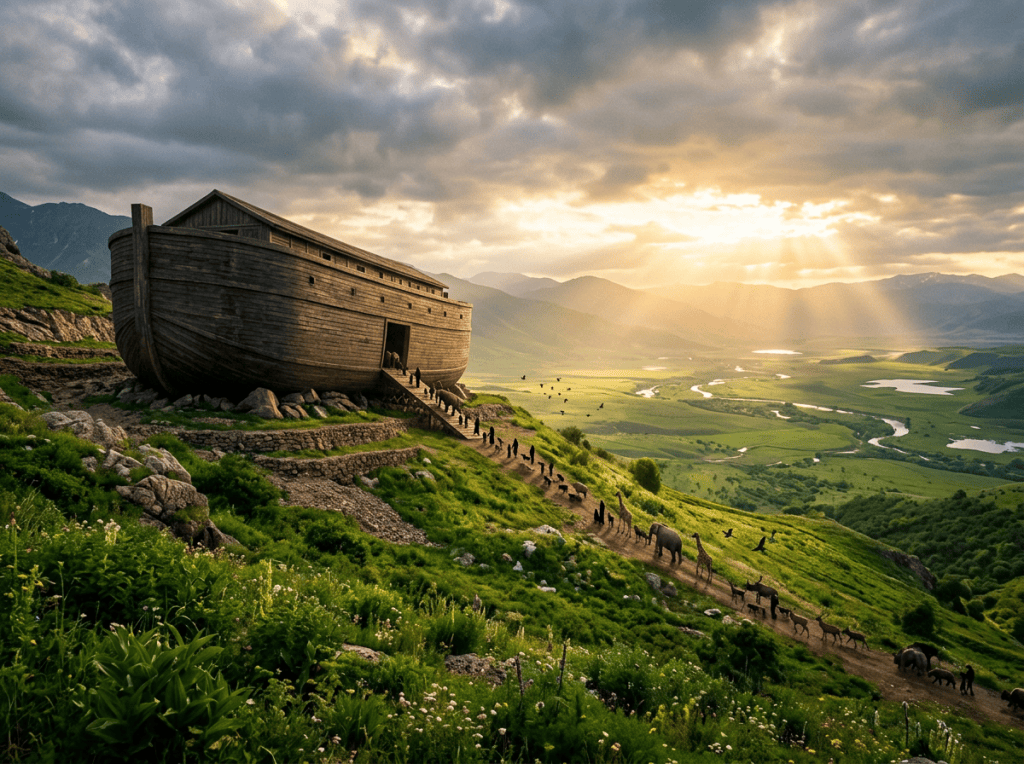
Genesis 8:15–19 (15)Then God said to Noah, (16)“Go out from the ark, you and your wife, and your sons and your sons’ wives with you. (17)Bring out with you every living thing that is with you of all flesh—birds and animals and every creeping thing that creeps on the earth—that they may swarm on the earth, and be fruitful and multiply on the earth.” (18)So Noah went out, and his sons and his wife and his sons’ wives with him. (19)Every beast, every creeping thing, and every bird, everything that moves on the earth, went out by families from the ark.(ESV)
For more than a year, the most important structure in Noah’s world was the ark. Then came the day when he was supposed to leave it.
Consider the significance of that instruction. Noah had spent years preparing for something that had never happened before. He’d built an enormous vessel according to God’s instructions. He’d gathered provisions, brought his family aboard, and received the animals God had directed him to preserve.
The ark had served its purpose. The waters had receded. The ground was dry. And God told Noah to come out.
The structure that had preserved his life was no longer the structure around which his life was supposed to revolve. Noah had been faithful in building the ark. Now he needed to be faithful in leaving it.
The Difference Between Surviving and Building
The ark was designed to preserve life. It wasn’t designed to accommodate the future of humanity. It could carry animals through the flood, but it couldn’t provide the land they would need to inhabit. It could protect Noah’s family, but it couldn’t become the world in which their descendants were meant to live.
It was an extraordinary solution to an extraordinary problem. But the problem was over. And the solution had fulfilled its purpose.
That’s a distinction we sometimes struggle to recognize in our own lives. We develop strategies to survive difficult circumstances. We establish routines. We build structures. We create systems that help us manage uncertainty, protect what matters, and endure conditions we can’t immediately change. And sometimes those systems work remarkably well. But what happens when the circumstances change?
The things that helped us survive one season may not be sufficient to build the next. A business operating under emergency conditions can’t necessarily grow using the same practices that kept it afloat. A family navigating a prolonged crisis may need to establish entirely different routines when stability returns. A church that has spent years protecting itself from internal problems may eventually need to rediscover how to serve the community beyond its walls. The structures that preserve something aren’t always the structures that allow it to flourish.
A good solution can outlive the problem it was designed to solve.
That doesn’t make it a bad solution. It means its purpose has been fulfilled.
The First Thing Noah Built
There’s something remarkable about what Noah did after leaving the ark. He built an altar.
Before Scripture records Noah planting a vineyard, before it describes the development of his family, and before it tells us about the generations that would follow, it tells us that Noah worshiped.
The first structure Scripture records him building after the flood wasn’t a house. It wasn’t a barn. It wasn’t another vessel. It was an altar to the Lord.
We shouldn’t assume that Noah had no other immediate responsibilities or that worship eliminated the practical necessities of establishing life outside the ark. But the placement of this event in the account matters.
Noah had entered a world dramatically different from the one he’d known. And the first thing the biblical narrative emphasizes is his relationship with the God who’d preserved him.
The circumstances had changed. The foundation hadn’t. That’s worth remembering when we find ourselves starting over.
We may need new plans. We may need new methods. We may need to develop skills we never expected to need. We may need to reconsider assumptions that once seemed perfectly reasonable. But not everything needs to be reinvented.
There are things that should remain constant even when everything around them changes. Noah didn’t need a new God for a new world.
Starting over doesn’t mean starting without a foundation.
An Old Command in a New World
Genesis 9 opens with something familiar. God blesses Noah and his sons and tells them to be fruitful, multiply, and fill the earth.
We’ve heard that instruction before. It echoes the command given to humanity in Genesis 1.
The flood had changed the world, but God’s purpose for humanity hadn’t been abandoned. Noah and his family weren’t simply supposed to exist. They were supposed to participate in the continuation of human life. Their responsibilities extended beyond the preservation of what had survived. There was a future to cultivate. And that future would require something different from what the previous season had required.
Before the flood, faithfulness had involved building the ark. During the flood, it had involved remaining within it. After the flood, it involved leaving it and participating in the work of filling the earth.
The instructions changed because the circumstances changed. The God giving those instructions remained the same.
There’s something important here. Consistency in our relationship with God doesn’t necessarily mean consistency in every activity we undertake.
Sometimes we become so attached to a particular expression of obedience that we forget the purpose it was intended to serve. We confuse the assignment with the mission. We confuse the method with the principle. We confuse the structure with the thing it was built to protect.
Noah’s faithfulness wasn’t demonstrated by continuing to build arks for the rest of his life. It was demonstrated by responding to what God had instructed him to do.
Faithfulness to God doesn’t require permanent attachment to every assignment He’s given us.
The Promise That Made Building Possible
After Noah offered his sacrifice, God declared that the regular rhythms of the earth would continue. Seedtime and harvest. Cold and heat. Summer and winter. Day and night.
Then God established His covenant with Noah, his descendants, and every living creature that had come out of the ark. The rainbow would serve as the sign of that covenant. God promised that never again would a flood destroy all flesh.
Consider what that promise meant for the future. Noah could plant without being told to prepare for another worldwide flood. His descendants could establish communities. Generations could develop lives beyond the emergency that had defined Noah’s previous season.
The covenant wasn’t a promise that no individual would ever experience another disaster. It wasn’t a guarantee that every harvest would succeed or every generation would live without hardship. But it established something essential.
The flood wasn’t going to become the recurring condition under which humanity was expected to live. There was a future beyond it. And humanity could participate in that future.
There’s a difference between preparing for uncertainty and allowing the last crisis to dictate every decision about tomorrow.
Wisdom remembers what happened. Fear can become so consumed with preventing its recurrence that it leaves little room for anything else.
Noah’s future wasn’t supposed to consist entirely of preparing for another flood. There was land to cultivate. There were generations to raise. There was life to build.
The Imperfect Beginning
It would be convenient if Noah’s story ended with the covenant and the rainbow. That would give us a beautiful picture of a faithful man entering a renewed world under the promise of God. But Genesis continues.
Noah plants a vineyard. He drinks its wine and becomes drunk. An incident within his family follows, exposing conflict and dishonor.
It’s an uncomfortable conclusion to the story of the man Scripture had described as righteous and blameless in his generation. But perhaps that discomfort is important.
The flood had removed the violent civilization described in Genesis 6. It hadn’t removed the sinful inclination of the human heart. In fact, God had acknowledged that inclination in Genesis 8:21 before establishing His covenant.
The new world wasn’t a perfect world. And Noah wasn’t a perfect man. The future would still contain mistakes, conflict, and consequences. That doesn’t invalidate Noah’s earlier faithfulness. It doesn’t mean the ark was built in vain. It doesn’t make God’s covenant meaningless. It means that starting over isn’t the same thing as achieving perfection.
A new beginning gives us an opportunity to build differently. It doesn’t guarantee that we will.
We still have decisions to make. We still have responsibilities to carry. We still need wisdom, correction, and grace. And we shouldn’t mistake the opportunity to begin again for proof that we’ve already become everything we need to be.
Starting Over
Noah built an ark. Then he built an altar. Then he planted a vineyard.
Three very different things. Each belonged to a different part of his story.
The ark preserved life. The altar expressed worship. The vineyard represented cultivation.
Noah couldn’t have spent his entire life building the first and expected to accomplish the work represented by the others. There came a time when the work of preservation had to give way to the work of cultivation. Perhaps that’s a transition some of us need to recognize.
We’ve become remarkably good at keeping things from falling apart. We’ve learned how to manage emergencies, protect what remains, and make difficult circumstances bearable. Those abilities have value. But keeping something alive and helping it grow aren’t always the same task.
A marriage needs more than the absence of conflict. A church needs more than protection from false teaching. A business needs more than the ability to pay its bills. A life needs more than the successful avoidance of another crisis.
Preservation matters. But preservation isn’t the entirety of our purpose. At some point, we need to ask what we’re preserving these things for.
What are we hoping to cultivate?
What are we preparing to build?
What are we doing with the future that’s been placed before us?
Noah’s greatest construction project had fulfilled its purpose. The world didn’t need him to build another ark. It needed him to step onto the ground and begin again.
Don’t become so committed to preserving what survived yesterday that you never cultivate what could grow tomorrow.
The ark had done its work. There was an earth to fill.




Leave a Reply