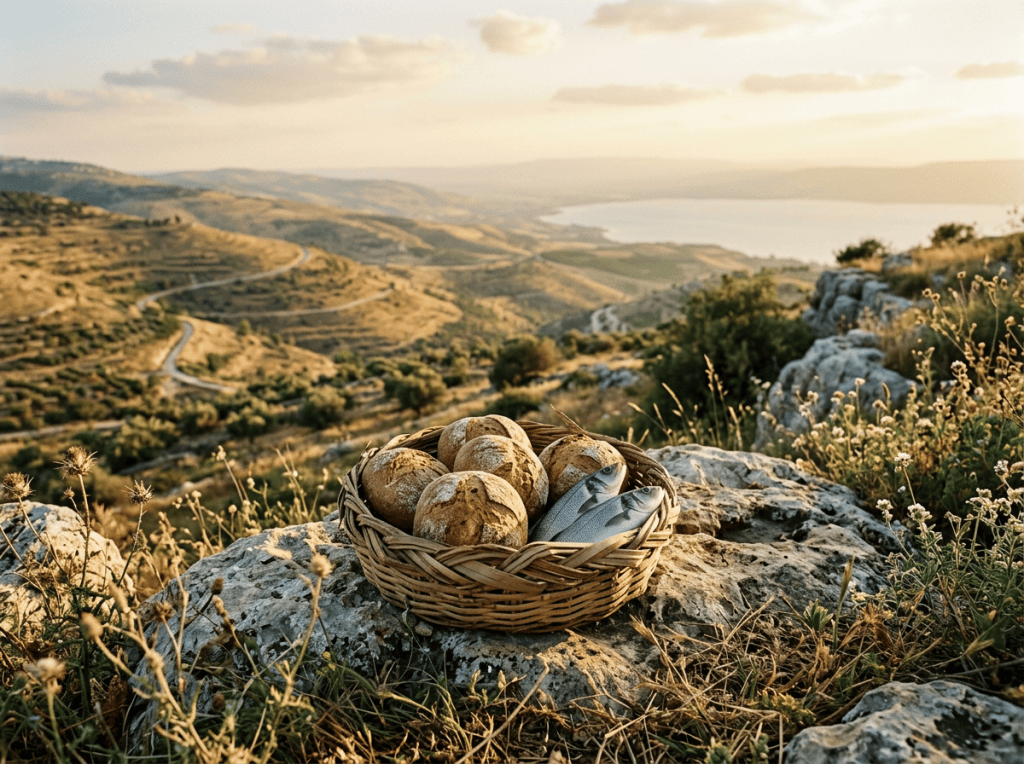
John 6:5–13 (5)Lifting up his eyes, then, and seeing that a large crowd was coming toward him, Jesus said to Philip, “Where are we to buy bread, so that these people may eat?” (6)He said this to test him, for he himself knew what he would do. (7)Philip answered him, “Two hundred denarii worth of bread would not be enough for each of them to get a little.” (8)One of his disciples, Andrew, Simon Peter’s brother, said to him, (9)“There is a boy here who has five barley loaves and two fish, but what are they for so many?” (10)Jesus said, “Have the people sit down.” Now there was much grass in the place. So the men sat down, about five thousand in number. (11)Jesus then took the loaves, and when he had given thanks, he distributed them to those who were seated. So also the fish, as much as they wanted. (12)And when they had eaten their fill, he told his disciples, “Gather up the leftover fragments, that nothing may be lost.”(ESV)
There’s a difference between having enough and having more than enough. It’s a distinction we understand quite well when we’re the ones responsible for providing. We calculate what’s needed, consider the resources available to us, and determine whether those resources will be sufficient. If they aren’t, we look for alternatives. If they are, we try to ensure that nothing is unnecessarily consumed.
We operate within limitations. God doesn’t.
Yet when we read about the feeding of the five thousand, we often focus so heavily on the extraordinary nature of the miracle that we overlook some of the decisions Jesus made throughout the event. We marvel that five loaves and two fish could feed thousands of people. We celebrate the power of God to accomplish what human hands couldn’t. But Jesus didn’t simply feed five thousand people. He fed them until they were satisfied. He gave them as much as they wanted. And when everyone had finished eating, there was more.
That abundance deserves our attention.
A Question He Already Knew the Answer To
All four Gospels record the feeding of the five thousand. Each provides details that help us understand the event more fully, but John gives us a particularly interesting glimpse into the conversation that preceded it.
Seeing the large crowd approaching, Jesus asked Philip where they could purchase enough bread to feed the people. It was a reasonable question. It was also a question Jesus didn’t need Philip to answer. John tells us that Jesus asked this to test Philip because He already knew what He would do.
John 6:5–7 (5)Lifting up his eyes, then, and seeing that a large crowd was coming toward him, Jesus said to Philip, “Where are we to buy bread, so that these people may eat?” (6)He said this to test him, for he himself knew what he would do. (7)Philip answered him, “Two hundred denarii worth of bread would not be enough for each of them to get a little.”(ESV)
Consider that for a moment. Jesus wasn’t looking for a solution. He wasn’t concerned that the crowd might be too large or that the available resources might be insufficient. He already knew what He would do.
Philip, however, approached the question as most of us would. He considered the size of the crowd, calculated the cost, and concluded that two hundred denarii wouldn’t purchase enough bread for everyone to receive even a little.
Philip wasn’t necessarily wrong. His assessment of the resources required to feed such a large gathering was perfectly reasonable within the limitations of ordinary human provision. But Jesus wasn’t operating within those limitations.
Philip was trying to determine what could be accomplished with the resources available to them. Jesus was preparing to demonstrate what could be accomplished with the resources available to Him.
Those are two very different calculations.
Go and See
The other Gospel accounts provide additional details. The disciples recognized that the people needed food. The day was growing late, and they suggested that Jesus dismiss the crowd so the people could find something to eat. Jesus responded by telling the disciples to feed them.
Mark 6:35–38 (35)And when it grew late, his disciples came to him and said, “This is a desolate place, and the hour is now late. (36)Send them away to go into the surrounding countryside and villages and buy themselves something to eat.” (37)But he answered them, “You give them something to eat.” And they said to him, “Shall we go and buy two hundred denarii worth of bread and give it to them to eat?” (38)And he said to them, “How many loaves do you have? Go and see.” And when they had found out, they said, “Five, and two fish.”(ESV)
It’s interesting that Jesus didn’t immediately reveal how He intended to provide the food. Instead, He instructed the disciples to investigate what was available. How many loaves did they have? Go and see.
John identifies Andrew as the disciple who reported that a boy had five barley loaves and two fish. Andrew, like Philip, recognized the inadequacy of the available resources.
What were these among so many? Neither disciple had discovered anything Jesus didn’t already know. Yet Jesus involved them in the process.
He allowed them to examine the need, consider the cost, investigate the available resources, and recognize the enormous difference between what they had and what was required.
They were confronted with their own limitations before witnessing the absence of His. There’s an important lesson here.
Faith doesn’t require us to pretend that our resources are sufficient when they aren’t. Philip’s calculation didn’t become inaccurate simply because Jesus could perform a miracle. Five loaves and two fish weren’t naturally sufficient to feed thousands of people.
The limitations were real. They just weren’t God’s limitations.
Sometimes we’re so concerned with demonstrating faith that we refuse to acknowledge the magnitude of the problem before us. We act as though admitting that something is beyond our ability is somehow a failure to trust God. But recognizing our limitations isn’t the same as placing those limitations upon Him. The disciples needed to understand what they couldn’t accomplish before they could fully appreciate what Jesus was about to accomplish.
As Much as They Wanted
Jesus instructed the disciples to organize the crowd.
Mark tells us that the people sat upon the green grass in groups of hundreds and fifties. Luke specifically records Jesus instructing the disciples to have them sit in groups of about fifty.
Jesus took the food, gave thanks, and distributed it. And everyone ate.
Matthew, Mark, and Luke tell us that everyone was satisfied. John adds a detail that deserves more attention. They received as much as they wanted.
Jesus didn’t ration the food. He didn’t calculate the minimum amount each person needed to sustain them until they could reach a nearby village. He didn’t instruct the disciples to distribute carefully so that those at the end of the crowd wouldn’t go without.
Philip had been concerned that they couldn’t afford to give everyone even a little. Jesus gave everyone as much as they wanted. And when everyone had eaten their fill, twelve baskets of fragments remained.
Matthew tells us that the five thousand men didn’t include the women and children who were also present. The actual number of people fed was greater than the number by which we remember the miracle. Yet no one is recorded as having gone hungry.
There was enough for every person. There was more than enough for every person. And that raises an interesting question. Why was there more?
Jesus already knew what He’d do. He knew the size of the crowd. The God who knows the number of hairs upon our heads certainly wasn’t incapable of knowing how much food the people would consume.
The abundance wasn’t the result of a miscalculation. Jesus could have provided precisely enough. Instead, when the need had been satisfied, there was still an abundance remaining.
A Pattern Established Long Before
The feeding of the five thousand wasn’t the first time God had provided food in this manner. In 2 Kings 4, a man brought Elisha twenty barley loaves and fresh grain. Elisha instructed his servant to give the food to the people so they could eat. The servant questioned how such a small amount could feed one hundred men. The similarities are remarkable. Barley loaves. An instruction to feed the people. A servant who recognized the inadequacy of the available resources. And a provision that exceeded what the people consumed.
2 Kings 4:42–44 (42)A man came from Baal-shalishah, bringing the man of God bread of the firstfruits, twenty loaves of barley and fresh ears of grain in his sack. And Elisha said, “Give to the men, that they may eat.” (43)But his servant said, “How can I set this before a hundred men?” So he repeated, “Give them to the men, that they may eat, for thus says the Lord, ‘They shall eat and have some left.’” (44)So he set it before them. And they ate and had some left, according to the word of the Lord.(ESV)
God had specifically declared that the people would eat and have some left. The leftovers weren’t an unexpected consequence of His provision. They were part of what He’d promised.
Centuries later, Jesus would feed thousands with even fewer loaves. And then He would do it again.
Matthew 15 and Mark 8 record the feeding of the four thousand. This time, seven loaves and a few small fish were available. Once again, the disciples questioned how so many people could be fed. Once again, everyone ate and was satisfied. And once again, baskets of food remained. Seven baskets this time.
Three accounts of extraordinary provision, separated by centuries in the case of Elisha, yet demonstrating the same remarkable pattern. God provided. The people ate. An abundance remained. But the existence of that abundance wasn’t merely something for the people to enjoy. It was also something the servants were supposed to understand.
Do You Not Yet Understand?
After the feeding of the four thousand, the disciples found themselves in a boat with Jesus. They’d forgotten to bring bread and had only one loaf with them. Jesus warned them about the leaven of the Pharisees and Herod, but the disciples misunderstood His words and began discussing their lack of bread. Jesus responded by reminding them of the two miracles they had witnessed.
Mark 8:14–21 (14)Now they had forgotten to bring bread, and they had only one loaf with them in the boat. (15)And he cautioned them, saying, “Watch out; beware of the leaven of the Pharisees and the leaven of Herod.” (16)And they began discussing with one another the fact that they had no bread. (17)And Jesus, aware of this, said to them, “Why are you discussing the fact that you have no bread? Do you not yet perceive or understand? Are your hearts hardened? (18)Having eyes do you not see, and having ears do you not hear? And do you not remember? (19)When I broke the five loaves for the five thousand, how many baskets full of broken pieces did you take up?” They said to him, “Twelve.” (20)“And the seven for the four thousand, how many baskets full of broken pieces did you take up?” And they said to him, “Seven.” (21)And he said to them, “Do you not yet understand?”(ESV)
Notice what Jesus asked them to remember. He didn’t ask them how many people had been fed. He didn’t ask them how much money Philip had calculated would be necessary. He didn’t ask them how many loaves they had started with and then leave the conversation there.
He specifically asked them how many baskets of broken pieces they’d gathered. Twelve. Seven.
The disciples remembered the numbers. But Jesus still asked whether they understood.
They’d personally participated in the distribution of the food. They’d witnessed thousands of people eating until they were satisfied. They’d gathered the fragments with their own hands. Yet here they were, concerned about having only one loaf of bread while sitting in a boat with the One who had fed thousands with five.
The problem wasn’t that they’d forgotten what happened. They remembered it quite well. The problem was that their understanding of what had happened hadn’t sufficiently changed how they approached the circumstances before them. They remembered the miracle without fully understanding its implications.
How often do we do the same?
We remember the times God has provided. We remember the prayers that were answered, the circumstances that changed, and the needs that were met. Yet when we encounter another difficulty, we return to the same calculations we made before.
We count the loaves. We consider the cost. We examine our resources. And sometimes we forget to consider who’s in the boat with us.
That doesn’t mean we should expect God to resolve every difficulty through another extraordinary miracle. It means that what we’ve learned about His character should inform how we face the next difficulty, even when we don’t know how He intends to address it.
When Enough Is Enough
There’s a danger in examining these miracles without considering another extraordinary act of divine provision. When the Israelites were in the wilderness, God provided manna for them to eat. They were instructed to gather according to what each person needed.
Some gathered more. Some gathered less. Yet when they measured what had been gathered, those who had gathered much had nothing left over, and those who had gathered little had no lack.
Exodus 16:16–18 (16)This is what the Lord has commanded: ‘Gather of it, each one of you, as much as he can eat. You shall each take an omer, according to the number of the persons that each of you has in his tent.’” (17)And the people of Israel did so. They gathered, some more, some less. (18)But when they measured it with an omer, whoever gathered much had nothing left over, and whoever gathered little had no lack. Each of them gathered as much as he could eat.(ESV)
Here we find a different expression of the same God’s provision. The people received enough. Not twelve baskets beyond what they could consume. Not seven baskets beyond what they needed. Enough. And under ordinary circumstances, they were instructed not to retain the manna until the following morning.
Those who attempted to preserve it discovered that it spoiled. God could’ve provided a year’s worth of food in a single morning. He could’ve given every household enough to ensure that they would never need to gather manna again.
Instead, He provided daily. There were exceptions, of course. The people were instructed to gather twice as much before the Sabbath, and a portion of manna was preserved as a testimony for future generations. But the ordinary pattern was one of daily sufficiency.
The Israelites were being taught to depend upon the God who provided rather than the quantity of provision they possessed. This is an important distinction.
If we examine only the feeding miracles, we might conclude that God’s provision should always exceed our immediate needs. If we examine only the manna, we might conclude that God intends to provide nothing beyond what’s necessary. Neither conclusion accounts for the fullness of what Scripture reveals.
Sometimes God provides enough for today. Sometimes He provides an abundance. Sometimes He provides in ways that require us to gather again tomorrow. The consistency isn’t found in the quantity of the provision. It’s found in the character of the Provider.
We shouldn’t interpret abundance as proof of greater faithfulness, nor should we interpret the absence of abundance as proof that God has withheld His favor.
The Israelites who gathered their daily manna weren’t receiving an inferior expression of God’s power. The thousands who ate their fill weren’t being given a promise that they would never experience hunger again. In both circumstances, God demonstrated His ability to provide. And in both circumstances, the people were being taught something that extended beyond the food itself.
When the Provision Becomes the Purpose
John records another detail that the other Gospel writers don’t include in their accounts of the feeding of the five thousand. After witnessing the miracle, the people recognized Jesus as the Prophet who was to come into the world. They then intended to take Him by force and make Him their king. Jesus withdrew.
John 6:14–15 (14)When the people saw the sign that he had done, they said, “This is indeed the Prophet who is to come into the world!” (15)Perceiving then that they were about to come and take him by force to make him king, Jesus withdrew again to the mountain by himself.(ESV)
Consider what had just happened. Jesus had demonstrated His power to provide for thousands of people without the resources ordinarily required to do so. The people recognized that power. They wanted Him to become their king. But Jesus refused to allow their response to the miracle to redefine His mission. The following day, when the people found Him again, Jesus confronted the reason they were seeking Him.
John 6:26–27 (26)Jesus answered them, “Truly, truly, I say to you, you are seeking me, not because you saw signs, but because you ate your fill of the loaves. (27)Do not work for the food that perishes, but for the food that endures to eternal life, which the Son of Man will give to you. For on him God the Father has set his seal.”(ESV)
They’d eaten their fill. They wanted the provision. But they hadn’t understood what the provision was supposed to reveal.
There’s a danger in becoming so captivated by what God can give us that we lose sight of who He is. We can become more interested in the blessing than the One who blesses. We can begin measuring God’s goodness by the abundance of what we receive rather than recognizing His goodness as an established part of His character. And when the abundance isn’t there, we can begin questioning the very character of God.
The people who wanted to make Jesus king had witnessed an extraordinary miracle. But they wanted a king who would continue providing the things they desired.
Jesus had come to give them something infinitely greater. Later in the same chapter, He would identify Himself as the bread of life.
The food they’d received would sustain them for a time. What Jesus had come to offer would endure into eternity.
The miracle was never intended to establish an expectation of limitless earthly provision. It was a sign pointing toward the One who had provided it.
More Than We Could Provide
Philip looked at the crowd and saw an expense they couldn’t afford. Andrew looked at the loaves and fish and saw resources that couldn’t possibly meet the need.
The disciples looked at the people and saw a problem that could be resolved by sending them away. Jesus looked at the same crowd and knew what He would do.
He didn’t need Philip to discover a way to purchase the bread. He didn’t need Andrew to find enough food. He didn’t need the disciples to accomplish the impossible. Yet He involved them in the work.
They investigated. They organized. They distributed. And they witnessed thousands of people receiving more than the disciples could’ve provided through their own efforts.
We aren’t promised that every difficulty we encounter will end with twelve baskets of abundance. We aren’t promised that every need will be met in the manner we expect or at the moment we desire. But neither should we allow the limitations of our resources to define our understanding of God’s capabilities.
The God who provided manna in the wilderness is the same God who multiplied the barley loaves. The God who provided precisely enough is the same God who provided more than enough.
His power wasn’t diminished when the Israelites had nothing left over. His power wasn’t increased when the disciples gathered twelve baskets. He was sufficient in both circumstances.
Perhaps that’s what the disciples had yet to understand when they found themselves in the boat with only one loaf. Their confidence was never supposed to rest in the number of loaves they possessed. It was supposed to rest in the One who was with them.
After Everyone Had Eaten
Most of the attention given to the feeding of the five thousand is directed toward the provision itself. And understandably so.
Five loaves. Two fish. Thousands of people. Everyone satisfied. It’s an extraordinary demonstration of the power of God. But the story doesn’t end when the people have eaten.
The crowd had received what it needed. The disciples had witnessed what they couldn’t accomplish themselves. The immediate purpose of the miracle had been fulfilled.
Yet Jesus still had something for His disciples to do. There was an abundance scattered among the people. Fragments of bread that remained after everyone had eaten their fill.
The One who could create more bread whenever He desired didn’t simply dismiss what remained. He gave His disciples an instruction. An instruction that John alone records, accompanied by a reason that deserves far more attention than we ordinarily give it.
Jesus had provided more than enough. Now He wanted the disciples to gather what remained. Not because His ability to provide had been exhausted. Not because the crowd was still hungry. Not because the miracle had somehow failed to accomplish its purpose. But because He didn’t want anything to be lost.
The miracle revealed the power of the One who provided. The instruction that followed would reveal something more about His character. Tomorrow, we’ll examine what Jesus wanted preserved, why the gathering mattered, and what the remaining fragments might teach us about the God who provided them.




Leave a Reply