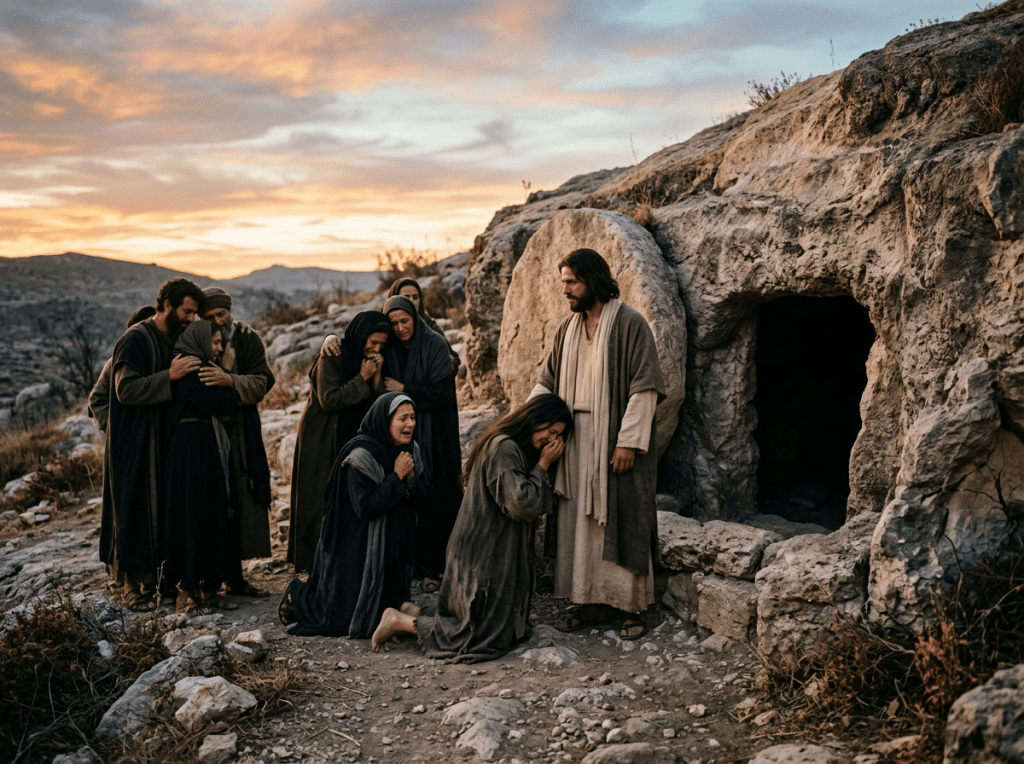
John 11:35 Jesus wept.(ESV)
There are passages of Scripture that I can read quickly. There are stories I know so well that my eyes can move through them almost automatically. I know what comes next. I know how the story ends.
Then I reach these two words.
Jesus wept.
And I stop.
I don’t consciously decide to stop. The pause simply happens. It feels almost demanded by the words themselves, as though this tiny moment in history deserves a moment of silence every time it’s remembered.
There’s something enormous inside that pause. There’s respect, dignity, grief, and love.
And, somehow, there’s also hope.
Jesus knew Lazarus was going to live again. He’d already told Martha, “I am the resurrection and the life” (John 11:25)(ESV). He knew what was behind the stone. He knew what He was about to do. He knew that within moments He would stand before that tomb and call Lazarus by name.
So why cry?
That question makes the pause even larger.
Jesus wasn’t weeping because He’d lost hope. He was weeping while possessing perfect hope. That matters.
We often treat grief and hope as though they oppose one another. We think faith should somehow insulate us from sorrow. If we really trust God, perhaps we shouldn’t hurt so deeply. If we know resurrection is coming, perhaps the grave shouldn’t bother us.
But Jesus stood in front of a grave knowing resurrection was only moments away. And He wept.
Love is the only explanation that makes sense to me.
Certainly He loved Lazarus. The people standing nearby recognized that immediately: “See how he loved him!” (John 11:36)(ESV).
But His love was larger than Lazarus.
He saw Mary crying. He saw the people who came with her crying. He knew Martha’s grief. He knew what Lazarus’s death had done to the people who loved him.
Jesus knew things about their situation that we don’t know. Scripture never tells us everything about that family. We don’t know every practical consequence Lazarus’s death might have brought. We should be careful not to build doctrine from what Scripture doesn’t tell us.
But Jesus knew.
He knew every fear that Mary and Martha carried.
Every unanswered question.
Every empty place at the table.
Every uncertainty about tomorrow.
Every conversation Lazarus would never have if he remained in that tomb.
And Jesus cared.
Then there’s something even larger.
The One standing before that grave wasn’t merely another mourner.
John began his Gospel by telling us who Jesus is:
John 1:1–3 (1)In the beginning was the Word, and the Word was with God, and the Word was God. (2)He was in the beginning with God. (3)All things were made through him, and without him was not any thing made that was made.(ESV)
The One through whom creation came into existence was standing in front of death.
Think about that.
The Creator of life looked at a tomb. The One who spoke creation into existence looked upon what sin and death had done to His creation.
And He wept.
Perhaps that’s part of what I see every time those two words force me to stop.
For just a moment, the entire story seems visible.
Behind Jesus is creation.
“In the beginning…”
Life.
Fellowship.
Creation declared good.
Then sin.
Separation.
Death.
Graves.
Widows.
Orphans.
Mothers burying children.
Children burying parents.
Friends standing helplessly beside tombs.
Thousands of years of human grief seem somehow gathered around that little cave in Bethany.
And standing before it is Jesus.
Jesus wept.
But the pause isn’t hopeless.
That may be the most important thing about it.
Because Jesus doesn’t remain standing there crying. The tears are real, but they aren’t the end of the story.
He walks toward the tomb. “Take away the stone.” Then: “Lazarus, come out.”
The dead man walks.
That’s why the pause is pregnant with hope.
Jesus’ tears tell us that God isn’t indifferent to suffering.
What happens next tells us that suffering doesn’t get the final word.
Jesus doesn’t dismiss grief simply because He knows resurrection is coming. He enters the grief first.
He stands with the grieving. He sheds tears. Then He confronts death.
And the story becomes even larger when we realize where Jesus is headed next.
Lazarus walks out of his tomb. Jesus begins moving toward His own.
The raising of Lazarus becomes part of the chain of events leading toward the decision to kill Jesus. The One who called Lazarus out of death would soon allow Himself to be placed inside another tomb.
Then another stone would be moved. Another grave would become empty.
But this time nobody would have to call the dead man out.
Death itself would have lost its claim.
Paul would later write:
1 Corinthians 15:26 The last enemy to be destroyed is death.(ESV)
And at the far end of Scripture we eventually arrive at another passage about tears:
Revelation 21:4 He will wipe away every tear from their eyes, and death shall be no more, neither shall there be mourning, nor crying, nor pain anymore, for the former things have passed away.”(ESV)
God will wipe away every tear.
That verse looks different to me when I remember John 11:35.
The God who promises to wipe away our tears is the God who entered creation and shed tears of His own.
He knows grief. Not theoretically. Not academically. Not from a safe distance.
Jesus stood beside a tomb.
Jesus wept.
Maybe that’s why I can’t read those words without stopping. Maybe I shouldn’t be able to.
There are times when familiarity with Scripture can become dangerous. We can know the stories so well that we stop seeing them. Our eyes keep moving even when our hearts should’ve stopped.
If I can rush through “Jesus wept” without feeling anything, I think I need to ask myself whether familiarity has begun forming a callus.
Not because everyone must respond emotionally in exactly the same way. But because these words should still mean something.
The Creator cried.
The Savior grieved.
Perfect knowledge didn’t eliminate compassion.
Perfect hope didn’t eliminate sorrow.
Knowing resurrection was coming didn’t make death acceptable.
And love refused to remain untouched by another person’s pain.
So when I reach John 11:35, I pause.
For just a moment I stand outside that tomb too.
I see Mary.
I see Martha.
I see Lazarus behind the stone.
I see the consequences of a broken creation.
I see Jesus crying.
Then I remember what happens next.
The stone moves.
The dead man walks out.
And suddenly the pause that began with grief becomes filled with hope.
Two words.
Jesus wept.
Don’t rush past them.
There’s an entire eternity inside that pause.







Leave a comment