Matthew 25:25 so I was afraid, and I went and hid your talent in the ground. Here, you have what is yours.’(ESV)
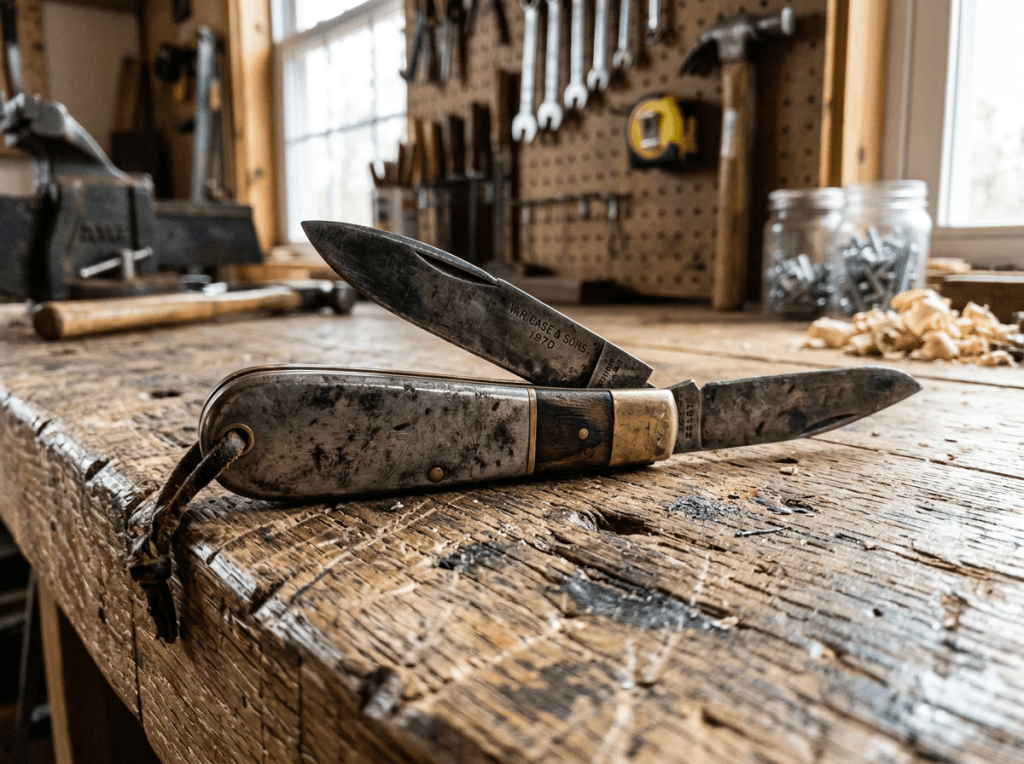
I love knives so, I have a large knife collection.
Some are practical. Some are beautiful. Some are rare. Some have stories attached to them. Most of them can cut. A few have seen years of hard use. One hangs on my wall.
It belonged to my dad.
I watched him abuse that knife in ways that would make collectors cringe. He cut sheet metal with it. He pried with it. He used it for jobs that had no business being done with a knife. The blade bears the scars to prove it.
I will never use that knife.
Not because it’s too valuable. Not because I am afraid of damaging it.
No, its purpose has changed. It’s no longer a tool in my collection. It’s a reminder of a man.
But there’s another knife I own that tells a different story.
I’ve carried it for years. I’ve sharpened it so many times that the blade is nearly half its original size. Every time it became dull, I removed a little more steel. Every time it was used, it paid the price of being useful.
That knife has earned every scratch. More than once it was the reason I made it home. It’s been used for exactly what it was designed to do.
And that got me thinking.
Most of us understand this principle when it comes to tools. We become confused when it comes to our lives.
We understand that a knife exists to cut. A hammer exists to drive nails. A lamp exists to provide light. A plow exists to break ground.
Yet somehow we convince ourselves that the gifts, opportunities, experiences, knowledge, and abilities God has given us can sit safely on a shelf indefinitely.
We admire them. We protect them. We preserve them. We rarely ask whether we’re using them.
The Purpose of a Thing
One of the simplest questions a person can ask is: What is this for?
When we understand the purpose of a thing, we understand how to evaluate it.
A knife that cuts well is a good knife. A lamp that provides light is a good lamp. A bridge that safely carries traffic is a good bridge.
The value of the object is connected to the purpose for which it was made.
The same principle applies to us.
God didn’t create human beings merely to exist. He didn’t save us merely to wait. He didn’t give gifts merely to be admired. He didn’t provide opportunities merely to be considered.
Everything God gives carries responsibility with it.
Knowledge carries responsibility. Resources carry responsibility. Influence carries responsibility. Wisdom carries responsibility. Experience carries responsibility. Faith carries responsibility.
We often pray for God to give us more while neglecting what He’s already placed in our hands.
The Comfortable Shelf
There’s something appealing about keeping things safe.
A knife that’s never used never gets dull. A truck that’s never driven never accumulates miles. A tool locked in a cabinet never gets scratched.
But usefulness always comes with wear.
Every meaningful act of service costs something. Every act of obedience costs something. Every investment of time, energy, money, or attention costs something.
This is why many people spend their lives preparing for things they never do.
They prepare to serve. They prepare to teach. They prepare to lead. They prepare to share their faith. They prepare to help. They prepare to build.
Preparation becomes a permanent state.
The shelf becomes comfortable. The tool remains pristine. Nothing is accomplished.
At some point we must ask whether we’re preparing for service or avoiding it.
The Fear of Scratches
Part of the problem is fear.
If I use the knife, it might get damaged. If I start the business, I might fail. If I share my faith, I might be rejected. If I teach, I might be criticized. If I serve, I might be taken advantage of. If I build, I might discover my limitations.
All of those risks are real. Every one of them.
But avoiding those risks carries its own cost.
A life spent protecting every gift God provides eventually becomes a life that never uses those gifts.
The servant who buried his talent in the ground didn’t lose it through reckless behavior. He lost it through fearful preservation.
The talent was protected. The purpose was abandoned.
That distinction matters.
Many of us think faithfulness means protecting what God gave us. Often faithfulness means investing it.
A Blade That Stays Sharp
There’s a strange irony in this. The sharpest knife in the room isn’t always the most valuable.
A knife that remains untouched for fifty years may retain a perfect edge. The worn knife with a thousand scratches may have fed families, built homes, repaired equipment, and served faithfully for decades.
Which one fulfilled its purpose?
The answer is obvious when discussing tools. It becomes less obvious when discussing people.
Many Christians spend years pursuing knowledge while rarely acting on what they already know.
We consume sermons. We read books. We listen to podcasts. We study theology. We gather information.
Information has value. Knowledge matters. Understanding matters.
But knowledge was never intended to be the destination.
Truth is supposed to transform us. The purpose of learning is living. The purpose of wisdom is application. The purpose of faith is obedience.
What Are You Preserving?
This weekend I would encourage you to spend some time asking a simple question.
What am I preserving that God intended me to use?
Maybe it’s a skill. Maybe it’s a calling. Maybe it’s a relationship. Maybe it’s a lesson learned through suffering. Maybe it’s a resource. Maybe it’s an opportunity. Maybe it’s simply the faith to take a step you already know God is asking you to take.
Whatever it is, remember this: Things become what they were created to be through use.
A lamp fulfills its purpose by shining. A plow fulfills its purpose by breaking ground. A knife fulfills its purpose by cutting. And followers of Christ fulfill their purpose not by admiring obedience, but by practicing it.
The knife that never cuts may remain beautiful. But beauty was never the reason it was forged.





Leave a Reply