Hebrews 6:17–20 (17)So when God desired to show more convincingly to the heirs of the promise the unchangeable character of his purpose, he guaranteed it with an oath, (18)so that by two unchangeable things, in which it is impossible for God to lie, we who have fled for refuge might have strong encouragement to hold fast to the hope set before us. (19)We have this as a sure and steadfast anchor of the soul, a hope that enters into the inner place behind the curtain, (20)where Jesus has gone as a forerunner on our behalf, having become a high priest forever after the order of Melchizedek.(ESV)
We often use the word hope when we’re uncertain.
We hope the weather cooperates. We hope the test results are good. We hope the money lasts until payday. We hope that the situation somehow works itself out.
In ordinary conversation, hope usually means that we want something to happen but don’t know whether it will.
Biblical hope isn’t like that.
It’s not wishful thinking with religious language wrapped around it. It’s not pretending that everything will work out the way we want. It’s not vague optimism that refuses to look honestly at suffering, danger, delay, or loss.
Biblical hope is an expected future resting upon the character and promise of God.
That expected future does more than comfort us when we think about tomorrow.
It governs the way we live today.
What we truly expect always reaches backward into the present.
A person who genuinely expects to die tomorrow will live differently today. There will be words that must be spoken, forgiveness that can no longer be delayed, and distractions that suddenly seem unimportant.
A person who expects to receive a large amount of money may begin making plans before the money ever arrives. They may change their spending, make promises, or commit themselves to decisions based upon what they believe is coming.
Expectation produces present movement.
Even when the expected event hasn’t yet happened, it begins exercising authority over current choices.
That’s why Christian hope can’t be passive.
If what God has promised is truly coming, then the future is already making demands upon the present.
We endure because suffering isn’t final.
We restrain desires because not everything we want belongs in the life to which Christ is leading us.
We forgive because present offenses won’t be permitted to govern eternity.
We obey because God’s promised future is more certain than many of the circumstances we can presently see.
Hope doesn’t merely help us survive today by thinking about something better tomorrow.
Hope teaches us how today must be lived.
This is what makes the language of Hebrews so powerful.
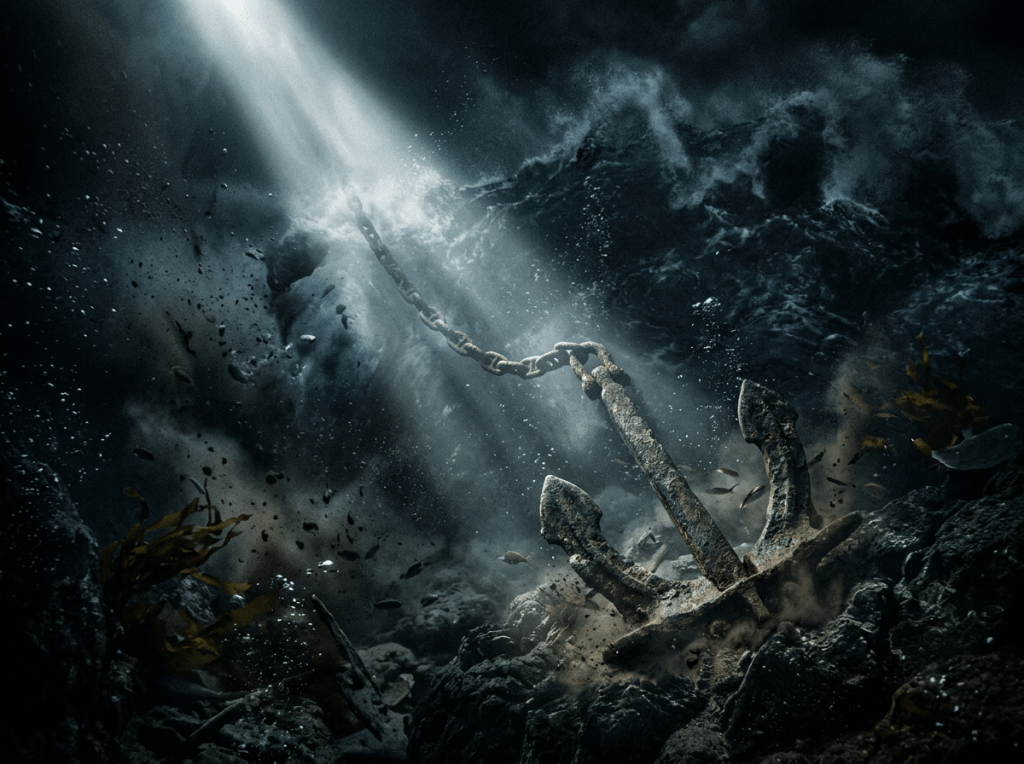
The author describes hope as an anchor of the soul.
That description must be handled carefully.
The text doesn’t grammatically call God’s oath or promise the anchor. Hope itself is the anchor.
However, the surrounding passage explains why that hope is secure.
God’s purpose is unchangeable.
God has guaranteed His promise.
It’s impossible for God to lie.
Christ has entered behind the curtain on our behalf.
The anchor holds because the future toward which it reaches rests upon the character of God and the completed work of Christ.
Christian hope isn’t secure because we desperately want it to be true.
It’s secure because God isn’t capable of becoming unfaithful to Himself.
An anchor is only useful when it has taken hold of something able to bear the force pulling against it.
A ship may rise, fall, turn, and strain against its line. The water may move violently around it. The wind may push it in every direction.
The anchor doesn’t remove the storm.
It gives the ship a fixed point within it.
In the same way, Christian hope doesn’t promise that we will never experience movement, fear, grief, doubt, or pressure.
It means that our future has been secured beyond the immediate reach of the storm.
Christ has gone ahead of us.
The hope set before us doesn’t rest within our present circumstances. It reaches beyond what we can currently see and takes hold where Christ has already entered.
This gives us a useful way to understand the relationship among faith, hope, and faithfulness.
Faith connects. Hope directs. Faithfulness continues.
These three are closely related, but they aren’t identical.
Faith connects.
Faith receives what God has spoken and attaches the life to Him.
It’s more than agreeing that God exists. It’s more than admitting that the claims of Scripture are intellectually possible.
Faith places the weight of the life upon the One who has spoken.
It trusts God enough to move when He commands, remain when He says to wait, and continue when visible circumstances seem to contradict what He has promised.
Faith is the present connection to the One who has made the promise.
Hope directs.
Hope gives that connected life an orientation.
Faith may tell us whom we trust, but hope tells us where His promise is leading.
Hope is the future God has promised exercising authority over the present.
It gives direction to endurance. It gives purpose to restraint. It gives meaning to sacrifice.
Without hope, present obedience can begin to feel pointless.
Why continue when nothing appears to be changing?
Why resist temptation when compromise would bring immediate relief?
Why remain faithful when faithfulness seems to produce only difficulty?
Hope answers by pointing beyond the moment.
This pain isn’t final.
This delay isn’t the whole story.
This temptation doesn’t deserve to rule a life that belongs to Christ.
This act of obedience isn’t wasted merely because its fruit can’t yet be seen.
Hope doesn’t deny the present. It places the present beneath the authority of what God has promised.
Faithfulness continues.
Faithfulness is what faith looks like when it remains through time.
It’s the maintained expression of faith through pressure, temptation, delay, disappointment, and strain.
Almost anyone can make a strong declaration in a powerful moment.
Faithfulness is revealed after the moment has passed.
It’s revealed when obedience becomes repetitive.
It’s revealed when no one applauds.
It’s revealed when the answer is delayed, the burden remains, and the cost becomes greater than expected.
Faithfulness isn’t merely beginning in the right direction.
It’s continuing in that direction because the One who called us hasn’t changed.
Faith connects.
Hope directs.
Faithfulness continues.
Yet the entire structure depends upon something greater than our own ability to hold everything together.
It depends upon the faithfulness of God.
Human faithfulness is the continued expression of faith toward someone or something.
God’s faithfulness is different.
God doesn’t place faith in an authority above Himself. There is no higher standard to which He must appeal and no greater power upon which He must depend.
God is faithful because He never contradicts His own character, word, promise, or purpose.
2 Timothy 2:13 if we are faithless, he remains faithful—for he cannot deny himself.(ESV)
God doesn’t remain faithful because our faith is always strong.
He remains faithful because He can’t deny Himself.
That doesn’t mean our unfaithfulness is harmless. Scripture repeatedly calls us to hold fast, endure, remain, obey, and continue.
Our choices matter.
Drift is real.
Abandonment is possible.
Faithfulness isn’t automatic simply because we once began.
However, our hope doesn’t rest upon the idea that our grip will never tremble.
Our confidence rests upon the One who made the promise.
Hebrews 10:23 Let us hold fast the confession of our hope without wavering, for he who promised is faithful.(ESV)
The command to hold fast is grounded in the faithfulness of the One who promised.
That distinction matters.
If our hope ultimately rested upon our own emotional stability, then every season of fear would threaten to destroy it.
If it rested upon our perfect understanding, then every unanswered question would loosen it.
If it rested upon our ability to perform without failure, then every stumble would become final.
But the anchor isn’t secured in our perfection.
It’s secured in the unchanging character of God and the work of Christ, who has gone before us.
This doesn’t produce passivity.
It produces faithful action.
Because God can’t lie, we can obey before we see the outcome.
Because Christ has entered ahead of us, we can continue when the path remains hidden.
Because the promised future is real, we can refuse to let temporary desires govern eternal lives.
1 John 3:3 And everyone who thus hopes in him purifies himself as he is pure.(ESV)
The expectation of seeing Christ produces present purification.
That’s hope working correctly.
It doesn’t leave a person staring into the distance while neglecting the life in front of them.
It reaches backward from the promised future and changes what the person does now.
We forgive now because we’re moving toward a kingdom where bitterness has no rightful place.
We endure now because pain won’t have the final word.
We resist sin now because we expect to stand before Christ.
We love now because the life to come is already revealing what truly matters.
We obey now because the future belongs to God.
The future you genuinely expect is already shaping the life you’re living.
It can be seen in what you prepare for, what you tolerate, what you sacrifice, what you pursue, and what you refuse.
If our claimed hope produces no present movement, then we should examine whether it’s truly governing us.
Christian hope isn’t an excuse to escape the present.
It’s God’s promised future calling the present into obedience.
Faith connects us to the One who has spoken.
Hope orients us toward what He has promised.
Faithfulness continues walking in that direction through every storm, delay, temptation, and pressure.
And beneath all of it is the faithfulness of God.
The line may strain.
The soul may rise and fall with the storm.
The darkness may make the destination difficult to see.
But Christ has already gone ahead of us.
Our hope isn’t anchored in an imagined future.
It’s anchored in the promise of the God who can’t lie and the work of the Christ who has already entered on our behalf.
Faith connects. Hope directs. Faithfulness continues.
And the line holds because God is faithful.





Leave a Reply