(Part 6 of 10)
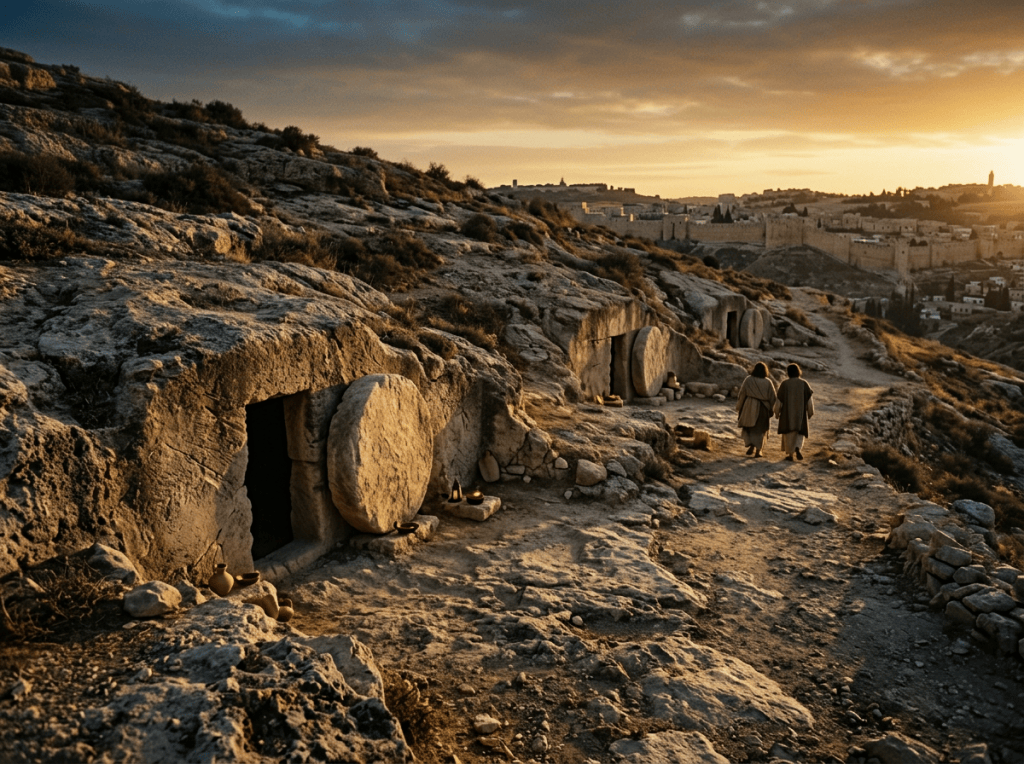
Matthew 27:52 The tombs also were opened. And many bodies of the saints who had fallen asleep were raised,(ESV)
There are moments in Scripture when the magnitude of an event seems completely disproportionate to the amount of space devoted to it. Matthew records one of those moments during his account of the crucifixion of Jesus. Jesus cries out and yields up His spirit. The curtain of the temple is torn in two from top to bottom. The earth shakes. Rocks split. Tombs are opened. And then Matthew tells us something extraordinary.
People who’d been dead were raised to life. Not one person. Not two people. Many.
Matthew tells us that after Jesus’ resurrection, these people came out of their tombs, entered Jerusalem, and appeared to many. Read that again.
People who’d died walked out of their graves and into Jerusalem. Then Matthew moves on.
That’s it. Two verses.
An event that could’ve occupied an entire book receives two verses.
We aren’t given a single name. We aren’t told how many people were raised. We aren’t told how long they’d been dead. We aren’t told who saw them. We aren’t told what they said. We aren’t told where they went. We aren’t told whether they eventually died again.
Matthew introduces one of the most extraordinary events in human history and then leaves it almost entirely unexplored. And none of the other Gospel writers picks up the thread.
Mark doesn’t explain it. Luke doesn’t expand upon it. John doesn’t provide additional details. We don’t encounter these people later in Acts. We don’t find one of Paul’s letters addressed to a congregation that includes someone who walked out of one of those tombs.
The Bible doesn’t tell us what became of them. Consider how unusual this is.
When Jesus raises Lazarus, we know his name. We know about his sisters. We know he’d been dead for four days. We know where he was buried. We know how Jesus called him out. We even know that the chief priests eventually plotted to kill him because his continued existence was causing people to believe in Jesus.
Scripture gives us enough of Lazarus’ story to understand something of the consequences of his resurrection. But these people? Nothing beyond their appearance in Jerusalem. It’s almost impossible to read those two verses without wanting to follow them.
Were these people recognized by those who’d buried them?
Were there families reunited?
Had some been dead for generations?
Did they understand what had happened to them?
Were they restored to ordinary mortal life as Lazarus apparently was, or was something different happening here?
These are fascinating questions. And they’re questions for which Scripture doesn’t provide answers.
We could spend an extraordinary amount of time constructing possibilities. People have. But eventually we have to confront the fact that our curiosity has taken us beyond the boundaries of what God has revealed.
That doesn’t mean the questions are wrong. It means we have to be careful about what we call answers.
There’s a difference between exploring Scripture and expanding Scripture. One seeks to understand what God’s given us. The other risks adding to it what we wish He’d given us.
The temptation to do that increases when the missing information is particularly interesting. And this may be one of the most interesting omissions in the entire New Testament. But perhaps we should spend some time examining where Matthew places these two verses rather than trying to determine what happened after them.
They appear in the account of Jesus’ death. The curtain separating the Most Holy Place from the rest of the temple is torn. The earth shakes. The rocks split. The tombs open. Matthew then connects the appearance of these resurrected people to the resurrection of Jesus Himself.
There’s something remarkable about that arrangement. Jesus dies. And the graves of other people are opened. The One who appears to have been defeated by death is the very One through whom death will ultimately be defeated.
What looks like the end is laying the foundation for a beginning. The cross was never simply about what happened to Jesus. It was about what His death and resurrection would accomplish for others.
That’s the context in which Matthew gives us these resurrected saints. Their appearance points toward something much larger than their individual stories.
Paul would later describe Christ as the firstfruits of those who have fallen asleep. In 1 Corinthians 15, Paul explains that the resurrection of Christ is inseparable from the resurrection promised to those who belong to Him.
Jesus’ resurrection isn’t merely an extraordinary event that happened to Jesus. It’s the foundation of our hope. His victory over death has implications for people who’ve already entered their graves and for people who haven’t entered them yet.
Matthew’s account gives us a remarkable picture of that reality. But it doesn’t explain all the mechanics of it. And there’s something we need to learn from that.
We don’t have to understand everything God’s done to understand what His actions reveal about Him.
We don’t know how many saints were raised. We know death wasn’t beyond His authority.
We don’t know what happened when they entered Jerusalem. We know they appeared to many.
We don’t know what ultimately became of them. We know what ultimately became of Jesus.
He rose. And unlike those unnamed saints, Scripture explicitly tells us that death no longer has dominion over Him.
That’s where our confidence belongs. Not in our ability to reconstruct the missing stories of these people. Not in our ability to explain every detail of what happened that day. Our confidence belongs in the One whose resurrection gives meaning to theirs.
Sometimes we struggle with that distinction. We want to know what God’s doing. We want to know how He’s doing it. We want to know why He’s doing it. We want to know what happens next. And preferably, we’d like all of those questions answered before we’re required to trust Him. But there are things God has revealed and things He hasn’t.
Deuteronomy 29:29 establishes that distinction. Some things belong to God, while the things He has revealed belong to us and our children so that we may live according to His instruction.
Notice that revelation creates responsibility. We’re not simply being given information to satisfy our curiosity. We’re being given truth upon which we’re expected to act. And sometimes we become so occupied with what hasn’t been revealed that we neglect what has.
We can spend years debating things God hasn’t explained while ignoring things He’s made perfectly clear. We can become experts in theories about the end times while struggling to love our neighbors. We can argue about the precise workings of spiritual gifts while failing to exercise the ones we’ve been given. We can become fascinated by the mechanics of resurrection while living as though death still has the final word.
There’s nothing wrong with studying the difficult things in Scripture. There’s nothing wrong with asking questions. But the pursuit of answers should never become a substitute for living according to the answers we already have. And there’s another danger.
Sometimes we’re so uncomfortable with an unanswered question that we accept almost any answer simply because it allows us to stop asking. Someone offers a convincing explanation. Someone constructs a timeline. Someone connects several passages and fills in the gaps. Eventually, we forget which parts came from Scripture and which parts came from the explanation.
What began as a possibility becomes a probability. What became a probability becomes an assumption. And eventually, the assumption becomes something we’re willing to defend as though God Himself had said it. But He didn’t.
Faithfulness to Scripture sometimes requires us to defend what Scripture says. Other times, it requires us to acknowledge what Scripture doesn’t say. Both require humility.
We should never be afraid to investigate something merely because it’s difficult. Neither should we be afraid to reach the end of that investigation and admit that we still don’t know.
An unanswered question isn’t necessarily a contradiction. A missing detail isn’t necessarily a missing truth. And our inability to explain something doesn’t automatically undermine the things we can establish.
Matthew gives us two verses about people who walked out of their graves. Then he returns our attention to Jesus. There’s something appropriate about that.
We want to follow the people into Jerusalem. We want to see who recognizes them. We want to hear their conversations. We want to know where their stories lead. But perhaps in our fascination with the people who came out of their tombs, we’re in danger of overlooking the One who would come out of His.
The unnamed saints are fascinating. Jesus is essential.
Their stories leave us with questions. His resurrection gives us an answer.
Death doesn’t get the final word. That doesn’t mean we know how every story will unfold. It doesn’t mean we’ll understand every loss. It doesn’t mean we’ll receive an explanation for every unanswered prayer. It doesn’t mean we’ll see the resolution to everything that troubles us during this life. But the Christian hope was never built upon our ability to understand every chapter. It’s built upon the promise of resurrection through Jesus Christ.
There are things about our own stories that we may never understand. There are things God’s done whose full significance we may never recognize in this life. There are questions we may carry all the way to the grave. But we don’t have to carry those questions without hope.
Matthew never tells us how the stories of those resurrected saints ended. He does, however, tell us how the tomb of Jesus was found. Empty. And because His tomb was empty, we have reason to hope even when we don’t know how the rest of our own story will unfold.
We don’t have all the answers. But we know the One who conquered the grave. And that’s enough to keep walking when we reach the edge of what we understand.



Leave a Reply