(Part 11 of 16)
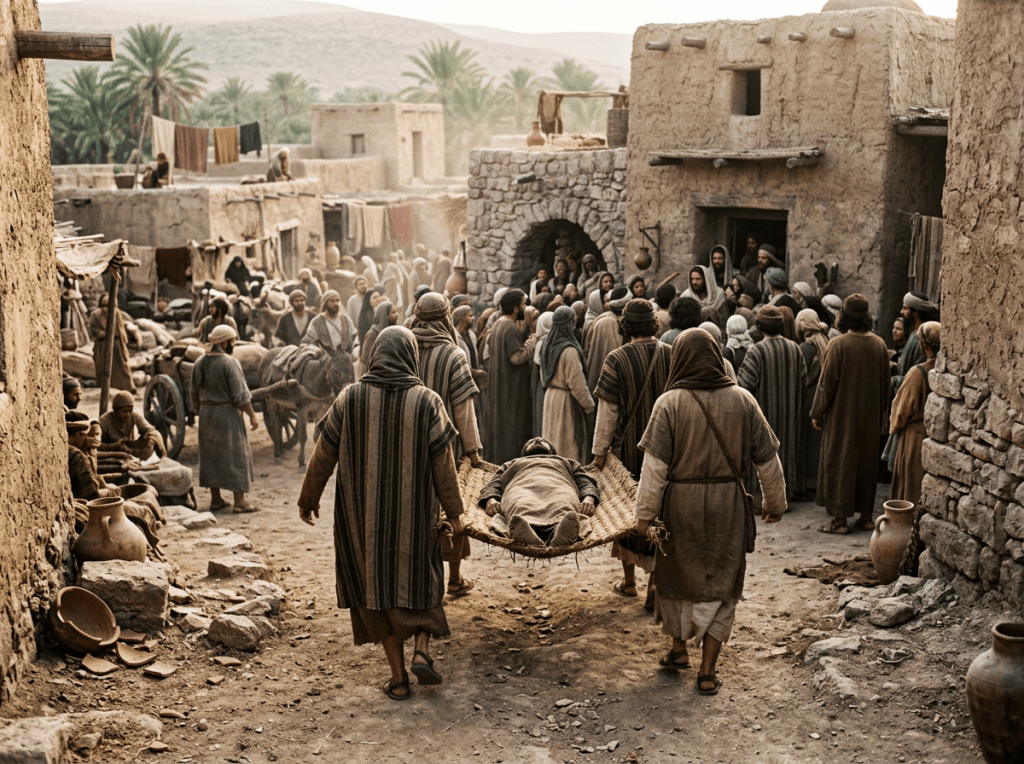
Mark 2:1–12 (1)And when he returned to Capernaum after some days, it was reported that he was at home. (2)And many were gathered together, so that there was no more room, not even at the door. And he was preaching the word to them. (3)And they came, bringing to him a paralytic carried by four men. (4)And when they could not get near him because of the crowd, they removed the roof above him, and when they had made an opening, they let down the bed on which the paralytic lay. (5)And when Jesus saw their faith, he said to the paralytic, “Son, your sins are forgiven.” (6)Now some of the scribes were sitting there, questioning in their hearts, (7)“Why does this man speak like that? He is blaspheming! Who can forgive sins but God alone?” (8)And immediately Jesus, perceiving in his spirit that they thus questioned within themselves, said to them, “Why do you question these things in your hearts? (9)Which is easier, to say to the paralytic, ‘Your sins are forgiven,’ or to say, ‘Rise, take up your bed and walk’? (10)But that you may know that the Son of Man has authority on earth to forgive sins”—he said to the paralytic—(11)“I say to you, rise, pick up your bed, and go home.” (12)And he rose and immediately picked up his bed and went out before them all, so that they were all amazed and glorified God, saying, “We never saw anything like this!”
Four men carried him to Jesus. One man walked home carrying his mat. Between those two moments, something extraordinary happened.
The man who’d been unable to walk stood before a crowded room, picked up his bed, and walked out in full view of everyone. The crowd was amazed. They glorified God. They declared that they’d never seen anything like it. And then the man went home. But there’s something about the way he arrived and the way he departed that deserves a closer look. Because the difference wasn’t merely that his legs worked.
The relationship between the man, his circumstances, and the people around him had changed.
The Men Who Carried Him
We don’t know the names of the four men. We don’t know their occupations. We don’t know how long they’d known the paralytic. We don’t even know the exact nature of their relationship with him. They may have been relatives, friends, or other people who cared enough to help.
What we do know is that they carried him. And when they arrived at the house where Jesus was teaching, they encountered a problem.
The crowd was too large. They couldn’t get through the door. They couldn’t reach Jesus by the ordinary route. So they went up to the roof. They opened it above the place where Jesus was teaching. And they lowered the man down on his bed.
It’s an extraordinary picture of determination. The paralytic couldn’t make the journey independently. But his inability to walk didn’t mean he was without people willing to help him. And their willingness to help made the encounter possible.
Mark tells us that Jesus saw their faith. Not merely the faith of the man on the bed. Their faith. The men who carried him mattered. Their actions mattered. Their willingness to do something difficult for someone else mattered.
Sometimes the faith that brings us to Jesus is demonstrated by the people willing to carry us when we can’t get there alone.
That’s not a lesser expression of faith. It’s part of the story Scripture chose to preserve.
The First Thing Jesus Addressed
The man was brought to Jesus because he couldn’t walk. At least, that’s the obvious need presented by the account. But Jesus didn’t begin by healing his legs.
He told the man that his sins were forgiven. That statement changed the atmosphere in the room. Some of the scribes questioned what Jesus had said. They understood that forgiveness of sins was a divine prerogative. And Jesus responded by asking which was easier to say: that the man’s sins were forgiven, or that he should rise, take up his bed, and walk. Then Jesus explained that the visible healing would demonstrate His authority to forgive sins.
He told the man to rise. Take up his bed. And go home.
The man stood. He picked up the bed. And he walked out.
The healing was extraordinary. But it wasn’t an isolated display of power.
Jesus used it to reveal something about His authority. That’s important because we shouldn’t reduce this passage to a motivational lesson about overcoming physical limitations.
The central claim of Mark 2 concerns Jesus’ authority to forgive sins. The healing serves that revelation. And the man’s departure gives us a remarkable picture of what happened afterward.
The Mat That Changed Hands
When the man arrived, the mat carried him. When he left, he carried the mat. It’s a simple reversal. But it’s a powerful one.
The same object that had supported his body now rested in his hands. The bed hadn’t changed. The man had. And Jesus instructed him to take it home.
We shouldn’t invent a symbolic meaning that Mark doesn’t explicitly provide. The mat was a practical possession, and carrying it demonstrated that the man could now walk. But the contrast is still worth considering.
Before the encounter, the man depended upon others to move him. Afterward, he could move himself.
The people who’d carried him were no longer required to carry him in the same way. His circumstances had changed. And with that change came new possibilities.
He could go places he couldn’t previously reach on his own. He could participate in activities that had been inaccessible. He could take responsibility for tasks that his condition had prevented him from performing.
Scripture doesn’t describe what he did with those possibilities. It doesn’t tell us whether he worked, traveled, married, or became involved in ministry. But it does tell us that he walked home. And he carried his own bed.
The help he’d received brought him to a moment when he could do something he couldn’t do before.
When Help Is Necessary
There’s a tendency in some Christian circles to treat independence as a measure of spiritual maturity. We admire the person who never asks for help. We praise the individual who carries every burden without complaint. We celebrate the one who seems capable of enduring anything alone. But that’s not the picture Scripture consistently gives us.
The paralytic needed help. He received it. And Jesus didn’t criticize him for being carried. He didn’t tell the four men that they were enabling weakness. He didn’t insist that the man demonstrate sufficient independence before approaching Him. The men carried him because he couldn’t get there on his own. And Jesus honored the faith demonstrated in their actions. That’s worth remembering.
There are seasons when people need to be carried. Sometimes physically. Sometimes financially. Sometimes emotionally. Sometimes through prayer, encouragement, or practical assistance.
A person facing illness may need others to provide meals or transportation. A family enduring hardship may need financial support. Someone overwhelmed by circumstances may need another person to help them make decisions or accomplish ordinary tasks. And sometimes the most faithful thing we can do is acknowledge that we can’t carry everything ourselves.
Needing help isn’t a moral failure. Refusing to recognize another person’s legitimate need isn’t a virtue.
The four men didn’t wait for the paralytic to become capable of reaching Jesus independently. They carried him. And that mattered.
When the Responsibility Changes
But there’s another side to the story. After Jesus healed the man, He didn’t instruct the four men to continue carrying him. He told the man to rise, take up his bed, and go home.
The responsibility had changed because his ability had changed. That’s an important distinction.
Help should respond to genuine need. But help can also change as the circumstances change.
Someone who once needed assistance with a task may eventually become capable of doing it independently. A person learning a new skill may begin by relying heavily on a teacher, then gradually assume responsibility for their own work. A family recovering from hardship may need substantial support for a season, then become capable of supporting others.
Those transitions can be healthy. But they aren’t always simple.
Sometimes the person receiving help has grown accustomed to depending upon others. Sometimes the people providing help have built part of their identity around being needed. Sometimes both sides struggle to recognize when the relationship should change. And sometimes the need remains, even when others believe it should’ve disappeared.
We must be careful here. Not every disability is healed. Not every limitation can be overcome through determination. And not every person who continues needing assistance is refusing responsibility.
The paralytic’s healing was a specific act of divine power. It isn’t a promise that every believer will become physically independent. But the account does illustrate something worth examining.
When our abilities change, our responsibilities may change with them.
And faithfulness includes recognizing both what we can do and what we still need others to help us accomplish.
The People Who Helped You Get There
There’s another question the passage leaves unanswered. What happened to the four men?
We don’t know. Mark doesn’t tell us whether they followed the man home. He doesn’t record their reactions. He doesn’t describe whether their relationship with him changed afterward. But their part in the story remains important.
Without their willingness to carry him, the encounter as recorded wouldn’t have happened in the same way.
They made an effort. They overcame an obstacle. They brought someone to Jesus. And then the focus of the account moved away from them.
That’s a familiar experience for people who serve others. You invest time in someone. You help them through a difficult season. You provide support, encouragement, resources, or opportunities. And eventually, they move forward.
Sometimes they no longer need the same help. Sometimes their lives take them somewhere else. Sometimes you never see the full results of what your efforts made possible. That doesn’t make your contribution insignificant.
The four men weren’t the ones who walked out carrying the mat. But their faith and effort helped bring the man to the place where Jesus changed his life.
You don’t have to remain at the center of someone’s story for your contribution to have mattered.
Sometimes the purpose of helping someone is to make it possible for them to continue without needing the same help from you. And that can be a beautiful outcome.
The Difference Between Support and Control
There’s a distinction worth making between helping someone and controlling them. Genuine support seeks another person’s good. It recognizes their needs. It respects their dignity. And where possible, it helps them develop the ability to act responsibly.
Control is different. Control can disguise itself as concern. It can insist that someone remains dependent even when they’ve become capable of greater independence. It can treat another person’s progress as a threat. It can make assistance conditional upon continued obedience to the person providing it.
That’s not what we see in Mark 2. The four men carried the paralytic to Jesus. But the authority to heal belonged to Jesus.
The men didn’t own the outcome. They didn’t become the center of the miracle. They didn’t receive authority over the man’s future because they had helped him reach the house. Their role was important. But it had limits. And those limits matter in our own relationships.
Parents must eventually allow, or expect, children to assume greater responsibility. Teachers must allow students to develop beyond constant instruction. Leaders should prepare others to carry responsibilities rather than making themselves permanently indispensable. And people who provide assistance should recognize that another person’s growing independence can be evidence that the help has accomplished something good.
The goal of faithful support isn’t to make ourselves permanently necessary. It’s to serve the genuine needs of the person before us.
Sometimes that means continuing to carry. Sometimes it means teaching. Sometimes it means encouraging. And sometimes it means stepping aside.
Carry Your Mat Home
The man arrived on a bed. Four men carried him. They opened a roof and lowered him before Jesus. Jesus forgave his sins. Jesus healed him. And Jesus told him to go home.
The man stood, took up his bed, and walked out before everyone. It’s a remarkable account of divine authority and human faith. But it also gives us a picture of how relationships can change when circumstances change.
There are times when we need others to carry us. There are times when we’re called to carry someone else. And there are times when the help we’ve received makes it possible for us to assume responsibilities we couldn’t carry before.
None of those positions makes us more valuable than another. Our worth isn’t determined by our independence. Our faithfulness isn’t measured by how little help we need. And our usefulness isn’t measured by how many people remain dependent upon us.
The question is whether we’re responding faithfully to the circumstances God has placed before us.
Are we willing to help when someone genuinely needs us?
Are we willing to receive help when we can’t manage alone?
Are we willing to recognize when another person’s abilities have grown?
And are we willing to take responsibility for what we can now do?
The four men carried their friend to Jesus. Jesus changed the man’s circumstances. And the man carried his mat home.
Sometimes faithfulness means carrying someone. Sometimes it means allowing yourself to be carried. And sometimes it means recognizing that it’s finally your turn to stand.





Leave a Reply