(Part 8 of 16)
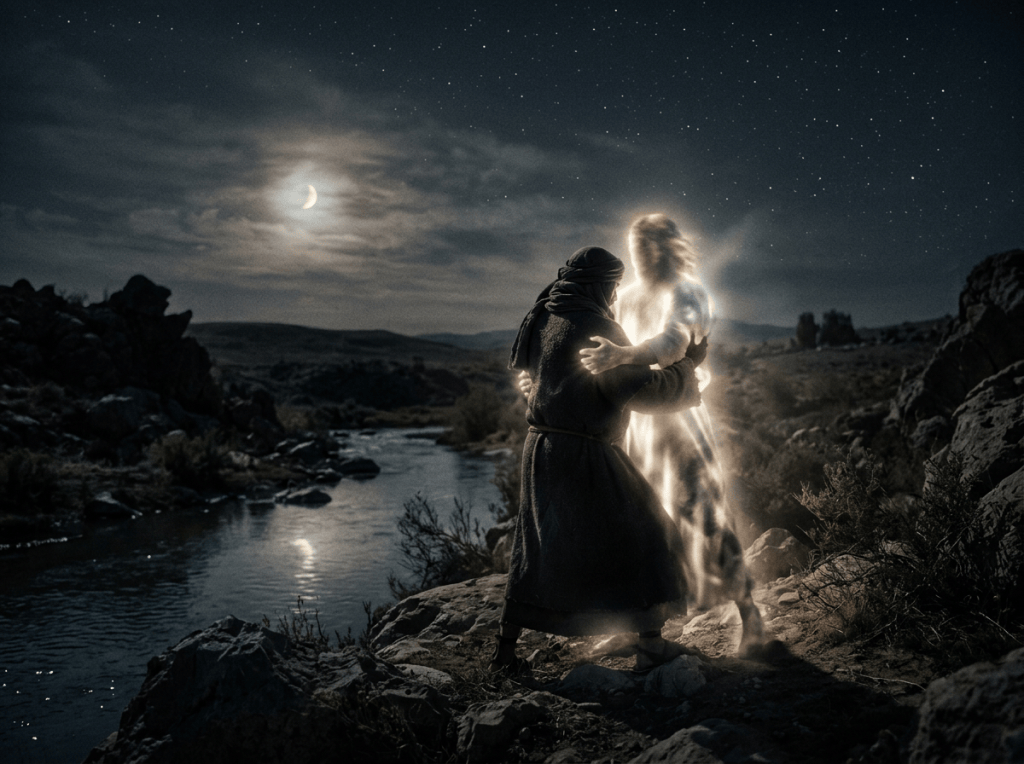
Genesis 32:24–31 (24)And Jacob was left alone. And a man wrestled with him until the breaking of the day. (25)When the man saw that he did not prevail against Jacob, he touched his hip socket, and Jacob’s hip was put out of joint as he wrestled with him. (26)Then he said, “Let me go, for the day has broken.” But Jacob said, “I will not let you go unless you bless me.” (27)And he said to him, “What is your name?” And he said, “Jacob.” (28)Then he said, “Your name shall no longer be called Jacob, but Israel, for you have striven with God and with men, and have prevailed.” (29)Then Jacob asked him, “Please tell me your name.” But he said, “Why is it that you ask my name?” And there he blessed him. (30)So Jacob called the name of the place Peniel, saying, “For I have seen God face to face, and yet my life has been delivered.” (31)The sun rose upon him as he passed Penuel, limping because of his hip.(ESV)
Jacob walked into the night with two good legs. He walked out with a blessing, a new name, and a limp.
We tend to focus on the blessing. We celebrate the name. We talk about the extraordinary encounter between Jacob and the mysterious figure who wrestled with him until daybreak. But there’s a detail that refuses to disappear.
Jacob was blessed. And Jacob was injured. Both happened in the same encounter. And when the sun rose, he had to keep walking.
The Night Before
Jacob had a problem. His brother Esau was coming to meet him. The last time their relationship had reached a breaking point, Esau had intended to kill him.
Jacob had deceived their father, Isaac, and received the blessing intended for Esau. He’d fled his home and spent years away.
Now he was returning. And Esau was approaching with four hundred men.
Jacob was afraid. He divided his people and possessions into groups. He prepared gifts for Esau. He prayed for deliverance. Then, after sending his family and possessions across the stream, Jacob was left alone. And a man wrestled with him until daybreak.
Scripture doesn’t explain how the encounter began. It doesn’t tell us what Jacob initially thought was happening. It simply tells us that the struggle continued through the night. Then the man touched Jacob’s hip socket, and his hip was put out of joint.
Jacob was injured. But he refused to let go without a blessing. And the blessing came.
The Name He Carried
Before the encounter ended, the man asked Jacob his name. Jacob. A name deeply connected to the history of his relationship with Esau.
Genesis had already associated his name with grasping his brother’s heel. Esau later connected Jacob’s name with the ways he had supplanted him. Jacob had spent much of his life obtaining what he wanted through schemes, bargains, and deception. Now he stood before someone he couldn’t manipulate into submission. And he received a new name. Israel.
The explanation given in Genesis 32 connects that name with striving with God and with men, and prevailing. The text is remarkable because Jacob didn’t emerge physically stronger. He didn’t overpower his opponent in the ordinary sense. He didn’t walk away untouched. He received the blessing while bearing the consequences of the encounter.
He prevailed, but he didn’t emerge unmarked.
That’s an uncomfortable picture of victory. We usually imagine overcoming something as leaving it behind. The struggle ends. The problem disappears. The evidence of the battle fades. We return to life stronger than before. But Jacob’s encounter didn’t fit that pattern.
He received something extraordinary. And he walked away differently.
The Limp
Genesis 32:31 tells us that the sun rose upon Jacob as he passed Penuel, limping because of his hip.
Consider that image. The night’s over. The encounter’s ended. The blessing’s been spoken. The new name’s been given. And Jacob is limping toward the very problem he’d feared the night before.
Esau’s still coming. The four hundred men haven’t disappeared. The difficult conversation hasn’t been canceled. Jacob still has to face his brother. But now he approaches that moment with a physical limitation he didn’t have before.
It’s tempting to turn the limp into a neat spiritual metaphor. Perhaps God needed to break Jacob’s strength. Perhaps the injury was necessary to teach him dependence. Perhaps Jacob had to be wounded before he could be blessed.
Those interpretations are familiar. But Genesis doesn’t explicitly tell us why the injury was inflicted. And we should be careful about claiming to know what God’s chosen not to explain.
The passage doesn’t establish that God must wound people to transform them. It doesn’t teach that every physical limitation is a spiritual lesson. And it certainly doesn’t give us permission to tell someone who’s suffering that God injured them for their own good.
What the passage does tell us is enough. Jacob was blessed. Jacob was given a new name. Jacob was injured. And Jacob continued his journey.
The blessing was real, even though the limp remained.
What We Expect a Blessing to Look Like
We have a habit of measuring God’s favor by the absence of difficulty. If God blesses us, we expect the road to become easier. If God answers our prayers, we expect the burden to become lighter. If God changes us, we expect the evidence of our former struggles to disappear. But Scripture doesn’t always present blessing that way.
Paul prayed repeatedly for the removal of what he called a thorn in his flesh. The answer he received wasn’t its removal. He was told that God’s grace was sufficient and that divine power was made perfect in weakness.
Paul’s circumstances and Jacob’s encounter are different. We shouldn’t pretend they describe the same experience. But both challenge the assumption that God’s favor must be demonstrated by the elimination of every limitation.
Sometimes the evidence of God’s work isn’t that we walk away without difficulty. It’s that we continue walking in faith despite it. And that raises a question.
Have we become so accustomed to expecting blessings to remove our limitations that we struggle to recognize God’s faithfulness when they remain?
The Morning After
The next chapter begins with Jacob looking up and seeing Esau approaching. The confrontation he feared is finally here. And something unexpected happens.
Esau runs to meet him. He embraces him. He kisses him. They weep. The brother Jacob feared would destroy him instead receives him with affection.
The encounter is beautiful. But notice something. Jacob’s injured hip hadn’t prevented him from moving forward. The text doesn’t describe how much pain he experienced during the meeting. It doesn’t tell us whether Esau noticed the limp. It doesn’t tell us how long the injury affected him. We know he was limping as the sun rose. We don’t know whether he limped for the rest of his life.
What we do know is that the encounter with Esau still took place. Jacob didn’t wait for everything to return to the way it had been before crossing the stream. He moved forward with the condition in which the previous night had left him. And perhaps that’s where this story becomes most relevant to us.
We sometimes postpone the next step because we’re waiting to feel completely restored. We want every uncertainty resolved. Every weakness removed. Every consequence erased. Every sign of the struggle gone. But life doesn’t always offer us that kind of beginning.
Sometimes we must continue while carrying evidence of what we’ve been through. Not because suffering makes us holy. Not because pain proves obedience. But because faithfulness isn’t reserved for people who’ve emerged from every struggle untouched.
Blessed and Limping
Jacob crossed the Jabbok as a man afraid of what awaited him. He emerged from the night with a new name, a blessing, and a limp. And then he went to meet his brother.
That’s the part of the story I don’t want us to overlook. The encounter with God wasn’t an excuse to stop living. The blessing wasn’t permission to avoid the road ahead. And the injury didn’t erase what God had spoken.
Jacob had to continue. So do we.
There may be things in your life that have changed you permanently. Some changes are visible. Others are known only to you. Some came through your own decisions. Others came through circumstances you never chose. And some remain difficult to understand.
We don’t need to assign a divine explanation to every wound to recognize that God can remain faithful in the presence of it. We don’t need to celebrate pain to acknowledge that life can continue after it. And we don’t need to pretend that every struggle ends with everything restored to its former condition.
Jacob received a blessing that night. He also received a new name. But when the sun rose, he still had to put one foot in front of the other.
Don’t confuse the presence of a limp with the absence of a blessing.
The sun rose. Jacob walked on. And the God who met him in the darkness hadn’t abandoned him in the morning.



Leave a Reply