(Part 3 of 16)
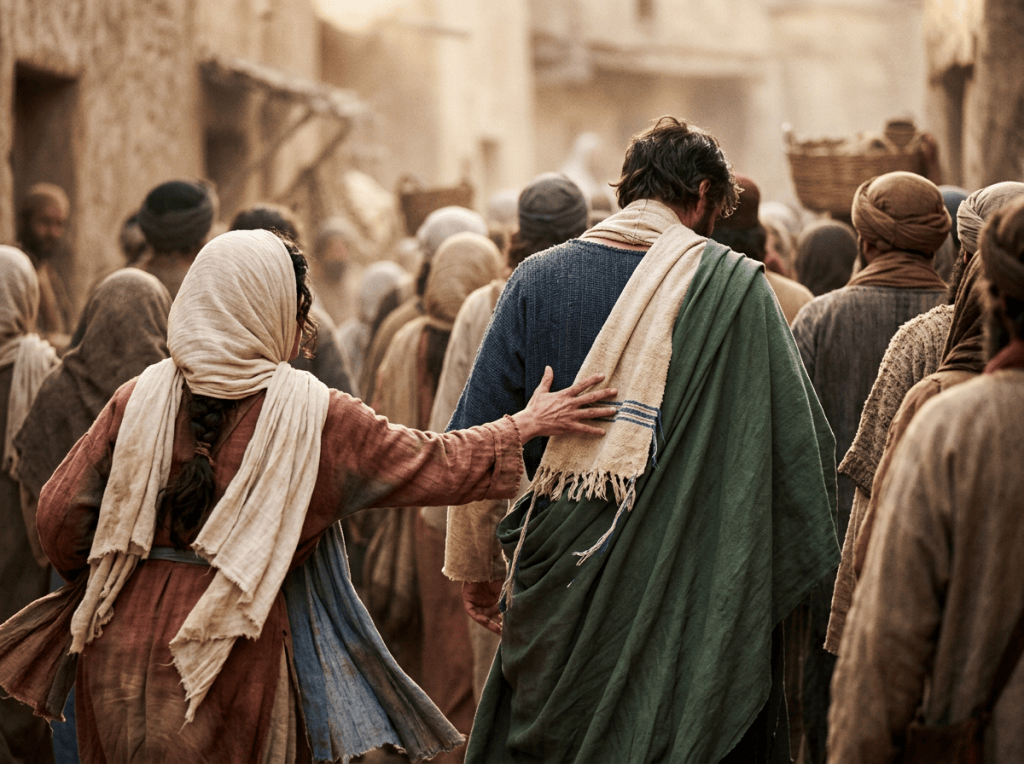
Mark 5:25–34 (25)And there was a woman who had had a discharge of blood for twelve years, (26)and who had suffered much under many physicians, and had spent all that she had, and was no better but rather grew worse. (27)She had heard the reports about Jesus and came up behind him in the crowd and touched his garment. (28)For she said, “If I touch even his garments, I will be made well.” (29And immediately the flow of blood dried up, and she felt in her body that she was healed of her disease. (30)And Jesus, perceiving in himself that power had gone out from him, immediately turned about in the crowd and said, “Who touched my garments?” (31)And his disciples said to him, “You see the crowd pressing around you, and yet you say, ‘Who touched me?’” (32)And he looked around to see who had done it. (33)But the woman, knowing what had happened to her, came in fear and trembling and fell down before him and told him the whole truth. (34)And he said to her, “Daughter, your faith has made you well; go in peace, and be healed of your disease.”
Twelve years. That’s a long time to live with anything. Twelve years of waking up with the same problem. Twelve years of looking for answers. Twelve years of hoping that the next attempt might finally be the one that changes everything. Twelve years of disappointment. And then, in a moment, it was over.
We know the woman in Mark 5 by her suffering. We don’t know her name, her family, her occupation, or much of anything else about her. We know she’d been bleeding for twelve years. We know she’d suffered under many physicians. We know she’d spent everything she had. We know she’d grown worse instead of better. And we know she believed that touching Jesus’ garment could make her well.
That’s almost everything Scripture tells us about who she was before the encounter. Think about that. We remember her by the very thing Jesus took away.
When Survival Becomes Your Life
Twelve years is long enough for a problem to work its way into nearly every corner of someone’s existence. It can shape the way you plan your day. It can determine where you go, what you do, what you can afford, and what you have the strength to accomplish.
It can change your relationships. It can alter your expectations. It can slowly replace the future you once imagined with a future built around managing the problem.
At some point, you may stop asking what life would look like without it. You start asking how to make life work with it.
That’s not necessarily surrender. Sometimes it’s simply survival.
The woman in Mark 5 had spent twelve years looking for relief. Scripture doesn’t suggest that she’d given up hope. Quite the opposite. When she heard about Jesus, she acted. But the passage does tell us something about the extent of her struggle.
She’d spent everything she had. Her condition hadn’t merely affected her body. It had consumed her resources.
Under the purity regulations of Leviticus 15, a prolonged discharge of blood also carried implications for ritual cleanness and contact with others. We shouldn’t assume every detail of her social life, but her condition had consequences extending beyond physical discomfort.
For twelve years, she’d been living with a problem that refused to leave. And then Jesus passed by.
The Touch That Changed Everything
She didn’t approach Jesus with a long speech. She didn’t ask Him to stop and explain her circumstances. She came through the crowd and touched His garment.
Mark tells us that she believed touching His clothes would be enough. And it was.
Immediately, the bleeding stopped. She knew something had changed in her body. Twelve years of suffering ended in a moment. But Jesus stopped.
He asked who’d touched His garments. The disciples were confused. People were pressing against Him from every direction. How could He ask who touched Him? But Jesus knew that power had gone out from Him. And the woman came forward.
Trembling, she fell before Him and told Him the whole truth. That detail matters. She had approached quietly, hoping to receive healing without drawing attention to herself. Now she stood before Jesus, telling Him everything. And Jesus addressed her.
Not as a problem. Not as an interruption. Not as a woman who’d taken something she wasn’t supposed to have.
He called her daughter. He affirmed her faith. He told her to go in peace and be healed of her disease. The healing had already happened. But the encounter wasn’t finished until Jesus had spoken to her.
She came looking for relief from her condition. She left having been personally acknowledged by the One who healed her.
And then she went. Scripture doesn’t follow her.
The Life Waiting on the Other Side
What happened the next morning?
We don’t know. We don’t know where she lived. We don’t know whether she had family waiting for her. We don’t know whether she returned to a household, a business, or a life that had been waiting for her to recover. We don’t know whether she was able to rebuild what she’d lost financially. And we shouldn’t invent those details. But one thing is certain. The problem that had shaped the previous twelve years was no longer there.
She had to live without it. That sounds like an easy thing. Who wouldn’t want to live without suffering? Who wouldn’t celebrate the end of something that had consumed so much of their life?
Of course she had reason to rejoice. But there’s a question here that reaches beyond her particular circumstances.
What happens when the thing you’ve spent years fighting is suddenly no longer the thing you have to fight?
For some people, that transition is wonderfully simple. For others, it can be surprisingly complicated.
A person who has spent years struggling financially may finally reach stability, only to discover that the habits formed during scarcity don’t disappear overnight. Someone who has spent years caring for a sick family member may find that the end of the crisis leaves an unfamiliar amount of time and responsibility to reorganize. Someone who has spent years fighting to overcome a destructive habit may discover that freedom requires more than simply avoiding the old behavior. Someone who has spent years defined by a difficult season may struggle to imagine who they are when that season ends.
The problem can be gone while the patterns developed around it remain. That doesn’t mean the deliverance was incomplete. It means human beings learn how to survive their circumstances, and sometimes those lessons remain useful long after the circumstances change. Other times, they become things we need to unlearn.
When the Old Answers No Longer Fit
Imagine spending twelve years making decisions around one persistent limitation. Every plan has to account for it. Every opportunity has to be measured against it. Every disappointment reinforces the need to be careful. Then the limitation disappears.
The decisions you made yesterday may no longer be the decisions you need to make tomorrow. The strategies that helped you endure may not be the strategies that help you grow. And the expectations that once protected you may now be unnecessarily limiting.
This is one of the quieter challenges of restoration.
We often ask God to change our circumstances while assuming we’ll automatically know how to live once those circumstances change.
Sometimes we do. Sometimes we don’t.
Consider Israel after leaving Egypt. For generations, the people had lived under oppression. They cried out to God, and God delivered them. But leaving Egypt didn’t instantly teach them how to live as a free people.
Their circumstances changed dramatically. Their thinking didn’t always keep pace. They repeatedly looked backward toward what had been familiar, even when that familiar life had been oppressive.
The wilderness exposed how much of Egypt they were still carrying within their expectations. That doesn’t mean the woman in Mark 5 responded the same way. Scripture gives us no reason to claim that she did. But Israel’s experience demonstrates a broader truth.
A changed circumstance doesn’t automatically produce a changed way of thinking.
And sometimes the next work of faith is learning how to live in the freedom we’ve received.
More Than What Happened to You
There’s another part of this story that deserves attention. We don’t know this woman’s name.
For two thousand years, readers have identified her by the condition from which Jesus healed her. The woman with the issue of blood. The bleeding woman. The woman who suffered for twelve years.
Those descriptions help us identify the biblical account, but they also reveal something about the way we remember people.
We often identify people by the most dramatic thing that happened to them. The addict. The divorcee. The prisoner. The victim. The failure. The sick person.
Sometimes those labels describe something real. Sometimes they describe something that’s already changed. But they rarely describe the whole person.
This woman was more than her condition. She had thoughts, experiences, relationships, hopes, and a life that existed beyond the few verses Mark gives us. We simply aren’t told those details.
Jesus, however, didn’t need her name recorded in Scripture to recognize her as a person. He stopped. He listened. He addressed her as daughter. And He sent her away in peace.
Her suffering was central to the story Mark recorded. It wasn’t the sum of her humanity.
That’s a distinction worth remembering when we look at others. And when we look at ourselves.
What happened to you may explain part of your story without defining the entirety of who you are.
The Danger of Holding On to Yesterday
There’s a subtle temptation that can appear after a long season of difficulty. We become familiar with the way things have always been. Even when those things are painful, they’re predictable. We know what to expect. We know what to avoid. We know how to survive. And sometimes the unknown possibilities of a different life can feel more intimidating than the familiar limitations of the old one.
That doesn’t mean people secretly want to remain sick, poor, trapped, or hurting. Such an accusation would be both unfair and unsupported by this passage. But it does mean that change can require adjustment, even when the change is good.
The person who has finally found peace may have to learn that not every disagreement is a threat. The person who has finally found stability may have to learn that not every unexpected expense is a catastrophe. The person who has finally received forgiveness may have to learn to stop treating every memory of failure as proof that forgiveness wasn’t real. And the person who has finally received an opportunity may have to learn to stop living as though every door remains closed.
Those adjustments don’t always happen instantly. Sometimes they take patience. Sometimes they take help. Sometimes they take years. And sometimes the old habits of survival return when we’re tired, afraid, or uncertain. But the presence of an old habit doesn’t mean the old condition still has authority over the future. We can acknowledge what shaped us without allowing it to determine everything that comes next.
When the Problem Is Gone
The woman touched Jesus’ garment. The bleeding stopped. Jesus called her daughter and sent her away in peace. That’s where the biblical account ends. But her life continued.
Whatever happened afterward, she no longer needed to organize her future around the same ongoing bleeding that had consumed twelve years of her past.
The story we remember her for had reached its conclusion. And now she had another story to live.
Maybe that’s the question worth carrying away from this encounter. Not merely what we’re asking God to remove. Not merely what we’re hoping He’ll restore. But what we’ll do when the thing we’ve spent so much of our lives struggling against is no longer standing in front of us.
Will we recognize the possibilities that have opened?
Will we allow our expectations to change?
Will we stop measuring every tomorrow by the limitations of yesterday?
Will we remember that we are more than the problems we’ve survived?
The woman in Mark 5 came to Jesus because she wanted to be healed. She received what she came for. And then Jesus sent her into a future no longer governed by the condition that had brought her to Him.
We don’t know what she did with that future. But we know she had one.
Don’t spend so much of your life learning how to survive the problem that you forget you were created for more than surviving it.




Leave a Reply