(Part 2 of 16)
1 Samuel 18:6–9 (6)As they were coming home, when David returned from striking down the Philistine, the women came out of all the cities of Israel, singing and dancing, to meet King Saul, with tambourines, with songs of joy, and with musical instruments. (7)And the women sang to one another as they celebrated, “Saul has struck down his thousands, and David his ten thousands.” (8)And Saul was very angry, and this saying displeased him. He said, “They have ascribed to David ten thousands, and to me they have ascribed thousands, and what more can he have but the kingdom?” (9)And Saul eyed David from that day on.(ESV)
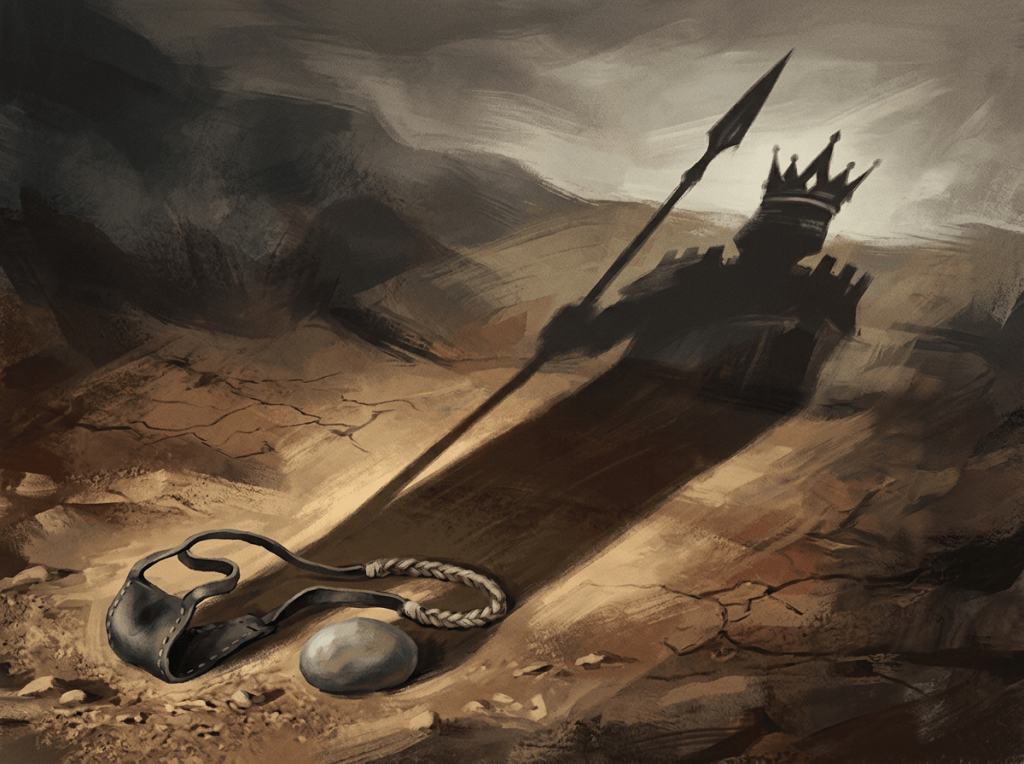
Everyone remembers the giant falling. A young shepherd stands before a warrior who has terrified an entire army. He carries no sword, wears no armor, and possesses none of the credentials that should qualify him for the battlefield. The king’s armor doesn’t fit him. His brothers don’t believe he belongs there. The giant himself considers David little more than an insult. And yet, David walks onto that battlefield with a confidence that the soldiers around him have forgotten how to possess.
He doesn’t trust the stone. He doesn’t trust the sling. He trusts the God who delivered him from the lion and the bear.
The stone flies. Goliath falls. Israel wins.
It’s one of the most familiar victories in all of Scripture. And that’s usually where we stop. But David’s story didn’t end when Goliath hit the ground.
In some ways, the trouble was just beginning.
When Victory Changes Everything
David hadn’t gone looking for a throne that morning. He’d been sent to deliver provisions to his brothers and inquire about their welfare. He arrived at a battlefield where the army of Israel was afraid to fight, and he heard a giant mocking the armies of the living God.
David saw a problem that needed to be confronted. And he confronted it.
The result was extraordinary. The Philistines fled. Israel pursued them. David became a national hero.
The boy who’d spent his days tending sheep was suddenly known throughout the kingdom. But fame has an interesting way of changing the relationships around us.
In 1 Samuel 18, the women of Israel came out celebrating the army’s return. They sang about Saul’s victories and David’s victories.
Saul had slain his thousands. David had slain his ten thousands.
It was a song of celebration. But Saul didn’t hear celebration. He heard comparison. He heard a threat. And Scripture tells us that Saul became angry.
Not because David had betrayed him. Not because David had disobeyed him. Not because David had tried to take his throne. But because David was receiving more recognition than Saul believed he should.
The same victory that brought David into national prominence also made him the object of the king’s suspicion.
David defeated the giant in front of him, only to discover that the next enemy would be standing behind him.
The Enemy You Didn’t Know You Had
There’s something particularly uncomfortable about Saul’s response. David had done exactly what Israel needed. Goliath had been challenging the army for forty days. Saul and his soldiers had been afraid. David stepped forward when no one else would.
The victory benefited Saul’s kingdom. It protected Saul’s people. It accomplished what Saul’s army had been unable to accomplish. And Saul resented the man who made it happen.
Think about that for a moment. David’s success wasn’t a threat to the kingdom. It was a threat to Saul’s pride. Those are two very different things.
Saul was supposed to be Israel’s king. His responsibility was to lead and protect the people entrusted to him. David had helped accomplish that purpose. A secure king could’ve celebrated the victory.
Saul saw competition. And the problem wasn’t really David. It was what David’s success revealed about Saul.
Sometimes your victory doesn’t create an enemy. It reveals one.
That’s a difficult lesson because we tend to believe that doing the right thing should produce the right response from the people around us.
If we work hard, people should appreciate it. If we solve a problem, people should be grateful. If we accomplish something good, people should celebrate. And sometimes they do. But not everyone measures your success by what it accomplishes.
Some measure it by what it means for their own position. Your growth may expose their stagnation. Your courage may expose their fear. Your integrity may expose their compromise. Your success may expose their insecurity.
That doesn’t mean everyone who resents you is secretly threatened by your righteousness. Sometimes criticism is deserved, and sometimes our own pride is the problem. But David’s story demonstrates that a person’s hostility isn’t always evidence that you’ve done something wrong. Sometimes the problem is what your obedience reveals.
The Battle Changed
Goliath was an obvious enemy. He stood in the valley shouting his challenge. Everyone knew what he wanted. Everyone understood the threat. There was no confusion about which side he represented.
Saul was different. Saul was David’s king. David served him. David played music to soothe him. David fought his battles. David married into his family. David remained loyal to him long after Saul began treating him as an enemy. And that made the conflict considerably more complicated.
You can recognize a giant standing across a battlefield. It’s much harder to recognize what to do when the person threatening you is someone you’re supposed to honor.
David couldn’t approach Saul the same way he approached Goliath. He couldn’t simply pick up another stone and solve the problem. In fact, when opportunities eventually came for David to kill Saul, David refused.
He wouldn’t take the throne by murdering the king God had anointed. That doesn’t mean David allowed Saul to destroy him. He fled. He hid. He took precautions. He protected himself and those with him. But he refused to become the kind of man Saul had become.
The first battle tested David’s courage. The next tested his character.
Against Goliath, David had to stand when everyone else was afraid. Against Saul, David had to restrain himself when retaliation was within his reach.
Both required faith. But they required very different expressions of it. And that’s something we don’t always recognize when we pray for victory.
We ask God to help us overcome the obstacle in front of us. We rarely ask what kind of person we’ll need to become after that obstacle is gone.
The Cost of Being Seen
Before Goliath, David was largely unknown outside his family and the people familiar with his work. After Goliath, he couldn’t return to that same obscurity. His victory had changed how others saw him.
Some admired him. Some loved him. Some followed him. And Saul increasingly feared him.
David hadn’t asked for all of those consequences. He hadn’t stood before Goliath because he wanted Saul’s throne. He stood because the giant was defying the living God. But doing the right thing didn’t give David control over how everyone else responded.
That’s worth remembering.
We often judge whether we’ve followed God correctly by what happens afterward. If things become easier, we assume we were obedient. If things become harder, we wonder whether we misunderstood Him. But David’s life challenges that reasoning.
His victory over Goliath was real. His trust in God was real. And the trouble that followed was real.
The difficulty that followed his obedience didn’t invalidate the obedience.
The next chapter wasn’t evidence that the previous chapter had been a mistake. It was simply the next chapter.
When the Celebration Ends
Imagine what David’s victory looked like from the outside. The giant was dead. The army was victorious. The people were celebrating. The king had a new champion. Everything appeared to be moving in the right direction. But behind the celebration, Saul’s jealousy was taking root.
The public victory and the private resentment existed at the same time. David couldn’t see every consequence of his success when he stepped onto that battlefield. And neither can we.
Sometimes the promotion we’ve worked toward places us under a leader who resents our abilities. Sometimes the truth we finally find the courage to speak changes a relationship we thought was secure. Sometimes the accomplishment we’ve prayed for attracts criticism we never expected. Sometimes the victory opens a door into responsibilities far heavier than the challenge we just overcame.
That doesn’t mean we should avoid the victory. David wouldn’t have been more faithful by leaving Goliath standing.
It means we need to understand that God’s faithfulness in one battle isn’t a promise that we’ll never face another. And the next battle may require something entirely different from us.
The courage that helped you confront the giant may need to become patience. The boldness that helped you speak may need to become restraint. The determination that helped you overcome the obstacle may need to become endurance. The faith that brought you onto the battlefield must also sustain you when the battlefield changes.
The Giant Wasn’t the Last Enemy
There’s a reason David’s story doesn’t end in 1 Samuel 17. Goliath wasn’t the destination. The victory wasn’t the completion of everything God intended to accomplish in David’s life. It was one event in a much larger story.
David still had years of learning, suffering, waiting, and responsibility ahead of him. He would discover that not every enemy announces himself from across a valley. Not every battle can be won with a sling. And not every victory brings applause.
Some victories are won by refusing to retaliate. Some are won by walking away. Some are won by waiting when you have the power to act. Some are won by remaining faithful when the people around you aren’t.
David’s greatest challenge wasn’t necessarily defeating the man who wanted to kill him on the battlefield. It was learning how to respond to the king who wanted to kill him afterward.
One enemy threatened his life. The other tested what he would do to preserve it. And David’s refusal to murder Saul showed that he understood something Saul had forgotten: A throne isn’t worth obtaining if you have to abandon your obedience to God to reach it.
So when God brings you through the battle you’ve been fighting, celebrate the victory. Give Him the glory. Remember what He’s done. But don’t assume that the absence of the giant means the absence of opposition. And don’t allow the next difficulty to convince you that the last victory wasn’t real.
David defeated Goliath. That mattered. Saul became his enemy. That mattered too. But Saul’s jealousy couldn’t undo what God had accomplished in the valley.
The giant fell. The victory was real. And David still had a life to live after the cheering stopped.





Leave a Reply