
John 3:29–30 (29)The one who has the bride is the bridegroom. The friend of the bridegroom, who stands and hears him, rejoices greatly at the bridegroom’s voice. Therefore this joy of mine is now complete. (30)He must increase, but I must decrease.”(ESV)
What happens when the thing you’ve spent your entire life preparing for is finally accomplished?
Not when you’ve failed. Not when you’ve abandoned your responsibilities or walked away from something difficult. Not when circumstances have forced you to surrender a dream.
What happens when you’ve succeeded?
When the work God entrusted to you has accomplished exactly what it was intended to accomplish?
We spend a great deal of time talking about discovering our purpose. We encourage people to seek God’s calling, prepare themselves for His work, and remain faithful until they see the fruit of their labor. But we rarely talk about what comes afterward.
We tend to imagine that a calling must last a lifetime. That the purpose God has given us must remain the central work of our lives until we draw our final breath. Yet Scripture gives us reason to question that assumption.
Sometimes the work that defines a life is accomplished long before that life is finished. And sometimes the greatest challenge isn’t discovering what God has called us to do. It’s recognizing when He’s brought that particular work to completion.
Born for a Purpose
Before John the Baptist was conceived, an angel appeared to his father, Zechariah, and announced that he would have a son. This child would be different. He would be filled with the Holy Spirit from his mother’s womb. He would turn many of the children of Israel toward the Lord. He would go before Him in the spirit and power of Elijah, preparing a people for the coming Messiah.
Luke 1:13–17 (13)But the angel said to him, “Do not be afraid, Zechariah, for your prayer has been heard, and your wife Elizabeth will bear you a son, and you shall call his name John. (14)And you will have joy and gladness, and many will rejoice at his birth, (15)for he will be great before the Lord. And he must not drink wine or strong drink, and he will be filled with the Holy Spirit, even from his mother’s womb. (16)And he will turn many of the children of Israel to the Lord their God, (17)and he will go before him in the spirit and power of Elijah, to turn the hearts of the fathers to the children, and the disobedient to the wisdom of the just, to make ready for the Lord a people prepared.”(ESV)
John’s calling wasn’t something he discovered through years of searching for meaning. It had been announced before he was born.
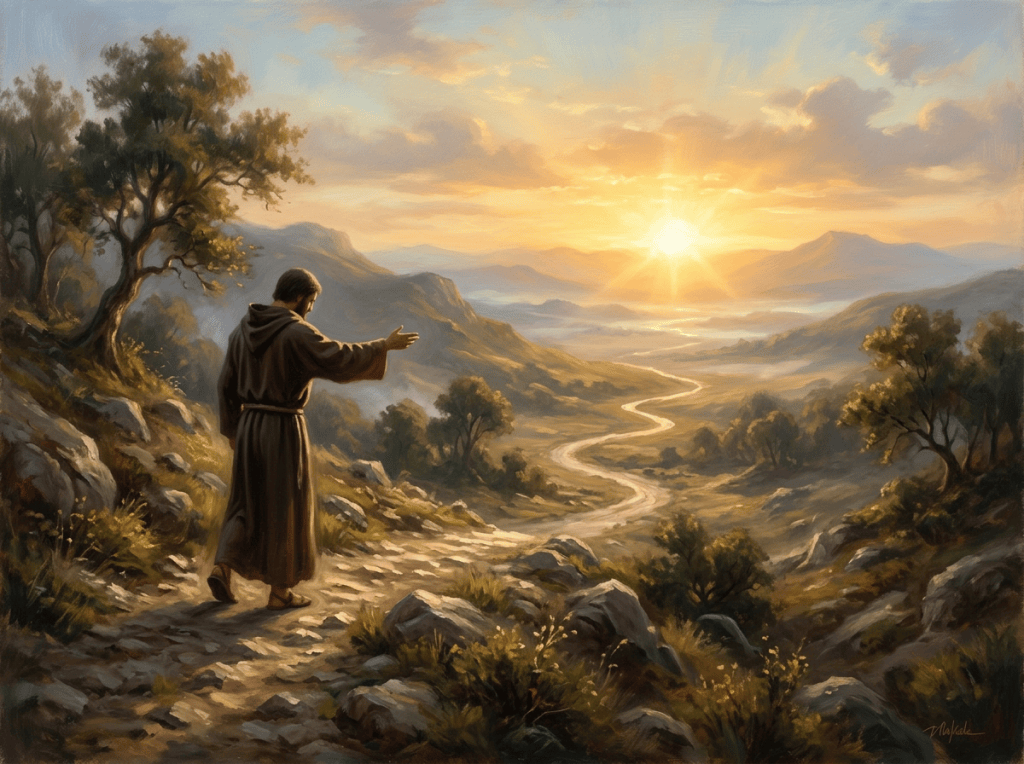
He was to be the herald. The voice crying out in the wilderness. The one who would prepare the way for the King. And John understood his assignment.
In John 1:31, he explains why he’d come baptizing with water.
John 1:29–34 (29)The next day he saw Jesus coming toward him, and said, “Behold, the Lamb of God, who takes away the sin of the world! (30)This is he of whom I said, ‘After me comes a man who ranks before me, because he was before me.’ (31)I myself did not know him, but for this purpose I came baptizing with water, that he might be revealed to Israel.” (32)And John bore witness: “I saw the Spirit descend from heaven like a dove, and it remained on him. (33)I myself did not know him, but he who sent me to baptize with water said to me, ‘He on whom you see the Spirit descend and remain, this is he who baptizes with the Holy Spirit.’ (34)And I have seen and have borne witness that this is the Son of God.”(ESV)
He’d come so that Jesus might be revealed to Israel.
Consider the weight of that statement. John’s ministry wasn’t ultimately about gathering followers, establishing a religious movement, or creating something that would endure under his name.
Everything he was doing pointed toward someone else. He preached repentance. He baptized. He prepared hearts. He called people to make ready the way of the Lord.
Then, one day, the One he’d spent his life preparing for stood before him in the Jordan River.
John baptized Jesus. The Spirit descended. The Father testified concerning His Son. The Messiah had been revealed. The defining moment of John’s calling had arrived. But John was still alive.
When the Assignment Changes
We sometimes read John’s story as though everything ended when Jesus appeared. The herald had announced the King. His purpose was fulfilled. His work was finished. But Scripture tells a more complicated story.
John continued baptizing after Jesus began His public ministry. He continued teaching. He continued calling people to repentance. Eventually, his confrontation with Herod’s unlawful marriage would lead to his imprisonment. The man whose calling had been to prepare the way for the Messiah still had work to do after the Messiah arrived.
That doesn’t diminish the significance of what happened at Jesus’ baptism. It reveals something about the nature of purpose.
The fulfillment of a defining assignment doesn’t necessarily mean the end of every responsibility connected to it.
John’s central mission had reached its decisive fulfillment. The Messiah had been identified. The King had arrived. But John’s responsibility to remain faithful continued.
His ministry didn’t become meaningless simply because its central objective had been accomplished. It changed. And John recognized that change.
When his disciples became concerned that people were leaving to follow Jesus, John didn’t fight to preserve his former prominence. He rejoiced. He understood that his diminishing influence wasn’t evidence that his ministry had failed.
It was evidence that the One he’d been preparing people to receive had finally come.
There’s a remarkable freedom in that understanding. John didn’t need to remain the center of attention to know that his life had mattered. He didn’t need to invent a new reason to preserve the position he had occupied. He could release the prominence of his former assignment without releasing his commitment to God. His calling had brought him to a moment of fulfillment. His faithfulness would carry him beyond it.
Five Loaves, Two Fish, and a Life We Know Nothing About
Now consider a very different person. A boy. We don’t know his name. We don’t know his parents, where he grew up, or what became of him. We know only that on one particular day, he was present among a great crowd gathered around Jesus. And he’d brought something with him. Five barley loaves and two fish.
John 6:5–13 (5)Lifting up his eyes, then, and seeing that a large crowd was coming toward him, Jesus said to Philip, “Where are we to buy bread, so that these people may eat?” (6)He said this to test him, for he himself knew what he would do. (7)Philip answered him, “Two hundred denarii worth of bread would not be enough for each of them to get a little.” (8)One of his disciples, Andrew, Simon Peter’s brother, said to him, (9)“There is a boy here who has five barley loaves and two fish, but what are they for so many?” (10)Jesus said, “Have the people sit down.” Now there was much grass in the place. So the men sat down, about five thousand in number. (11)Jesus then took the loaves, and when he had given thanks, he distributed them to those who were seated. So also the fish, as much as they wanted. (12)And when they had eaten their fill, he told his disciples, “Gather up the leftover fragments, that nothing may be lost.” (13)So they gathered them up and filled twelve baskets with fragments from the five barley loaves left by those who had eaten.(ESV)
Andrew noticed the boy’s food and brought it to Jesus’ attention. What happened next became one of the most recognizable miracles recorded in Scripture.
Thousands were fed. The crowd witnessed an extraordinary demonstration of God’s provision. And the boy disappeared from the biblical narrative.
We aren’t told whether he became a disciple. We aren’t told whether he married, raised children, worked the land, or lived another fifty years. We aren’t even told whether he fully understood what had happened that day. But his small contribution became part of a story that would be told for generations.
Was that the primary purpose for which God created him? Scripture doesn’t tell us. We shouldn’t claim to know what God hasn’t revealed. But consider what we can say.
The moment for which Scripture remembers him may have occupied only a few minutes of his entire life.
Everything that came before prepared him, in ways we can’t trace, to be present at that particular moment. Everything that came afterward remains unknown to us. Yet those five loaves and two fish became part of something far greater than the boy could’ve accomplished on his own.
We often assume that the most important work of our lives must also be the work that consumes most of our lives. But why?
Why must the thing God uses most significantly also be the thing that takes the longest?
Why couldn’t decades of ordinary faithfulness prepare someone for a single extraordinary moment?
And why couldn’t that person continue living faithfully for decades afterward?
The significance of an assignment isn’t necessarily measured by its duration. Sometimes a moment carries consequences far beyond the time it takes to accomplish it.
The Years Before the Moment
There’s something else we often misunderstand about purpose. We tend to think preparation begins when we recognize what we’re being prepared for. But Scripture repeatedly demonstrates otherwise.
Moses spent decades in Egypt and decades more tending sheep before returning to confront Pharaoh. David was anointed king long before he sat upon the throne. Joseph endured betrayal, slavery, imprisonment, and years of uncertainty before he stood in a position to preserve lives during famine.
Each man’s life contained experiences that would become significant in work he couldn’t yet fully understand. And none of them could’ve seen the complete picture while living through those experiences.
Preparation doesn’t always announce itself. Sometimes it looks like ordinary responsibility. Sometimes it looks like waiting. Sometimes it looks like disappointment, interruption, or a season that seems to have little connection to anything meaningful.
We must be careful not to assume that every hardship was deliberately arranged as preparation for a specific future assignment. Scripture doesn’t give us permission to explain every painful experience that way. But it does show that God can work through circumstances we don’t understand, developing abilities, relationships, wisdom, and endurance that may later become important.
The person being prepared may not even recognize the preparation. The boy with the loaves and fish probably didn’t wake that morning believing he was about to participate in one of the most widely remembered miracles in human history. He simply had something available when the moment arrived. And that was enough for Jesus to work with.
Recognizing When the Work Is Finished
Discovering a calling can be difficult. Recognizing its completion may be even harder.
We become attached to the things we’ve spent years building. Our responsibilities become part of our identity. Our work becomes part of how we understand ourselves. We measure our usefulness by the things we accomplish and the people who depend upon us. And when those responsibilities begin to change, we can mistake the transition for failure.
Sometimes we keep trying to preserve a season God is bringing to a close. Read that again.
Sometimes we cling to a position because we don’t know who we are without it. Read that again.
Sometimes we continue doing what was once right simply because we haven’t considered that faithfulness might now require something different. Read that again.
But we must exercise discernment.
Not every difficult season means an assignment is finished. Not every closed door is a divine instruction to stop. Not every loss of influence means God is calling us elsewhere.
John had unusually clear knowledge of his calling. Most of us don’t receive an angelic announcement explaining the work God intends for our lives. We have to examine Scripture, pray, seek wise counsel, consider our responsibilities, and honestly evaluate the circumstances before us. We must also recognize that a completed assignment and an abandoned assignment can look remarkably similar from the outside.
The difference matters because there’s no virtue in quitting something God has entrusted to us merely because the work has become difficult. But there’s also no virtue in clinging to something merely because we once believed it would define our lives.
Faithfulness isn’t measured by how long we hold on. It’s measured by whether we’re obedient in holding on or letting go.
John understood that his prominence was supposed to diminish. His disciples struggled with that reality. He didn’t. He knew the difference between completing his assignment and losing his purpose.
What Comes After?
Imagine spending your entire life preparing for something. You sacrifice for it. You organize your days around it. You endure difficulty because you believe the work matters. Then the moment comes. The work is accomplished. The thing you were preparing for has happened. And tomorrow morning, you wake up.
What now?
This is a question that reaches far beyond ministry. A parent spends decades raising children who eventually leave home. A teacher prepares students who eventually surpass them. A worker completes a career and enters retirement. A person spends years pursuing a goal, only to discover that achieving it doesn’t answer every question about what comes next.
Even when the accomplishment is good, the transition can be unsettling. We can become so accustomed to defining ourselves by what we’re doing that we struggle to understand ourselves when the work changes. But our value was never supposed to depend upon a particular assignment.
God didn’t begin loving John when John started preaching in the wilderness. And John’s worth didn’t diminish when people began following Jesus instead.
His calling was significant. His obedience mattered. But his identity wasn’t confined to the work he had been given.
The same is true of us. God may entrust us with a defining assignment. He may give us several. He may use us in ways we never recognize during our lifetime.
Some assignments may last decades. Others may last only moments. And some may be accomplished so quietly that we never realize how significant they were. But the completion of a particular work doesn’t mean we’ve exhausted every reason God might continue working through us.
Being finished with an assignment isn’t the same as being finished with God.
Nor does it mean God is finished with us.
The Herald’s Final Lesson
John the Baptist understood something that many people spend their entire lives struggling to accept. He wasn’t the center of the story. He was part of it. An important part. A divinely appointed part. A part that Jesus Himself would honor. But still only a part.
John didn’t need to remain the herald after the King had been revealed in the same way he had been before. He didn’t need to preserve his following to validate the years he’d spent preparing them. He didn’t need his former prominence to prove that his life had mattered.
His joy was complete because the One he’d been waiting for had arrived. And yet, John continued serving.
His remaining days weren’t meaningless simply because the defining moment of his ministry had passed. He remained accountable to the God who had called him. He continued bearing witness to truth, even when doing so carried a terrible cost. His assignment had changed. His faithfulness hadn’t.
Perhaps that’s the lesson we most need to understand. We may spend years searching for our purpose, only to discover that God has been using us all along. We may spend decades preparing for a moment that passes in minutes. We may accomplish something extraordinary and then return to a life that appears entirely ordinary. And we may never know which moments mattered most in the story God was writing through us.
That’s not a reason to stop searching for His direction. It’s a reason to stop believing that our worth depends upon identifying one extraordinary thing we were created to accomplish.
We belong to God before the assignment begins. We belong to Him while the work is being done. And we belong to Him after the work is finished.
The herald’s purpose was never to remain the herald forever. It was to prepare the way for the King. And when the King arrived, John rejoiced.
What if the greatest act of faithfulness in your life isn’t discovering what God has called you to do, but recognizing when He’s accomplished it through you?
And if that day comes, will you have the faith to ask what He would have you do next, without demanding that tomorrow look like yesterday?
The work may be finished. The calling may have changed. But the One who called you remains the same.




Leave a Reply