(Part 6 of 9)
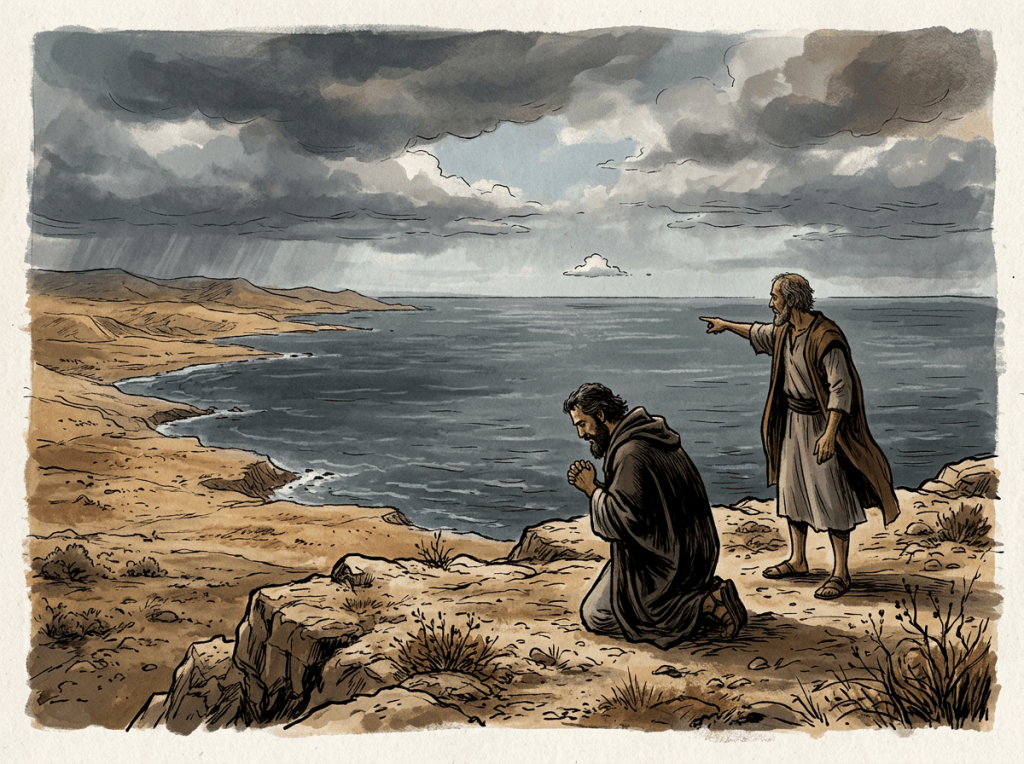
1 Kings 18:43 And he said to his servant, “Go up now, look toward the sea.” And he went up and looked and said, “There is nothing.” And he said, “Go again,” seven times.(ESV)
We remember Elijah standing on Mount Carmel. We remember the prophets of Baal crying out to a god who never answered. We remember Elijah rebuilding the altar, soaking the sacrifice with water, and calling upon the Lord. And we remember the fire.
The fire that consumed the sacrifice, the wood, the stones, and even the water in the trench. It was an extraordinary demonstration of God’s power. But that wasn’t the end of the chapter.
There’d been a drought. A devastating drought that had lasted for years. And after the confrontation on Mount Carmel, Elijah announced that rain was coming.
Then he went to the top of the mountain to pray. But he wasn’t alone.
There was someone else with him. Someone whose name Scripture never tells us.
The Man Who Went to Look
Elijah bowed himself down on the earth, putting his face between his knees. Then he instructed his servant to go up and look toward the sea.
The servant went. He looked. He returned. And he reported that there was nothing.
Elijah told him to go again. And again. And again. Seven times.
We know what happened on the seventh trip. A small cloud appeared, and before long the sky grew dark with clouds and wind. Heavy rain followed.
That’s the part we remember. But there’s another person in this account whose actions deserve attention.
While Elijah prayed, his servant repeatedly went to look. He didn’t call down fire. He didn’t confront the prophets of Baal. He didn’t announce the coming rain. He simply did what Elijah asked him to do. And he kept doing it.
Nothing to Report
Imagine how differently we would tell this story if the servant had been the central character. He receives an instruction. He follows it. He returns with an accurate report. Nothing.
Then he’s sent again. Nothing. Again. Nothing.
Scripture doesn’t tell us whether he became frustrated or discouraged. It doesn’t tell us whether he understood why Elijah kept sending him.
We shouldn’t manufacture those details. But we can recognize something important about what he did.
He continued carrying out his assignment even when he had nothing new to report.
He didn’t invent a cloud because Elijah expected rain. He didn’t exaggerate what he saw. He didn’t tell Elijah what he thought Elijah wanted to hear. He reported what was actually there. Nothing.
That’s a form of faithfulness we don’t often celebrate. We tend to admire people who return with exciting news. People who announce breakthroughs. People who can point to measurable results. But what about the person whose responsibility is simply to observe carefully and report truthfully? What happens when the honest answer is that nothing has changed?
The Value of an Honest Report
Elijah had announced that rain was coming. He was praying for it. But his servant wasn’t responsible for making the rain appear.
He was responsible for looking toward the sea and reporting what he saw. Those are different responsibilities. And confusing them can create serious problems.
When people are expected to produce a particular result, they can feel pressure to report progress that doesn’t exist. When leaders become convinced that something is about to happen, those working under them may become reluctant to deliver disappointing information.
Sometimes we want the answer to be positive so badly that we stop listening to the people who are telling us what’s actually happening. But Elijah’s servant didn’t report rain before there was evidence of rain.
He said there was nothing. And Elijah sent him again.
The servant’s report wasn’t treated as a personal failure. It was information. Accurate information. That distinction matters.
A faithful report isn’t necessarily an encouraging report. Sometimes faithfulness requires telling the truth when the truth is that nothing has changed.
Different Work, Same Moment
There’s another detail worth examining. Elijah and his servant were participating in the same event, but they had different assignments.
Elijah prayed. The servant watched.
Elijah had announced the coming rain. The servant observed the horizon.
Neither man’s actions should be confused with the source of the rain. God was the one who would bring it. But their roles were different.
We sometimes make the mistake of assuming that the person doing the most visible spiritual work is the only person whose contribution matters. We celebrate the preacher and overlook the people preparing the building. We recognize the leader and forget the people carrying out the instructions. We praise the person standing before the crowd and ignore the people whose ordinary responsibilities make the gathering possible.
That doesn’t mean every supporting role is equally important in every circumstance. It means importance isn’t always measured by visibility.
The servant wasn’t the central figure in the account. But Scripture still records his participation.
Seven trips. Seven reports. And finally, the observation that a small cloud had appeared.
The Seventh Trip
On the seventh trip, the servant saw something different. A little cloud rising from the sea, about the size of a man’s hand.
That’s what he reported. Not a storm. Not a downpour. Not an enormous cloud covering the horizon. A little cloud. And that was enough for Elijah to send word to Ahab to prepare his chariot and leave before the rain stopped him.
The servant’s job hadn’t changed. He was still observing and reporting.
The circumstances had changed. And because he was paying attention, he recognized the difference.
There’s an important lesson here.
Faithfulness doesn’t mean repeating the same answer regardless of what happens. It means remaining attentive enough to recognize when the answer changes.
For six trips, the report was nothing. On the seventh, there was a cloud.
The servant didn’t need to exaggerate either report. He simply needed to tell the truth.
The People Behind the Moment
We don’t know this servant’s name. We don’t know much about his life. We don’t know what happened to him afterward. But for a few verses, Scripture allows us to see someone participating in an extraordinary event without being the person everyone remembers. And that should challenge the way we think about significance.
Not everyone is called to stand before a crowd. Not everyone is responsible for making the announcement. Not everyone is the person whose name will be remembered when the story is told.
Sometimes our responsibility is to carry out an ordinary assignment faithfully. Sometimes it’s to observe carefully. Sometimes it’s to provide accurate information. Sometimes it’s to keep doing the work that needs to be done even when there’s nothing exciting to report. And sometimes our contribution will be forgotten by nearly everyone who benefits from it. That doesn’t make the work worthless.
What Are We Responsible For?
It’s tempting to measure our contribution by the outcome. Did the project succeed? Did the ministry grow? Did the plan work? Did the people respond? Did something extraordinary happen?
Those questions have their place. But they aren’t the only questions that matter.
We should also ask whether we fulfilled the responsibility entrusted to us. Were we attentive? Were we honest? Did we do the work carefully? Did we communicate what we actually knew rather than what someone wanted to hear? Did we continue carrying out our responsibilities when the work became repetitive or unremarkable? And when circumstances changed, were we paying enough attention to recognize it?
Elijah’s servant couldn’t make the rain come. He couldn’t control the clouds. He couldn’t determine when the drought would end. But he could look toward the sea. And he could report what he saw.
The Man We Almost Forgot
We remember the fire on Mount Carmel. We remember Elijah’s prayer. We remember the rain that finally ended the drought. But between the prayer and the storm, there was a servant carrying out an ordinary assignment.
He looked. He returned. He reported. And he went again. His name never became famous. His work wasn’t dramatic. But it was part of the story Scripture chose to preserve. We shouldn’t have to stand at the center of an extraordinary event before we recognize the value of faithfully doing what’s been entrusted to us.
Sometimes the most important thing we can do is fulfill our responsibility without pretending we’re responsible for the outcome.
Elijah prayed for rain. God sent the rain. And somewhere in the middle, an unnamed servant faithfully watched the horizon.
Not everyone is called to announce the storm. Sometimes our responsibility is simply to tell the truth about what we see.





Leave a Reply