(Part 3 of 9)
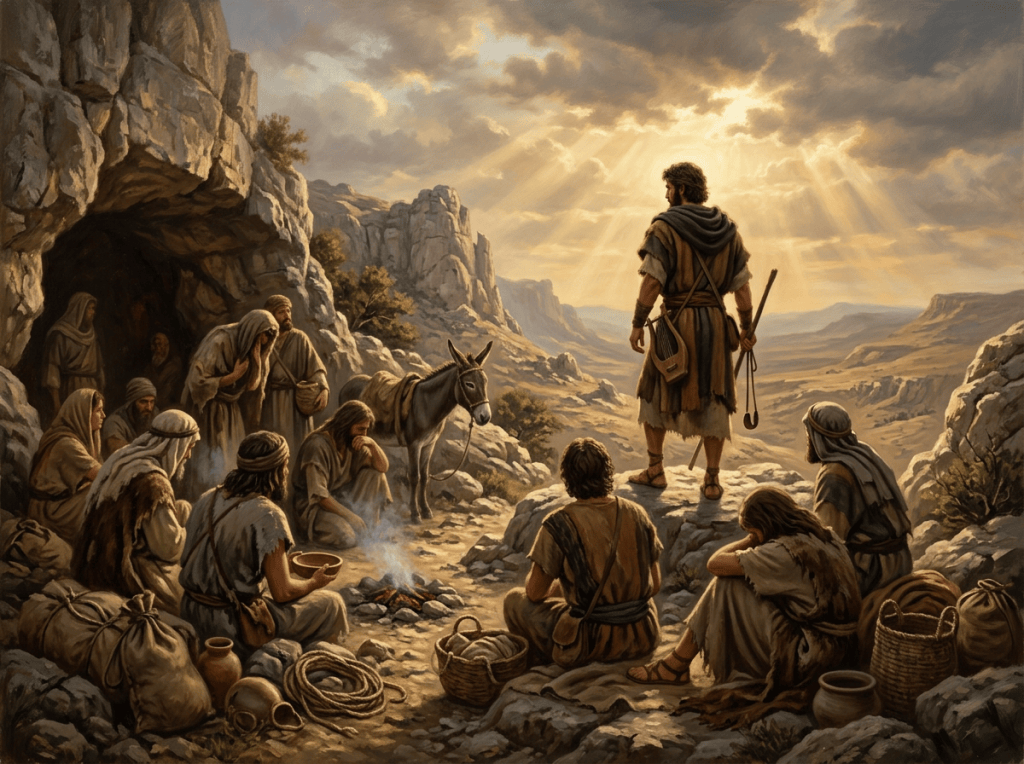
1 Samuel 22:2 And everyone who was in distress, and everyone who was in debt, and everyone who was bitter in soul, gathered to him. And he became commander over them. And there were with him about four hundred men.(ESV)
We remember David as the shepherd who defeated Goliath. We remember the king who united Israel. We remember his victories, his failures, and the promises God made concerning his throne. But between the shepherd and the king, there was a fugitive.
David was running from Saul. He’d been anointed by Samuel, served in Saul’s household, fought Israel’s enemies, and earned the admiration of the people.
Now the king wanted him dead. So David fled. And eventually, he found himself hiding in a cave.
We often tend to focus on what that experience meant for David. The fear, the uncertainty, the injustice of being hunted by the very king he’d faithfully served. But David wasn’t alone for long.
Other people began showing up. And the Bible tells us something interesting about the men who came to him.
The People Nobody Wanted
First Samuel tells us that everyone who was in distress, everyone who was in debt, and everyone who was bitter in soul gathered to David. About four hundred men.
Think about that for a moment. David was already struggling to survive. He’d lost his position in Saul’s household. He was separated from the life he’d known. He had no throne, no palace, and no secure future. And the people gathering around him weren’t exactly the powerful and prosperous members of society.
They were struggling. Some were burdened by debt. Some were distressed. Some were deeply discontented.
Scripture doesn’t tell us every circumstance that brought these men to David. We shouldn’t assume they were all innocent victims or that they shared the same motivations. But we do know they were people living under significant pressure. And they came to a man who was under pressure himself.
Then Scripture tells us something remarkable. David became their commander.
Leadership Without a Throne
David had already demonstrated courage and military ability. But leading soldiers into battle isn’t quite the same thing as becoming responsible for a gathering of distressed and discontented people.
These men brought their problems with them. Their debts didn’t disappear when they entered the cave. Their frustrations didn’t magically resolve because David was their leader. Their fears, personalities, ambitions, and disagreements didn’t vanish.
And David was still being hunted by Saul.
We sometimes imagine leadership beginning when someone receives a position of authority. But David was exercising leadership long before he occupied the throne.
He didn’t have a crown. He didn’t have a palace. He didn’t have the security of an established kingdom.
What he had was a group of men who had chosen to follow him. And that meant his decisions no longer affected only himself.
When Other People Pay for Your Decisions
Consider what happened when Saul entered the cave where David and his men were hiding.
David’s followers saw an opportunity. Saul was vulnerable.
The man hunting David had walked into a place where David could kill him. The men urged David to act.
From their perspective, this may have looked like the perfect opportunity to end their suffering. If Saul died, perhaps David could take the throne. Perhaps they could stop running. Perhaps the danger would finally be over.
David refused. He wouldn’t kill Saul.
We usually teach this moment as a lesson about David respecting the Lord’s anointed. And that’s certainly part of it. But consider the men standing around him.
David’s decision didn’t affect only David. It affected everyone following him.
By refusing to kill Saul, David was choosing not to take what might have appeared to be the quickest path out of their circumstances. His men would continue living with the consequences of that decision.
Leadership sometimes means refusing to do what the people following you desperately want you to do. Even when their reasons are understandable. Even when the opportunity appears favorable. Even when refusing means the hardship continues.
David had to lead men who might not always agree with him. And he had to do it without allowing their frustration to determine his convictions.
The Danger of a Desperate Crowd
There’s another side to this story.
People who are hurting can become dangerous when their suffering begins directing their decisions. That doesn’t mean suffering makes someone wicked. It means desperation can make an otherwise unacceptable choice appear reasonable.
David’s men were tired of running. They had reasons to want Saul gone. But their desire for relief didn’t make killing Saul the right decision.
David had to recognize that distinction. And he had to persuade his men to accept it.
1 Samuel 24 tells us that David restrained his men and didn’t permit them to attack Saul.
That’s an important detail.
David didn’t simply decide that he personally wouldn’t kill Saul. He prevented the men following him from doing it.
His responsibility extended beyond his own conduct. He had to exercise authority over the people under his command.
A leader who refuses to do wrong but allows those following him to do wrong on his behalf hasn’t demonstrated the same integrity. David’s restraint mattered because it shaped what his men were permitted to do.
The Men Were Becoming Something Too
We often describe David’s years as a fugitive as preparation for his eventual kingship. But David wasn’t the only person being shaped by those experiences.
The men following him were living through them too. They were learning how David made decisions. They were seeing how he responded to danger. They were discovering what he would and wouldn’t permit. They were learning whether their leader would abandon his convictions when circumstances became difficult. And they were participating in the consequences of those decisions. Later, David would have experienced warriors and loyal supporters around him. But here, in the middle of the story, we see a group of struggling men gathering around a struggling leader.
We should be careful not to claim that every man in the cave eventually became one of David’s mighty men. Scripture doesn’t establish that.
What it does establish is that David’s leadership was developing among real people, with real problems, long before he became king. The cave wasn’t simply a place where David waited. It was a place where other people’s lives became connected to his decisions.
Who Is Following You?
Most of us will never lead an army. We won’t command hundreds of men or make decisions that determine the future of a kingdom. But leadership isn’t limited to kings, commanders, pastors, or executives.
Parents lead their children. Teachers influence their students. Employers affect their workers. Friends influence one another. And sometimes people begin looking to us for direction without ever formally asking us to lead them.
That’s where David’s story becomes uncomfortable. It’s easy to think about what we would do if we were in David’s position.
Would we kill Saul?
Would we wait?
Would we trust God?
But perhaps we should also ask what happens to the people who are affected by our decisions.
Are we teaching them to act out of fear?
Are we encouraging them to take shortcuts?
Are we allowing their frustrations to justify behavior we know is wrong?
Are we willing to disappoint them when doing what’s right requires it?
And when the people around us are hurting, do we recognize that their suffering deserves attention even while we’re dealing with our own?
David had problems enough for one man. Then four hundred more men arrived with problems of their own. And David became their commander.
The Middle of Leadership
We remember the crown. We remember the throne. We remember the mighty men and the victories they eventually won. But before all of that, there was a cave filled with distressed, indebted, and discontented people. And a fugitive who became their leader.
David’s story reminds us that leadership isn’t merely about reaching a position of authority. It’s about what we do with the responsibility we already have. It’s about the decisions we make when other people are depending on us. It’s about whether we will maintain our convictions when those following us would prefer an easier answer. And it’s about recognizing that our choices can shape the lives of people whose stories are unfolding alongside our own.
David wasn’t the only man whose story was being written in that cave.
There were hundreds of others. And while we remember the king David eventually became, we shouldn’t overlook the people he was already responsible for leading.
Sometimes the middle of our story is where we discover that it was never only our story to begin with.





Leave a Reply