(Part 6 of 16)
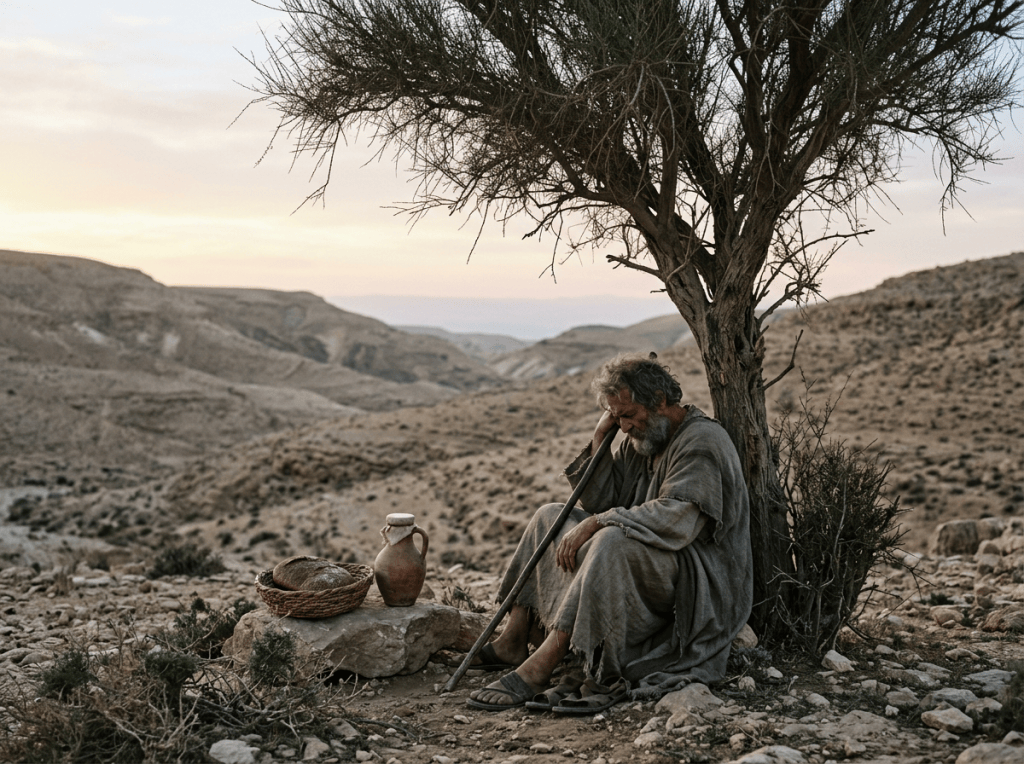
1 Kings 19:4–8 (4)But he himself went a day’s journey into the wilderness and came and sat down under a broom tree. And he asked that he might die, saying, “It is enough; now, O Lord, take away my life, for I am no better than my fathers.” (5)And he lay down and slept under a broom tree. And behold, an angel touched him and said to him, “Arise and eat.” (6)And he looked, and behold, there was at his head a cake baked on hot stones and a jar of water. And he ate and drank and lay down again. (7)And the angel of the Lord came again a second time and touched him and said, “Arise and eat, for the journey is too great for you.” (8)And he arose and ate and drank, and went in the strength of that food forty days and forty nights to Horeb, the mount of God.(ESV)
The fire fell. The people saw it. The prophets of Baal were defeated. The drought that had gripped the land was finally coming to an end. Everything Elijah had been standing for seemed to have reached its defining moment.
On Mount Carmel, the distinction between the living God and the false gods of Israel had been made unmistakably clear. Elijah had stood before the people and challenged them to stop wavering between two opinions.
If the Lord was God, they were to follow Him. If Baal was god, they were to follow him.
The prophets of Baal had called upon their god from morning until evening. Nothing happened.
Then Elijah prayed. And the fire of the Lord fell.
The people fell on their faces and declared that the Lord was God.
What a victory. What a moment. What an extraordinary demonstration of God’s power. And then Elijah ran for his life.
When the Victory Doesn’t Change Everything
It’s tempting to read the account of Mount Carmel as the moment everything should’ve changed. The people had witnessed something extraordinary. The false prophets had been exposed. The Lord had answered by fire.
Surely the nation would now turn back to God. Surely the opposition would end. Surely Elijah could finally rest. But that’s not what happened.
Ahab told Jezebel what Elijah had done. Jezebel sent a message threatening Elijah’s life. And Elijah fled.
The prophet who’d stood before the entire nation now traveled into the wilderness. He sat beneath a broom tree. And he asked God to take his life.
It’s a startling transition.
One chapter ends with fire from heaven. The next finds Elijah exhausted, afraid, and overwhelmed.
We could read that contrast and conclude that Elijah’s faith had failed. But that would be a shallow reading of the account.
Elijah had been carrying an extraordinary burden. He’d confronted a king. He’d lived through a prolonged drought. He’d stood against widespread idolatry. He’d witnessed God’s power in a way few people ever would. And after all of that, the threat against his life remained.
The victory was real. So was the exhaustion that followed it.
Those two things can exist at the same time.
The Weight of Carrying On
There’s a kind of exhaustion that doesn’t come from doing something wrong. It comes from doing something difficult for a very long time. It comes from responsibility. It comes from sustained effort. It comes from standing firm when giving up would be easier. It comes from carrying burdens that don’t disappear simply because one particular challenge has been overcome.
Sometimes we imagine that faithful service should leave us perpetually energized. We expect spiritual victories to produce spiritual enthusiasm. We expect answered prayers to eliminate discouragement. We expect people who’ve witnessed God’s faithfulness to remain confident in every circumstance. But human beings don’t work that way.
Our bodies have limits. Our minds have limits. Our emotional endurance has limits. And recognizing those limits isn’t necessarily evidence of spiritual failure.
Elijah was a prophet. He was also a man.
James 5:17 reminds us that Elijah was a man with a nature like ours. That matters.
The same man who prayed and saw the drought end also reached a point where he could barely continue. His humanity didn’t disappear because God had worked through him. And God’s power wasn’t diminished by Elijah’s exhaustion.
Being used by God doesn’t make a person immune to the cost of being human.
The God Who Let Him Sleep
One of the most remarkable details in this account is what God did first.
Elijah lay down beneath the broom tree and slept. An angel touched him and told him to arise and eat. There was bread and water. Elijah ate, drank, and lay down again. Then the angel came a second time. Again, Elijah was told to eat. He needed strength for the journey ahead.
Think about what God didn’t do in that moment. He didn’t immediately rebuke Elijah for being tired. He didn’t demand that Elijah explain why he’d fled. He didn’t begin with a lecture about the victory on Mount Carmel. He didn’t tell Elijah that a man of faith should be stronger than this.
He provided food. He allowed rest. And He provided more food.
That doesn’t mean Elijah’s understanding of his circumstances was entirely correct. Later in the chapter, God would challenge Elijah’s perspective. But the order matters.
God attended to Elijah’s immediate physical needs before the conversation continued. There’s a lesson here that the church sometimes struggles to remember.
Not every problem is solved by telling someone to pray harder. Not every season of exhaustion is evidence that someone’s neglected their spiritual life.
Sometimes the faithful servant needs sleep. Sometimes the exhausted parent needs help. Sometimes the person carrying an overwhelming responsibility needs relief. Sometimes the person who’s spent years caring for everyone else needs someone to care for them.
Prayer matters. Faith matters. Obedience matters. But so do the bodies God gave us.
Rest isn’t the opposite of faithfulness. Sometimes rest is what makes continued faithfulness possible.
The Danger of Measuring Everything by the Moment
Mount Carmel was extraordinary. But extraordinary moments can distort our expectations.
When God acts in a dramatic way, we may begin to expect that every problem should now be resolved. We may believe the breakthrough should produce immediate and lasting change. We may assume that everyone who witnessed what happened will respond appropriately. But people don’t always respond to truth the way we expect.
The people of Israel had seen fire fall from heaven. Jezebel remained hostile. The victory on Carmel had demonstrated God’s power. It hadn’t eliminated every opponent. And Elijah still had a life to live. That can be deeply discouraging. Especially when we’ve invested so much in reaching a particular moment.
We tell ourselves that once the crisis is over, everything will be different. Once the project is finished, we’ll finally relax. Once the relationship is restored, the tension will disappear. Once the debt is paid, the pressure will end. Once the prayer is answered, the uncertainty will be gone.
Sometimes those expectations are fulfilled. Sometimes the answer solves one problem while leaving others untouched. And sometimes the emotional weight we’ve been carrying doesn’t disappear the moment the circumstances change.
Elijah’s experience reminds us that a dramatic victory doesn’t necessarily produce an immediate sense of peace.
The fire can fall, the prayer can be answered, and the person who prayed can still be exhausted.
The Whisper After the Fire
Eventually, Elijah traveled to Horeb, the mountain of God. There, the Lord asked him what he was doing. Elijah explained his circumstances. He’d been zealous for the Lord. Israel had forsaken the covenant. The altars had been torn down. The prophets had been killed. And Elijah believed he alone remained.
Then came a remarkable sequence. A great wind tore through the mountains. An earthquake followed. Then fire. But the Lord wasn’t in those manifestations.
After the fire came the sound of a low whisper. Elijah wrapped his face in his cloak and went to the entrance of the cave.
There’s a temptation to turn this passage into a formula. God always speaks quietly. God’s never in dramatic events. The whisper is more spiritual than the fire. But that would ignore what had just happened on Mount Carmel. God had answered Elijah by fire.
The point isn’t that God prefers one volume over another. The point is that Elijah needed to attend to what God was revealing in that moment. The extraordinary display on Carmel hadn’t been the end of God’s work. And the quieter encounter at Horeb wasn’t evidence that God had become less powerful.
God was still present when the spectacle was over.
That’s an important truth for anyone who has experienced a remarkable season of spiritual activity.
The conference ends. The revival service concludes. The mission trip is finished. The crisis passes. The extraordinary moment becomes a memory. And life grows quiet again.
God hasn’t disappeared. We may simply need to learn how to recognize His faithfulness when nothing dramatic is happening.
You Aren’t the Only One
Elijah’s understanding of his situation had become painfully narrow. He believed he was alone. He believed the people had abandoned the covenant. He believed his life was the last remaining obstacle to the complete destruction of faithful worship. But God corrected him.
There were seven thousand in Israel who hadn’t bowed to Baal. Elijah wasn’t alone. His work wasn’t the only work being done. And God’s purposes weren’t dependent upon Elijah carrying everything himself.
That’s an important correction. Especially for people who’ve spent years bearing responsibilities that seem to rest entirely on their shoulders.
Sometimes the burden becomes so familiar that we begin to believe no one else can carry it. We may be the only person who knows how to accomplish a particular task. We may be the only one willing to confront a particular problem. We may be the person everyone depends upon when something goes wrong. And over time, responsibility can begin to feel like indispensability. But those aren’t the same thing.
Elijah was important. His ministry mattered. His obedience mattered. But God hadn’t entrusted the entire future of Israel to Elijah alone.
There were others. There would be successors. God’s work would continue.
You can be faithful without being indispensable.
That doesn’t diminish the value of your service. It places your service in the proper perspective. God’s purposes are greater than any one servant. And sometimes recognizing that truth is what allows us to finally put down a burden we were never meant to carry alone.
The Assignment After the Exhaustion
God didn’t leave Elijah beneath the broom tree. He didn’t abandon him in the wilderness. He didn’t end his ministry because he’d reached a point of exhaustion.
He fed him. He strengthened him. He corrected his understanding. And He gave him further instructions.
Elijah was to return and carry out additional work. Among those instructions was the appointment of Elisha as his successor. That’s significant.
Elijah’s story wasn’t over. But the next part of his story wouldn’t look exactly like the previous part. He would continue serving. He would also prepare someone else to carry the work forward.
The man who believed he was alone would soon have another man walking beside him. The prophet who’d carried so much would become part of preparing the next generation. And the work of God would continue beyond his own ministry. There’s something deeply reassuring about that.
God didn’t need Elijah to remain permanently at the height of Mount Carmel. He didn’t require him to reproduce the fire again and again. He didn’t demand that every day of Elijah’s life be extraordinary. He gave him the strength and direction needed for what came next.
After the Fire Falls
Elijah’s story reminds us that the aftermath of a spiritual victory can be surprisingly difficult.
Not because the victory wasn’t real. Not because God had failed. Not because the servant had necessarily done something wrong. But because extraordinary moments don’t erase ordinary human limitations.
The fire fell. The rain returned. God demonstrated His power. And Elijah still needed to eat. He still needed to sleep. He still needed correction. He still needed to understand that he wasn’t alone. And he still needed direction for the road ahead.
Perhaps you’ve been carrying something for a very long time. Perhaps you’ve finally reached the moment you prayed for. Perhaps the crisis has passed, the work is finished, or the breakthrough has come. And instead of feeling triumphant, you feel empty.
Tired. Uncertain. Maybe even disappointed that everything doesn’t feel different.
Don’t mistake exhaustion for proof that the victory was meaningless. Don’t assume that needing rest means you lack faith. Don’t believe that God’s work depends upon your ability to continue without limits.
The God who answered Elijah by fire was the same God who provided bread beneath the broom tree. Both were expressions of His care. Both mattered. And neither should be overlooked.
Sometimes the most faithful thing you can do after standing on the mountain is eat, rest, and allow God to prepare you for whatever comes next.
The fire had fallen. The victory was real. And God wasn’t finished with Elijah.




Leave a Reply