(Part 9 of 12)
Ruth 4:17 And the women of the neighborhood gave him a name, saying, “A son has been born to Naomi.” They named him Obed. He was the father of Jesse, the father of David.(ESV)
There’s a baby in Bethlehem. People are celebrating. A family line continues. A woman who once believed her life had become empty is holding a child.
His name is Obed. It’s a beautiful ending to the book of Ruth.
Then the narrator tells us something the people standing in that room can’t possibly understand.
Obed will have a son. His name will be Jesse. Jesse will have a son. His name will be David. And suddenly we realize that the little family story we’ve been reading is connected to something much larger. But even David isn’t the end of it. Because centuries later, another baby will be born in Bethlehem. And Ruth’s name will still be part of the story.
Start With Bethlehem
When we think about Bethlehem, we usually think about Jesus. Mary. Joseph. A manger. Shepherds. Angels. The birth of Christ. But Bethlehem had a story before Christmas.
David came from Bethlehem. Before David, Jesse lived there. Before Jesse, there was Obed. Before Obed, there was Ruth. And Ruth wasn’t from Bethlehem. She wasn’t even an Israelite. She was from Moab.
So if we’re going to understand how Ruth becomes part of Bethlehem’s story, we have to leave Bethlehem first. We have to go backward.
There Was a Famine
The book of Ruth begins:
Ruth 1:1 In the days when the judges ruled there was a famine in the land, and a man of Bethlehem in Judah went to sojourn in the country of Moab, he and his wife and his two sons.(ESV)
A man named Elimelech leaves Bethlehem with his wife Naomi and their two sons. They go to Moab. Already there’s irony here. Bethlehem means house of bread. The house of bread has no bread. So the family leaves.
Then everything falls apart. Elimelech dies. Naomi’s sons marry Moabite women, Orpah and Ruth. Then both sons die.
Naomi is left without her husband and without her sons. This isn’t the beginning of a royal story. It looks like the end of a family.
Naomi Goes Home
Eventually Naomi hears that the LORD has visited His people and given them food. So she decides to return to Judah. Orpah and Ruth begin traveling with her. Naomi tells them to go back. Orpah eventually does. Ruth doesn’t.
Then Ruth says words that have become famous:
Ruth 1:16 But Ruth said, “Do not urge me to leave you or to return from following you. For where you go I will go, and where you lodge I will lodge. Your people shall be my people, and your God my God.(ESV)
We know how important that decision becomes. Ruth doesn’t.
She isn’t making a calculated move toward Bethlehem because she knows David will eventually come from her family. She isn’t trying to enter a genealogy. She’s choosing faithfulness. She’s choosing Naomi. She’s choosing Naomi’s people. She’s choosing Naomi’s God.
Then two widows arrive in Bethlehem. No husbands. No sons. No obvious future. The women of the town recognize Naomi. “Is this Naomi?”
Naomi answers:
Ruth 1:20 She said to them, “Do not call me Naomi; call me Mara, for the Almighty has dealt very bitterly with me.(ESV)
Then she says: “I went away full, and the LORD has brought me back empty.”
Empty. That’s how Naomi understands the story. And from where she’s standing, you can understand why.
But Ruth Is Standing Beside Her
There’s something almost painful about Naomi saying she has returned empty while Ruth’s standing there.
Naomi can’t yet see what Ruth’s presence will mean. That’s not criticism.
Grief doesn’t owe us prophetic clarity. Naomi’s buried her husband. She’s buried her sons. She’s allowed to feel empty. But as readers, we can see something she can’t.
She’s returned to Bethlehem believing there’s nothing left. Yet Ruth came with her. And the story is already moving.
Then Ruth Goes to Work
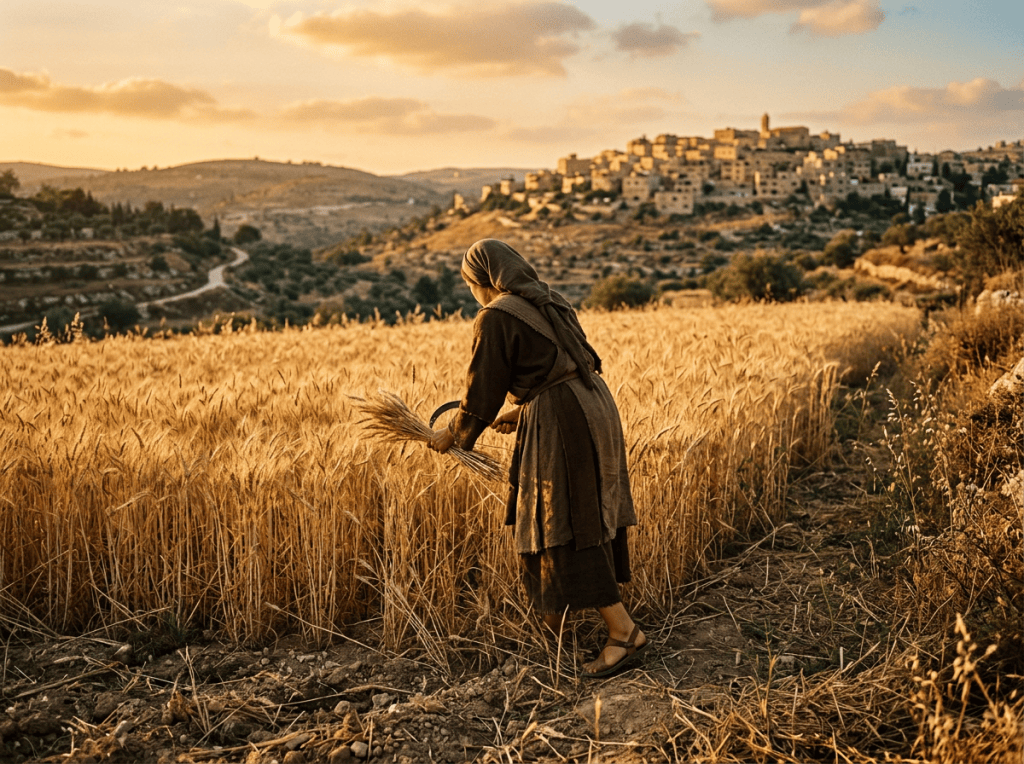
Ruth and Naomi need food. So Ruth goes into the fields to glean behind the harvesters. There’s nothing glamorous about this.
She’s poor. She’s a foreigner. She’s gathering what remains after others harvest.
Then the text gives us one of my favorite understated sentences in Scripture:
Ruth 2:3 So she set out and went and gleaned in the field after the reapers, and she happened to come to the part of the field belonging to Boaz, who was of the clan of Elimelech.(ESV)
She happened to.
From Ruth’s perspective, that’s probably exactly what it looked like. A field. She needed food. So she went to work. She didn’t wake up thinking: Today I’ll take another step toward the Davidic line.
She was gathering grain. That’s all she could see. Sometimes the moments that become enormous later feel completely ordinary while we’re living them.
Boaz Notices Ruth
Boaz arrives and asks about her. He’s already heard what Ruth did for Naomi. He knows she left her homeland. He knows she came to live among people she didn’t previously know. He tells her to remain in his fields. He tells the young men not to touch her. He makes sure she has water. He ensures she has food. He tells his workers to intentionally leave extra grain for her. Ruth came looking for enough food to survive. She found favor.
Then Naomi hears whose field Ruth has been working in. Boaz is one of their redeemers.
Now Naomi begins seeing possibilities Ruth couldn’t have understood when she walked into the field. The story grows.
A Family Is Restored
Eventually Boaz marries Ruth. They have a son. The women of Bethlehem celebrate with Naomi. And Naomi, who returned saying she was empty, holds Obed. That’s already enough for a beautiful story.
If Ruth ended there, it would still matter. A widow found a home. Naomi found hope after devastating loss. A family line continued. A child was born.
We have a tendency to make every small story valuable only because of the enormous thing it eventually produces. We shouldn’t do that here.
Ruth mattered before David. Naomi mattered before David. Obed mattered before David.
Their faithfulness wasn’t valuable only because a king eventually appeared. But then Scripture pulls the camera backward. Or maybe forward. And shows us that their little story belongs to something much larger.
Obed Had a Son
Obed becomes the father of Jesse. Jesse becomes the father of David.
Now we’re generations beyond Ruth’s walk into that field. Ruth never sees David. She never hears Israel sing songs about him. She never sees him crowned king. She never knows about Goliath. She never knows about the covenant God will make with David.
She simply lives her life. And yet David’s story has Ruth in it.
Then centuries pass. Kingdoms rise. Kingdoms fall. Israel divides. Judah goes into exile. Generations come and go. Then Matthew opens his Gospel with a genealogy.
Abraham. Isaac. Jacob. Judah. The names continue.
Then:
Matthew 1:5–6 (5)and Salmon the father of Boaz by Rahab, and Boaz the father of Obed by Ruth, and Obed the father of Jesse, (6)and Jesse the father of David the king.(ESV)
There she is. Ruth. The Moabite widow who followed Naomi home. The woman who went into a field because she needed food.
Her name survived the centuries. And Matthew keeps going. Generation after generation.
Until:
Matthew 1:16 and Jacob the father of Joseph the husband of Mary, of whom Jesus was born, who is called Christ.(ESV)
Back to Bethlehem.
Ruth Never Knew
I think that’s the part worth sitting with. Ruth never knew. She knew Naomi. She knew grief. She knew hunger. She knew what it meant to leave home. She knew what it meant to work in a field. She knew Boaz. She knew Obed. But she never knew David.
She certainly never stood in Bethlehem centuries later and watched shepherds running through the streets talking about angels. She didn’t know where her story was going. She couldn’t.
The consequences of her faithfulness extended beyond the boundaries of her lifetime. That’s different from everything we’ve explored so far.
David eventually saw Goliath fall. Joseph eventually saw the famine. Moses eventually stood before Pharaoh. Esther eventually saw the decree reversed. Peter eventually experienced restoration. Shadrach, Meshach, and Abednego eventually walked out of the furnace. Elijah eventually saw rain. Ruth died without seeing where her story ultimately went. And yet the story kept going.
We Like Stories We Get to Finish
We naturally want to see the result. If we’re faithful, we want to see what the faithfulness accomplished. If we sacrifice, we want to know why. If we teach our children, we want to see what they become. If we pour into someone, we want to see the fruit. If God asks us to take a difficult step, we’d like to eventually understand where it led.
Sometimes we do. Sometimes we don’t.
Some of the things God does through a life may not reach their visible conclusion within that life. That’s difficult for us because we tend to measure significance by what we can see.
Ruth could see Obed. She couldn’t see David. She couldn’t see Jesus. But her inability to see those generations didn’t make them disconnected from her story.
Before Bethlehem
The Christmas story begins: “In those days a decree went out from Caesar Augustus…”
Joseph goes to Bethlehem. Mary goes with him. Jesus is born. But that’s where that chapter begins.
The road to Bethlehem stretches much farther backward. Before Mary and Joseph arrived, David had called Bethlehem home. Before David, there was Jesse. Before Jesse, Obed. Before Obed, Ruth. Before Ruth met Boaz, she followed Naomi. Before she followed Naomi, she buried her husband. Before that, a famine drove an Israelite family into Moab.
Pull backward far enough and the clean lines disappear.
You find ordinary people making decisions without knowing what those decisions will eventually touch. A widow chooses loyalty. A woman goes home. A landowner shows kindness. A family continues. A child is born. Then another. Then another. Generation after generation. Until one night in Bethlehem, another child is born.
Nobody standing beside Ruth in that field could’ve seen that far. Ruth couldn’t either. She didn’t need to.
She only needed to be faithful in the part of the story she’d been given.
We spend so much time trying to understand what God’s doing with our lives. Maybe some of it isn’t ours to understand yet. Maybe some of it won’t be ours to see at all. Because sometimes the story God is writing through one generation doesn’t reveal its destination until another generation arrives.
Ruth went to Bethlehem looking for a place to live. She went into a field looking for something to eat. She built a family. She raised a son. And centuries after Ruth was gone, Bethlehem was still telling her story.
Long before there was a manger in Bethlehem, God was already weaving the road that led there.





Leave a Reply