
(Part 1 of 12)
Genesis 1:1 In the beginning, God created the heavens and the earth.(ESV)
Every story has a beginning. At least, we think it does.
Imagine walking into a kitchen just as a chef reaches over and turns on the stove. Click. Whoosh. The flame appears.
If someone were telling the story of the meal, that’s probably where they would begin. The chef turned on the stove…
It makes sense. Something is happening now. There’s movement. There’s heat. There’s something worth watching. But that isn’t where the meal began.
Before the stove was turned on, vegetables had already been washed and cut. Meat had been trimmed. Ingredients had been measured. Knives had been sharpened. Recipes had been studied. The kitchen had been prepared.
Keep going backward.
Someone bought those ingredients. Someone stocked them. Someone delivered them. Someone harvested them. Someone planted them.
There was rain that helped them grow. Maybe there was a drought that nearly destroyed them.
There were farmers, truck drivers, warehouse workers, grocery-store employees, and countless other people whose names will never appear on the menu.
Keep going.
The chef had to learn how to cook. There were meals that went wrong. There were lessons learned. There were burns, cuts, mistakes, successes, failures, and years of experience that eventually produced the person standing in that kitchen.
Maybe that chef almost wasn’t there that day. Maybe there’d been sickness. Maybe there’d been grief. Maybe quitting had crossed their mind a hundred times.
There’s an entire story behind that meal. But we walked into the kitchen when the fire started.
So that’s where we decided the story began.
We Do This With Scripture
We do the same thing when we read the Bible.
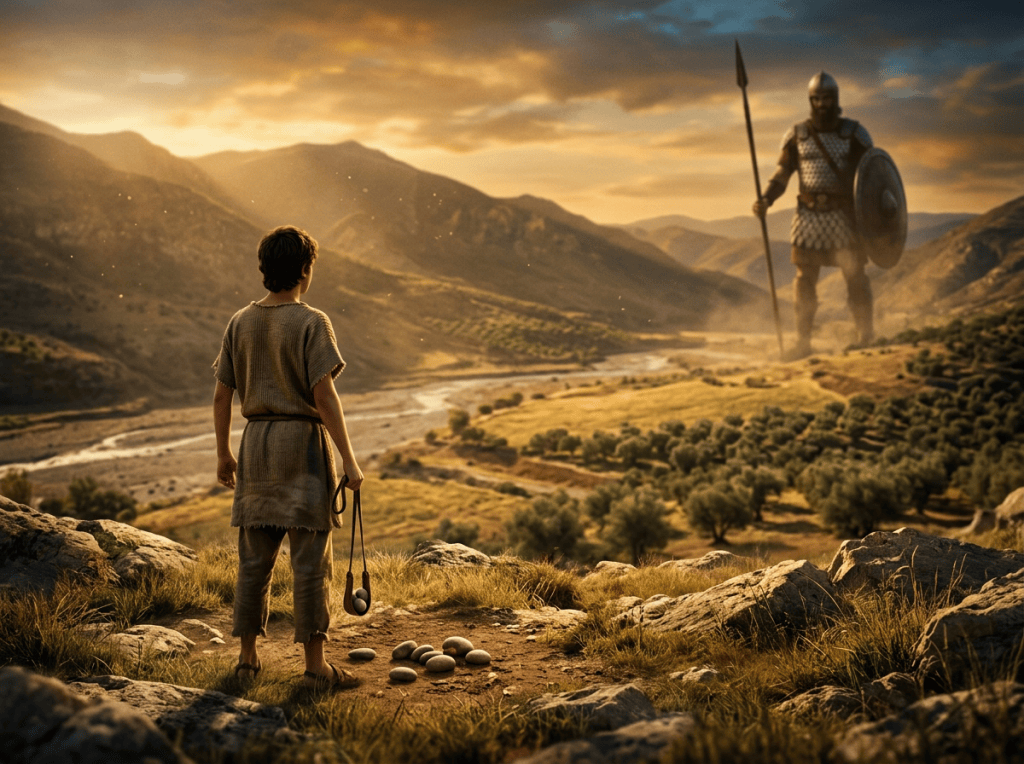
We begin David’s story with Goliath standing across the valley. We begin Moses’ story at the burning bush. We begin Esther’s story when Haman threatens her people. We begin Joseph’s story with the famine and his rise to power. We begin Peter’s failure beside a charcoal fire.
Those are memorable moments. They’re the fire on the stove. But God had already been working.
David didn’t learn courage while walking toward Goliath. Long before there was a giant, there were sheep. There was a lion. There was a bear. There were lonely hours in fields where nobody was applauding.
Moses didn’t suddenly become useful when the bush started burning. There had already been a basket floating among the reeds. There had been Pharaoh’s household. There had been failure, exile, marriage, shepherding, and decades in Midian.
Esther didn’t arrive at the palace after Haman announced his plan. She was already there.
Joseph wasn’t placed in Egypt after the famine started. He was already there.
Again and again, we enter the kitchen when the stove catches fire.
God was there long before we arrived.
The Story Had Already Begun
That’s something we can see easily because we have the benefit of looking backward. David didn’t. Joseph didn’t. Esther didn’t. Moses didn’t.
They didn’t have chapter headings. Joseph didn’t wake up in the pit and see: Chapter 37: The Beginning of God’s Plan to Save a Nation From Famine.
He saw a pit. Then slavery. Then false accusation. Then prison.
If you’d asked Joseph somewhere in the middle what God was preparing him for, I’m not sure he could’ve told you.
We can. We have the ending.
That’s the advantage we have when reading their stories. It isn’t the advantage we have while living ours.
Before We Know
There’s a dangerous version of this idea that we need to avoid.
Not every inconvenience means that God is preparing us for some spectacular miracle. Not every painful event should be reduced to a lesson God needed to teach us. We don’t get to look at someone’s suffering and casually announce, “God did this because He’s preparing you for something bigger.”
Scripture doesn’t give us that authority. But Scripture does give us something much stronger.
God is never surprised by the moment that surprises us.
Before Peter denied Jesus, Jesus told him: (31)“Simon, Simon, behold, Satan demanded to have you, that he might sift you like wheat, (32)but I have prayed for you that your faith may not fail. And when you have turned again, strengthen your brothers.” — Luke 22:31–32(ESV)
Read the order carefully. Peter hasn’t denied Him yet. Peter hasn’t failed yet. Peter hasn’t wept yet. Peter hasn’t returned yet.
And Jesus is already talking about what Peter will do afterward.
Peter doesn’t know the story has begun. Jesus does.
There’s a failure coming. There’s restoration coming. There’s ministry beyond the restoration. And before Peter experiences any of it, Jesus says: “I have prayed for you.”
The preparation had already begun.
What’s Coming?
There may be a miracle coming. There may be a struggle coming that God will have to carry you through. There may be a temptation you haven’t encountered yet. There may be a reason to doubt that hasn’t appeared yet. There may be an opportunity you aren’t ready to recognize. There may be a person you haven’t met. There may be a door you don’t even know exists. There may simply be a long season in which remaining faithful will be harder than you currently imagine.
We don’t know. That’s the point.
If we knew what was coming, we would know which moments mattered.
We would recognize the preparation. We would know which conversation to remember. We would know which lesson we’d need later. We would know why this particular season mattered.
But we don’t get to read our lives backward. We live them forward.
Before the Fire
That’s what we’re going to explore throughout this series. We’re going to rewind some familiar stories.
Before Goliath. Before the famine. Before Pharaoh. Before Haman. Before the denial. Before the furnace. Before the moment everybody remembers.
We’re going to walk backward through the kitchen and ask what was already happening before someone turned on the stove.
Because when we do, we may begin to recognize something about our own lives.
Maybe nothing dramatic is happening today. Maybe there’s no giant standing across the valley. No burning bush. No decree from the king. No furnace. No miracle. No crowd.
Maybe today looks painfully ordinary. That doesn’t mean nothing is happening.
A seed doesn’t look like a harvest. A shepherd’s field doesn’t look like preparation for a battlefield. A prison doesn’t look like a road to a palace. A young woman becoming queen doesn’t look like the preservation of a people. And a fisherman being warned about his own weakness doesn’t look like a man who’ll one day stand before thousands and preach Christ.
We recognize those beginnings because we know what happened next. We don’t know what happens next in our own story.
Maybe the stove hasn’t been turned on yet. Maybe there isn’t any fire to see. Maybe nobody—including you—knows there’s a story worth telling.
But God does. Because sometimes, by the time we realize there’s a story to tell, the story has already begun.





Leave a comment