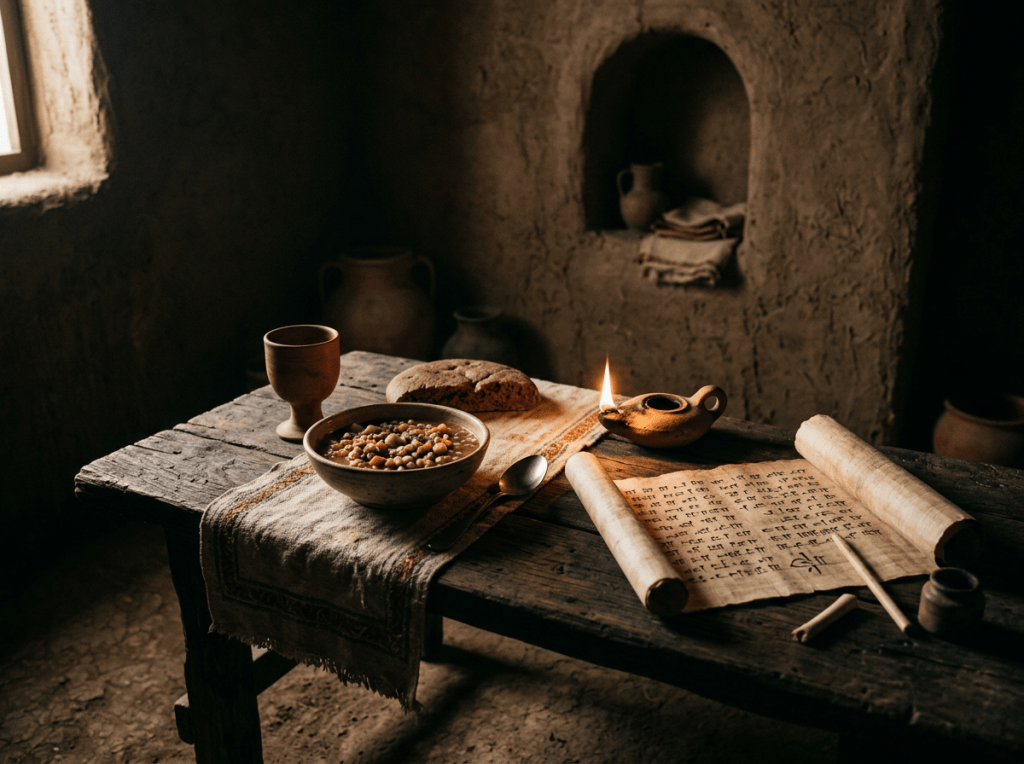
Daniel 1:8 (8)But Daniel resolved that he would not defile himself with the king’s food, or with the wine that he drank. Therefore he asked the chief of the eunuchs to allow him not to defile himself.(ESV)
Daniel didn’t escape Babylon.
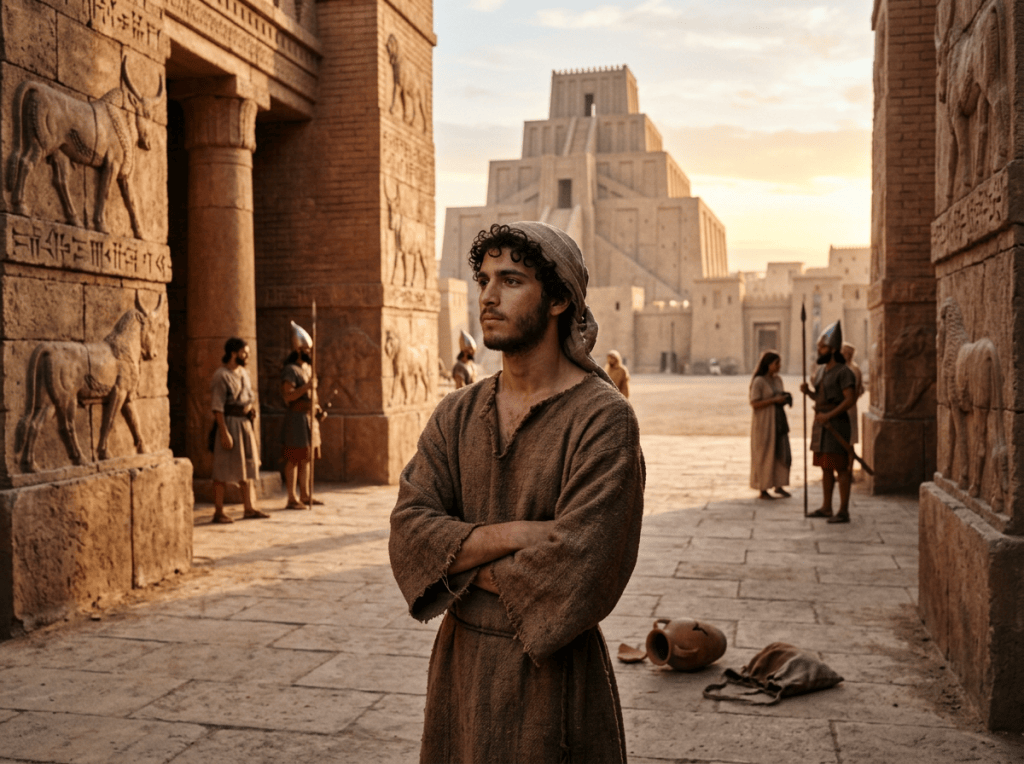
That can be easy to forget because we know how his story ends. We know about the dreams, the promotions, the lions, and the kings who came and went. But Daniel remained in captivity.
God didn’t immediately return him to Judah. He didn’t restore the life Daniel had before. Daniel had to learn how to live faithfully in a place he never chose.
That required more than simply remembering who he was. It required learning what could change and what couldn’t.
Daniel learned the language of Babylon. He studied its literature. He worked inside its government. He served pagan kings. He answered to the name they gave him. He became exceptionally good at functioning inside the world that had taken him captive.
Then Daniel 1:8 says: Daniel resolved that he would not defile himself.
There was the line.
Daniel didn’t reject everything simply because it came from Babylon. He also didn’t accept everything simply because he lived there.
He learned how to distinguish between adaptation and surrender. That can be much harder than simply saying no to everything.
If Daniel had refused to learn the language, refused the education, refused government service, and fought every Babylonian custom, he probably would’ve disappeared from the story very quickly.
Instead, Daniel learned how to live there without allowing Babylon to decide who he would become.
Captivity often requires the same kind of discernment.
Sometimes God removes us from the situation. Sometimes He leads us through a door and tells us never to go back. But sometimes the consequences remain.
The recovering alcoholic still lives in a world where alcohol exists. The person escaping pornography still lives in a world filled with screens and easy access. The person rebuilding after financial failure still has bills. The person who damaged relationships may repent and still have to live with consequences. The person grieving a death can’t simply remove the grief from the room.
The first message was about refusing the identity captivity tries to give us.
The next question is harder: How do I live while the captivity, temptation, consequence, or wound is still part of my environment?
Daniel’s answer wasn’t isolation. It was resolve.
He knew the boundary before the pressure reached it. That becomes even clearer later in Daniel’s life.
When the law was passed forbidding prayer to anyone except the king, Daniel didn’t suddenly develop a prayer life.
Daniel 6:10 says he prayed: “as he had done previously.”
The crisis didn’t create Daniel’s faithfulness. It revealed it.
For years, perhaps decades, Daniel had been practicing the same identity Babylon had tried to replace.
He prayed. He served. He worked. He learned. He remained honest.
He remembered God.
Then when Babylon finally demanded something he couldn’t give, the decision had already been made.
That’s where many of us get into trouble.
We wait until temptation is screaming before deciding where the boundary should be. We wait until the bottle is in front of us. Until the website is open. Until the anger has already taken over. Until the relationship has crossed another line. Until the money is already being spent.
Then we try to decide who we want to be.
Daniel resolved before the meal reached his mouth.
The strongest boundaries are often decided before they’re tested.
That doesn’t mean the test becomes easy.
It means the answer is no longer being negotiated in the middle of the temptation.
Daniel also had something else Babylon failed to remove completely. He had people who remembered where they came from. Hananiah. Mishael. Azariah.
When Daniel faced death in chapter two, he went to them and asked them to seek mercy from God with him.
Babylon had isolated them from Judah. It hadn’t completely isolated them from one another.
Captivity grows stronger in isolation. Addiction loves secrecy. Shame tells us to hide. Failure tells us nobody will understand. Pain tells us to withdraw.
But Daniel didn’t carry Babylon alone. He had people who still knew his real name.
We all need people like that.
People who know the difference between who we are and what we’re fighting. People who can tell us the truth without allowing our failure to become our identity. People who pray when we can no longer see clearly. People who remember who we were before captivity started naming us.
Daniel became remarkably successful in Babylon. That might be one of the most dangerous parts of the story.
Captivity doesn’t always look miserable. Sometimes Babylon promotes you. Sometimes the thing reshaping you also rewards you. Sometimes compromise makes life easier. Sometimes the wrong environment celebrates the person you’re becoming.
Success isn’t proof that the direction is right.
Daniel could accept promotion without allowing promotion to become lord. He could serve Nebuchadnezzar without worshiping Nebuchadnezzar. He could learn Babylon without belonging to Babylon.
That’s the difficult balance.
Faithfulness isn’t refusing to interact with a broken world. Jesus never called us to become useless to everyone who doesn’t believe as we do.
Daniel was useful. Exceptionally useful. Kings depended on him. Governments trusted him. His enemies searched his work looking for corruption or negligence and couldn’t find it.
Daniel lived so faithfully in Babylon that Babylon benefited from having him there.
But Babylon never owned him.
There will be things we can change. There will be things we need to leave. There will be habits we have to rebuild. There will be people we need beside us. There will be consequences we simply have to endure.
And there may be circumstances we can’t change at all.
The answer isn’t pretending Babylon doesn’t exist. Daniel knew exactly where he was.
The answer is learning to live there without surrendering the throne inside you.
The first question was: Who gets to tell you who you are?
The second is: Who gets to decide how you live?
Daniel gave the same answer to both. God.
Babylon could change Daniel’s location. It could change his education. It could change his job. It could change what people called him. It could even threaten his life.
But Daniel had already decided who sat on the throne.
You may have to live in Babylon for a while. Learn what you need to learn. Do the work in front of you. Accept the help you need. Build the boundaries before the pressure comes. Find people who still know your real name.
And when captivity finally asks for something that belongs to God alone: Resolve.
You can live in Babylon without becoming Babylon.


 Walking With Christ
Leave a comment