(Part 8 of 9)
Luke 22:33–34 (33)Peter said to him, “Lord, I am ready to go with you both to prison and to death.” (34)Jesus said, “I tell you, Peter, the rooster will not crow this day, until you deny three times that you know me.”(ESV)
We know Peter denied Jesus three times. We know the rooster crowed. We know Jesus turned and looked at him. And we know Peter went outside and wept bitterly.
It’s one of the most heartbreaking moments in the Gospels. But when we teach this story, we often concentrate on two things. Peter’s failure. And Peter’s eventual restoration.
We remember the denial because it was devastating. We remember the restoration because it was beautiful. But between Peter’s confident declarations and his bitter tears, there was an entire sequence of decisions and circumstances that deserves our attention.
Peter didn’t wake up that morning planning to deny Jesus. And understanding how he arrived at that moment may teach us something we miss when we focus exclusively on what happened afterward.
A Man Who Believed His Own Words
Peter was confident. When Jesus warned that Satan had demanded to sift the disciples like wheat, Peter declared that he was ready to go with Jesus to prison and even to death.
Those are strong words. And there’s no reason to assume Peter was deliberately lying.
He may have sincerely believed he was prepared to do exactly what he promised.
He had followed Jesus. He’d witnessed miracles. He’d walked on water, however briefly. He’d confessed that Jesus was the Christ. He’d seen things most people could scarcely imagine. And now he was convinced that his loyalty would withstand whatever came next. But Jesus knew something Peter didn’t.
Peter’s confidence was greater than his readiness.
Jesus told him that before the rooster crowed, he would deny knowing Him three times.
Peter had received a direct warning. And yet he still didn’t fully understand the danger.
When Confidence Becomes a Blind Spot
There’s nothing inherently wrong with wanting to be faithful. There’s nothing wrong with committing ourselves to stand firm when circumstances become difficult. But there’s a difference between commitment and overconfidence.
Peter was measuring his future behavior against what he believed about himself in the present.
He loved Jesus. He wanted to remain loyal. He couldn’t imagine abandoning Him. But wanting to do something and being prepared to do it aren’t always the same thing.
We make similar mistakes. We insist that we would never betray someone’s trust. We declare that we would never compromise our convictions. We confidently explain how we would respond if someone threatened our family, our livelihood, or our reputation. But most of those declarations are made while we’re safe.
It’s easy to imagine courage when we aren’t frightened. It’s easy to promise patience when we aren’t exhausted. It’s easy to promise faithfulness when remaining faithful costs us nothing.
Peter was about to discover the difference between what he intended to do and what he would actually do under pressure.
The Warning in the Garden
Later, Jesus took His disciples to the Mount of Olives. He told them to pray that they wouldn’t enter into temptation. Then He withdrew to pray. When He returned, He found them sleeping.
Luke tells us they were sleeping because of sorrow. That detail matters.
We sometimes describe the sleeping disciples as though they were simply careless or uninterested. But Scripture identifies sorrow as part of their condition.
They were emotionally burdened. They were tired. They were struggling. And Jesus again instructed them to pray so they wouldn’t enter into temptation.
The warning wasn’t hidden. It wasn’t vague.
Jesus told them what they needed to do. But the disciples weren’t responding to the situation with the alertness it required.
There’s an uncomfortable lesson here.
Sometimes we recognize that something’s wrong without recognizing how vulnerable we’ve become.
We know we’re tired. We know we’re overwhelmed. We know we’re under pressure. But we continue assuming that our intentions will be enough to carry us through whatever happens next.
Peter wanted to be faithful. But wanting to remain faithful wasn’t a substitute for heeding Jesus’ warning.
The Sword and the Courtyard
When the crowd arrived to arrest Jesus, the disciples suddenly faced a situation they hadn’t anticipated.
Luke records that one of them struck the servant of the high priest, cutting off his right ear. John identifies that disciple as Peter.
Jesus stopped the violence and healed the wounded man. Peter had just demonstrated that he was willing to use force in response to the arrest.
That makes what happened afterward even more interesting. A man willing to draw a sword in the garden would soon deny knowing Jesus when questioned in a courtyard.
How could those two actions come from the same person?
Because courage isn’t always consistent across circumstances.
The willingness to fight doesn’t automatically mean someone is prepared to endure humiliation, uncertainty, or fear without fighting. Peter could act boldly when he believed he knew what the situation required. But Jesus rejected the violent response.
And the events that followed placed Peter in circumstances he couldn’t control.
Following at a Distance
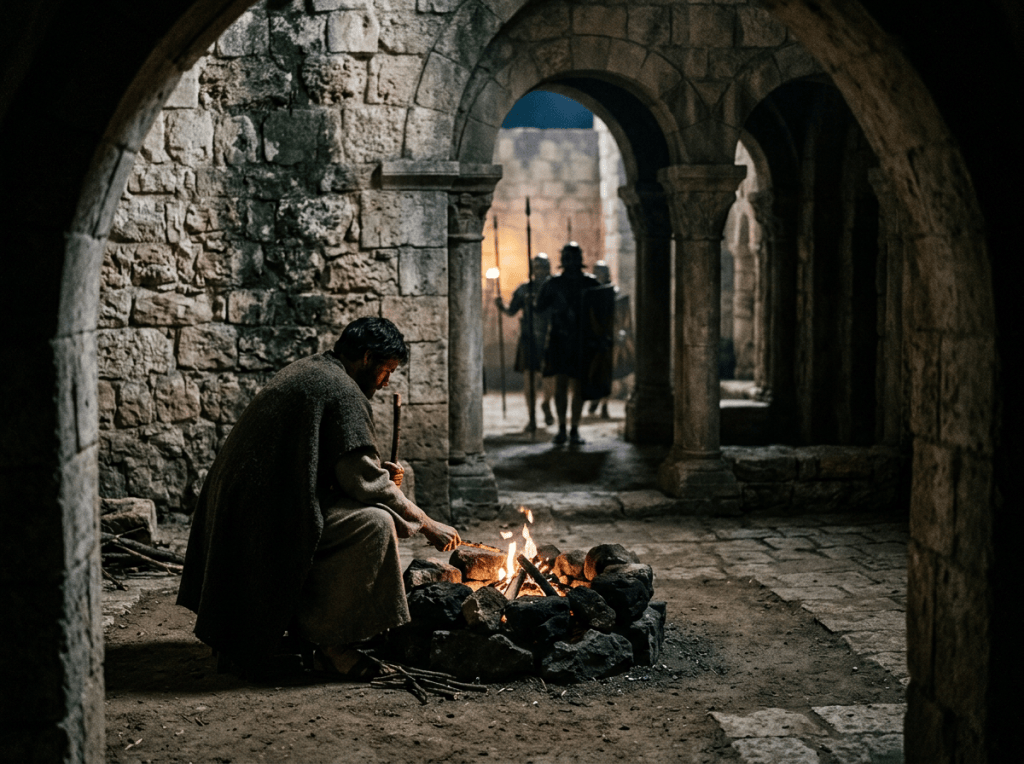
After Jesus was arrested, Peter followed at a distance. This detail doesn’t get enough attention. He entered the courtyard of the high priest and sat among those gathered around a fire. We often emphasize the distance as though it proves Peter had already abandoned Jesus. But we should be careful.
Peter was still following. He hadn’t simply disappeared. He was close enough to observe what was happening, but he was no longer standing openly beside Jesus.
That doesn’t excuse what followed. It simply reminds us that Peter’s actions were more complicated than a sudden decision to abandon everything he believed.
He was caught between competing impulses.
He wanted to remain near Jesus. But when people began identifying him as one of Jesus’ followers, he denied the connection.
First, a servant girl recognized him. Then another person accused him of belonging to Jesus’ followers. Later, someone insisted that Peter must’ve been with Jesus because he was a Galilean.
Each accusation gave Peter another opportunity to tell the truth. And each time, he denied it.
The Failure Wasn’t One Moment
We often speak of Peter’s denial as a single failure. But Scripture records three denials. Three separate responses. Three opportunities to acknowledge Jesus.
Peter didn’t simply make one frightened statement and immediately recover. The denial continued. And that’s worth considering because many failures don’t begin with one enormous decision.
They develop. A compromise is made. Then another. A lie is told. Then another lie becomes necessary to maintain the first. A boundary is crossed. And rather than turning back, we continue moving farther in the wrong direction.
Not every failure follows that pattern, but Peter’s denial shows us that a person can be given repeated opportunities to change course and still continue.
His earlier confidence didn’t prevent it. His love for Jesus didn’t prevent it. His experience as a disciple didn’t prevent it.
He’d been warned. And still, he failed.
The Look
Then the rooster crowed. Luke tells us that Jesus turned and looked at Peter. And Peter remembered what Jesus had told him.
We don’t know exactly what Jesus’ expression communicated. We shouldn’t invent anger, disappointment, condemnation, or reassurance and pretend the text tells us which one Peter saw. But we do know what happened next.
Peter remembered. And he went outside and wept bitterly.
The man who’d promised to go to prison and death with Jesus had denied knowing Him. Three times.
He’d discovered something painful about himself. His intentions had been sincere enough to declare. But they hadn’t been sufficient to withstand the pressure.
The Warnings We Ignore
This is where Peter’s story becomes more than a familiar account of failure.
How often do we recognize danger only after the consequences arrive?
How often do we dismiss warnings because we’re convinced we know ourselves well enough?
How often do we assume that our past faithfulness guarantees our future faithfulness?
How often do we believe that because we love someone, we could never hurt them?
Peter’s story challenges that confidence.
He wasn’t a stranger to Jesus. He wasn’t someone who’d never witnessed God’s power. He wasn’t an outsider who lacked understanding of what Jesus had taught.
He was one of the Twelve. He’d spent years following Christ. And he still failed.
That’s a warning against trusting our own determination as though it makes us immune to temptation.
Faithfulness requires more than confidence. It requires humility. It requires attentiveness. It requires a willingness to recognize our weaknesses before those weaknesses become failures. And it requires taking seriously the warnings God has already given us.
Before the Restoration
We know Peter’s story continues. We know Jesus restores him. We know Peter eventually stands before crowds and boldly proclaims the gospel. But those events shouldn’t cause us to minimize what happened in the courtyard.
Peter’s failure was real. His denials were real. His tears were real. And the warnings he’d received before those moments were real.
We shouldn’t rush past them simply because we know forgiveness is coming. The middle of Peter’s story teaches us something we need to understand before we ever reach the restoration.
Sincere intentions aren’t the same thing as spiritual readiness.
We can genuinely love Christ and still underestimate our vulnerability. We can make sincere promises and still fail to keep them. We can believe we’re prepared for a challenge while ignoring the very things that would help us endure it.
Peter’s failure didn’t begin when the rooster crowed. The rooster simply announced that the words Jesus had spoken were now fulfilled. And perhaps that’s the lesson we most need to hear.
Don’t wait until the rooster crows to take the warning seriously.






Leave a Reply