(Part 1 of 9)
Luke 10:36 Which of these three, do you think, proved to be a neighbor to the man who fell among the robbers?”(ESV)
Sometimes the problem isn’t that we don’t know the story. It’s that we know it so well we’ve stopped paying attention to what it actually says.
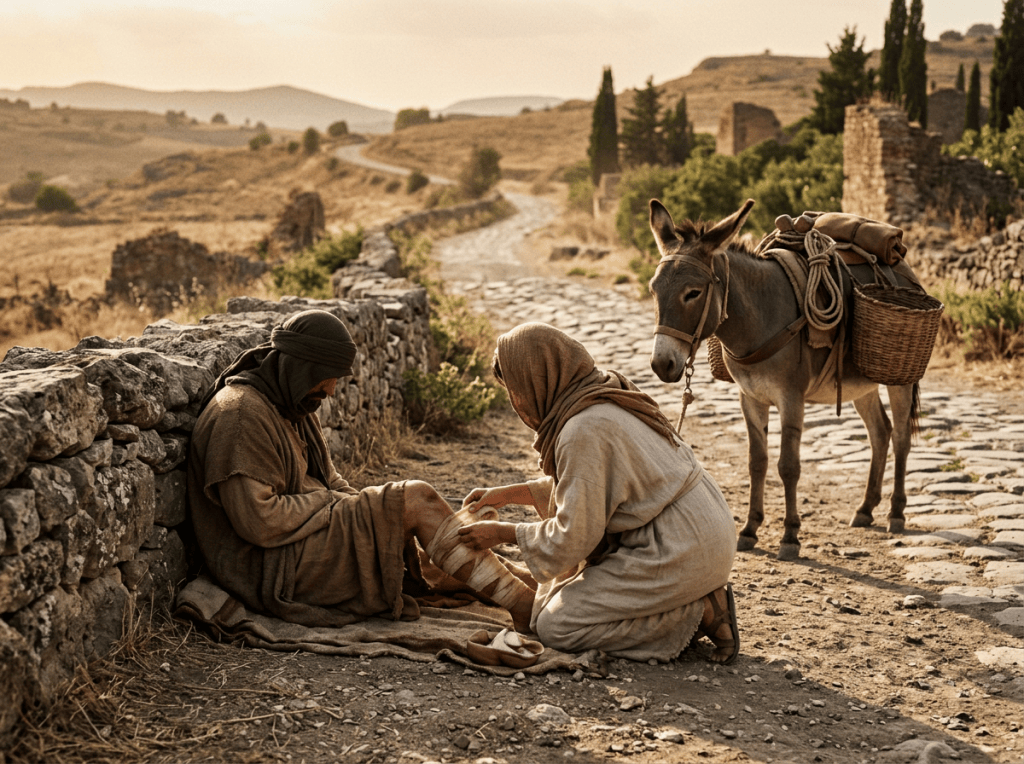
Think about the parable of the Good Samaritan. We know this one. A man is attacked by robbers and left for dead. A priest walks past him. A Levite does the same. A Samaritan stops, helps the wounded man, and makes arrangements for his care.
The lesson’s simple. Love your neighbor. Help people in need. Don’t allow prejudice or indifference to prevent you from showing compassion.
That’s a good lesson. It’s an important lesson. But is that all Jesus was teaching?
The Question That Started Everything
We often begin teaching this parable with the wounded man lying beside the road. Jesus didn’t begin there.
The story started with a lawyer asking Jesus what he must do to inherit eternal life. Jesus directed him to the Law, and the man correctly identified the commandments to love God and love his neighbor. Then Luke tells us something important.
The man wanted to justify himself.
So he asked Jesus another question. “Who is my neighbor?”
That’s the question that prompted the parable. And suddenly, the story becomes more than an illustration about helping people. It’s a response to someone attempting to define the boundaries of his own responsibility.
The man wasn’t simply asking how to show compassion. He was asking whom he was obligated to love. Those are very different questions.
The People We Walk Past
Now look at the people Jesus chose for the story. A priest. A Levite. A Samaritan.
The first two were associated with Israel’s religious life. They would’ve been familiar figures to the lawyer listening to Jesus.
The third was a Samaritan, someone from a community with longstanding religious and ethnic tensions with the Jews.
Jesus didn’t choose these characters accidentally.
The people who might have been expected to demonstrate righteousness walked past the wounded man. The person whom some listeners might have regarded with suspicion was the one who demonstrated mercy. But notice something else.
Jesus never tells us why the priest and Levite passed by.
We can speculate about fear, inconvenience, ritual purity, or simple indifference. But the passage doesn’t give us their explanations.
We know what they did. We don’t know what they were thinking.
That distinction matters because we can become so occupied with explaining their behavior that we overlook what Jesus actually chose to tell us.
They saw the man. They passed by. The Samaritan saw the man. He had compassion.
What Compassion Actually Cost
The Samaritan didn’t simply feel sorry for the wounded man. He approached him. He treated his wounds. He placed him on his own animal. He brought him to an inn and cared for him.
Then he paid for the man’s continued care and promised to cover additional expenses.
There was time involved. There was effort involved. There was personal inconvenience and financial expense.
We often summarize all of that with the phrase “he helped him.” And that’s true.
But those three words compress a considerable amount of action into a comfortable little statement.
The Samaritan’s compassion wasn’t merely an emotion. It became a series of decisions, each requiring something of him.
He could’ve stopped after bandaging the wounds. He could’ve stopped after bringing the man somewhere safe. He could’ve decided that he’d already done enough.
Instead, he continued providing for the man’s needs.
The details matter because they show us what his mercy looked like.
The Question Jesus Actually Asked
When Jesus finished the parable, He didn’t ask the lawyer whether the Samaritan was a good person. He didn’t ask which character had behaved most admirably.
He asked which of the three had proved to be a neighbor to the wounded man.
Do you see the shift?
The lawyer asked, “Who is my neighbor?” He wanted to identify the people who qualified to receive his love.
Jesus turned the question around. Which man became a neighbor through his actions?
The lawyer was asking about the boundaries of his obligation. Jesus directed his attention toward the responsibility of showing mercy. And then Jesus told him to go and do likewise.
We can teach this parable as a lesson about kindness and be entirely correct. But if we stop there, we risk missing the challenge Jesus was making to the man who asked the question.
The problem wasn’t simply that some people fail to help others. It was that someone could understand the commandment to love his neighbor while still looking for a way to limit whom that commandment included.
The Parts We Skip
This is something we do with Scripture all the time. We remember the dramatic moments. We remember the miracles. We remember the victories, the failures, and the lessons we’ve heard preached a hundred times. And sometimes we become so familiar with the conclusion that we stop examining everything that happened along the way.
We read a passage looking for the point we already know. We recognize the familiar details, connect them to the familiar lesson, and move on.
But what about the conversation that prompted the story? What about the people standing nearby? What about the decisions that were made before the famous moment? What about the ordinary actions that reveal something important about the people involved? What about the details that don’t fit neatly into the lesson we’ve always been taught?
Those details don’t necessarily overturn the familiar interpretation. Sometimes they deepen it. Sometimes they correct it. And sometimes they reveal that we’ve been concentrating so heavily on one part of the story that we’ve overlooked another lesson sitting right in front of us.
Learning to Read Again
Over the next several messages, we’re going to revisit some familiar biblical accounts. Not to search for secret meanings. Not to invent motives Scripture never reveals. And not to argue that generations of teachers have somehow missed everything important.
We’re simply going to slow down. We’re going to pay attention to the people who usually become supporting characters. We’re going to examine decisions that tend to get overshadowed by their outcomes. We’re going to ask what was happening while everyone was waiting for the part of the story we remember.
Because sometimes the lesson isn’t hidden. Sometimes we’ve just been looking somewhere else.
The Good Samaritan is still a lesson about loving our neighbors. But it’s also a warning about trying to define our way around the responsibility to love them.
Both lessons belong to the same story. And we need to be willing to see both.
The next time you open your Bible to a story you already know, don’t begin by asking what you’ve always been taught it means.
Read it. Pay attention. Ask what the passage actually says. Ask what questions you’ve never thought to ask. And perhaps most importantly, ask whether you’ve been so focused on the ending that you’ve forgotten to examine what happened in the middle.
Sometimes the parts we skip are the very parts we need to hear.






Leave a Reply