(Part 7 of 10)
⚓ Floatie: Authority Is Not Destroyed by Sin, but by Refusal to Repent
2 Samuel 12:7 Nathan said to David, “You are the man! Thus says the Lord, the God of Israel, ‘I anointed you king over Israel, and I delivered you out of the hand of Saul.(ESV)
David’s failure is severe. It’s calculated. It’s hidden. And it abuses power at multiple levels.
But David’s story isn’t remembered as a warning about unchecked sin alone. It’s remembered because something happens here that hasn’t happened yet in this series.
Authority is confronted—and it yields.
✒️ Forge: Power Corrupts When It Is Unchallenged
2 Samuel 11:1–5 (1)In the spring of the year, the time when kings go out to battle, David sent Joab, and his servants with him, and all Israel. And they ravaged the Ammonites and besieged Rabbah. But David remained at Jerusalem. (2)It happened, late one afternoon, when David arose from his couch and was walking on the roof of the king’s house, that he saw from the roof a woman bathing; and the woman was very beautiful. (3)And David sent and inquired about the woman. And one said, “Is not this Bathsheba, the daughter of Eliam, the wife of Uriah the Hittite?” (4)So David sent messengers and took her, and she came to him, and he lay with her. (Now she had been purifying herself from her uncleanness.) Then she returned to her house. (5)And the woman conceived, and she sent and told David, “I am pregnant.”(ESV)
2 Samuel 11:14–17 (14)In the morning David wrote a letter to Joab and sent it by the hand of Uriah. (15)In the letter he wrote, “Set Uriah in the forefront of the hardest fighting, and then draw back from him, that he may be struck down, and die.” (16)And as Joab was besieging the city, he assigned Uriah to the place where he knew there were valiant men. (17)And the men of the city came out and fought with Joab, and some of the servants of David among the people fell. Uriah the Hittite also died.(ESV)
David doesn’t stumble accidentally. He sends. He takes. He arranges. He conceals. Every step reinforces the same truth: power without restraint accelerates moral decay.
This is what unchecked authority does best—it removes friction. David has access. David has loyalty. David has silence working in his favor.
No one stops him. No one questions him. No one intervenes.
Until Nathan.
This is the first moment in Scripture where authority is confronted by truth from below, and the outcome changes everything.
⚒️ Anvil: Accountability Requires Someone Willing to Speak
2 Samuel 12:1–6 (1)And the Lord sent Nathan to David. He came to him and said to him, “There were two men in a certain city, the one rich and the other poor. (2)The rich man had very many flocks and herds, (3)but the poor man had nothing but one little ewe lamb, which he had bought. And he brought it up, and it grew up with him and with his children. It used to eat of his morsel and drink from his cup and lie in his arms, and it was like a daughter to him. (4)Now there came a traveler to the rich man, and he was unwilling to take one of his own flock or herd to prepare for the guest who had come to him, but he took the poor man’s lamb and prepared it for the man who had come to him.” (5)Then David’s anger was greatly kindled against the man, and he said to Nathan, “As the Lord lives, the man who has done this deserves to die, (6)and he shall restore the lamb fourfold, because he did this thing, and because he had no pity.”(ESV)
Nathan doesn’t accuse directly. He tells a story.
He bypasses David’s defenses and appeals to the part of him that still recognizes justice. This isn’t manipulation. It’s discernment. Nathan understands the danger of confronting power, and he does it anyway.
This is what real accountability looks like:
- Truth spoken without self-protection
- Risk accepted without leverage
- Faithfulness without guarantee
Nathan isn’t protected by position. He is protected by obedience. Authority doesn’t collapse when confronted. It collapses when confrontation is absent.
🔥 Ember: Repentance Determines Whether Authority Survives Exposure
2 Samuel 12:13 David said to Nathan, “I have sinned against the Lord.” And Nathan said to David, “The Lord also has put away your sin; you shall not die.(ESV)
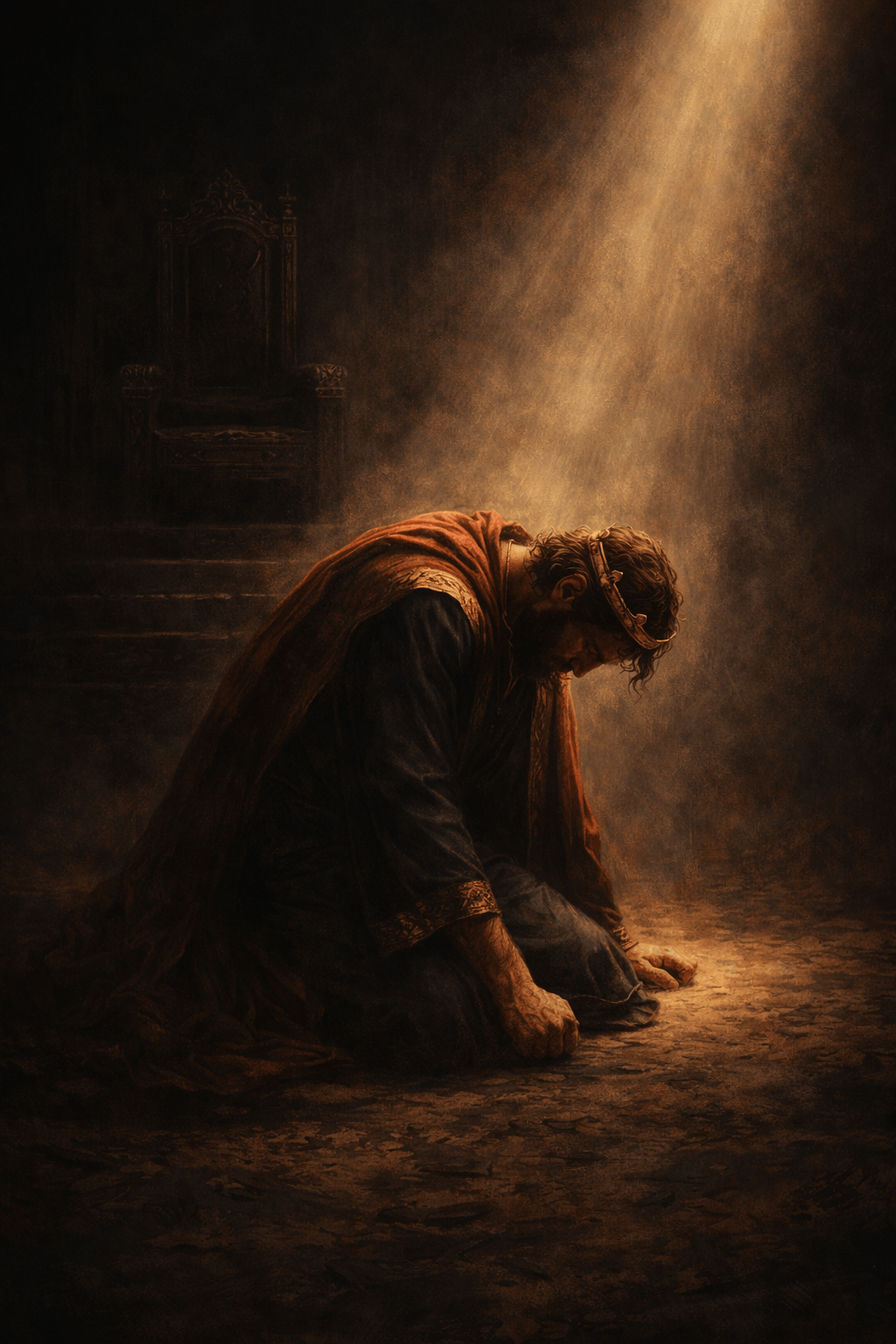
David does something no one else in this series has done so far. He stops defending. No explanation. No justification. No appeal to circumstance. No blame-shifting. “I have sinned against the Lord.”
That sentence changes the trajectory of everything that follows. David still faces consequence. The damage isn’t erased. The sword doesn’t depart from his house.
But authority is preserved because repentance is real. This is the hinge point of the entire series.
🌿 Covenant Triumph: God Preserves Authority That Submits to Truth
Psalm 51:16–17 (16)For you will not delight in sacrifice, or I would give it; you will not be pleased with a burnt offering. (17)The sacrifices of God are a broken spirit; a broken and contrite heart, O God, you will not despise.(ESV)
David’s repentance doesn’t undo the harm he caused. It does something far more important. It restores alignment.
Covenant authority isn’t preserved by moral perfection. It’s preserved by submission—submission to truth, to correction, and to consequence. David doesn’t retain authority because he is special. He retains it because he bows.
This is what separates David from Saul.
Saul confessed to protect his image. David confessed to restore his posture.
God resists authority that clings to power. He sustains authority that relinquishes it.
Where This Leaves the Reader
This message exists so the series doesn’t turn cynical.
Scripture doesn’t present authority as doomed to corruption. It presents authority as redeemable when it submits. David proves that failure doesn’t have to end in collapse—if truth is received and repentance is real.
From the beginning, authority was never meant to be flawless. It was meant to be correctable. And correction only works where truth is allowed to speak—and power is willing to kneel.
[⚓ Floatie] [✒️ Forge] [⚒️ Anvil] [🔥 Ember] [🌿 Covenant Triumph]
This post follows the Forge Baseline Rule—layered truth for the discerning remnant.






 Walking With Christ
Leave a reply to RW – Disciple of Yahshua Cancel reply