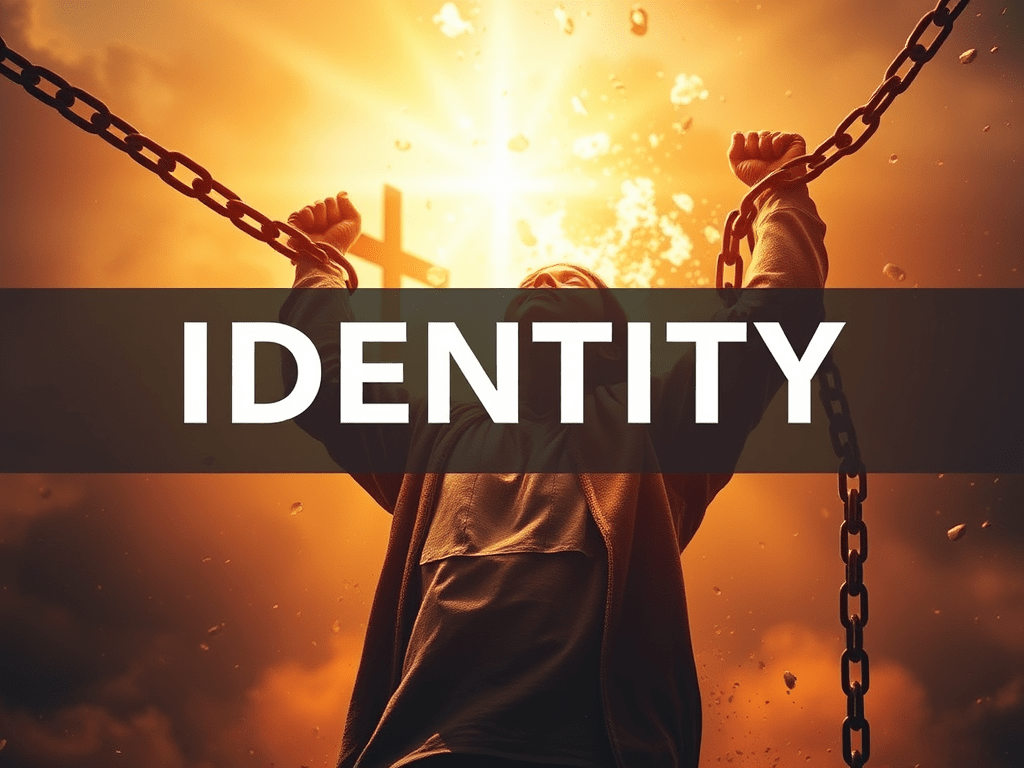
⚓ Floatie: Breaking False Labels, Becoming Adopted Heirs
2 Corinthians 5:17–18 (17)Therefore, if anyone is in Christ, he is a new creation. The old has passed away; behold, the new has come. (18)All this is from God, who through Christ reconciled us to himself and gave us the ministry of reconciliation;(ESV)
Romans 8:15–17 (15)For you did not receive the spirit of slavery to fall back into fear, but you have received the Spirit of adoption as sons, by whom we cry, “Abba! Father!” (16)The Spirit himself bears witness with our spirit that we are children of God, (17)and if children, then heirs—heirs of God and fellow heirs with Christ, provided we suffer with him in order that we may also be glorified with him.(ESV)
Identity in Christ isn’t inspirational decor. It is covenant, reconstruction, and rebirth. It is the divine declaration that you belong to God—not to your history, not to your trauma, not to your survival patterns, and not to the labels you learned to wear just to get through the day.
But for many of us, identity in Christ raises a far deeper question than we ever admit: How does God make a “new creation” when the old one never had a chance to fully form?
Some people lose themselves in sin. Some lose themselves in shame. Some lose themselves in performance. And others—like me—never had a self to lose in the first place.
✒️ Forge: Where Identity Is Formed or Stolen
There is a kind of childhood trauma that doesn’t just wound you—it interrupts the formation of the self before the self exists. It forces a child to build a “survival identity” instead of a real one. What should have been personhood becomes architecture. What should have been identity becomes a mask.
This is where the conversation usually fails in the Church. We assume everyone starts with a reasonably intact “self” that simply needs a little refining. We assume people know their likes, their dislikes, their boundaries, their temperament, their voice.
But some of us grew up in the Genesis 3 version of childhood—our “beginning” was breathed in the shadow of fallenness, betrayal, chaos, and danger. We didn’t grow up learning who we were. We grew up learning who we had to become to stay alive.
The self that trauma builds is not a personality. It is a strategy. It is fluid, perceptive, adaptive, and reactive. It learns to read rooms before it learns to read books. It tracks threat before it tracks preference. It survives by mimicry long before it knows how to speak honestly. So identity becomes a mosaic of borrowed traits. A costume of convenience.
A Ship of Theseus soul—every piece replaceable, none original, all functional.
For many like me, this was not a choice. It was the only option.
⚒️ Anvil: Where My Story Meets the Reader’s Story
This section carries weight. It needs to.
I grew up in a world where innocence was a luxury and safety was a rumor. Torment, betrayal, fear, and confusion were the atmosphere. I learned early that being myself—whatever that even meant—was too costly. So I learned to adapt. To blend. To become whatever the environment wanted.
I became a mimic.
Not because I wanted to deceive people, but because I didn’t yet exist as a person who could be known. I mirrored the interests of others so I could fit in. I studied group dynamics like a survival textbook. I learned hobbies I didn’t care about simply to create common ground. I became an “expert” in things I felt nothing toward because being an outsider meant being unsafe.
People saw confidence.
What they were looking at was camouflage.
Inside, there was almost nothing.
My “self” was a layered defense system—skillful, intelligent, adaptive, and empty. Every trait was optional. Every interest was detachable. Every preference was negotiable. The line between “me” and “not me” blurred so completely I couldn’t name a single thing that felt fundamentally mine.
This wasn’t sin. It was survival. And here is the terrifying truth trauma survivors rarely speak out loud: When survival forms the personality, adulthood becomes the slow realization that you don’t know who you are.
But here’s where the story pivots.
Despite all of this, one person—my wife—became a place of safety. Not perfect safety, but real safety. A place where I could speak openly about things I never dared name. A place where trauma responses weren’t judged but understood. A place where healing could finally begin—not because the mimic died, but because for the first time in my life the real self had room to breathe.
It hasn’t been easy.
We’ve stepped on each other’s trauma reflexes more times than I can count. We’ve had to re-learn how to talk without triggering the ghosts in the room. But she is the one person I trust to see the unmasked version of me—even when I don’t know who that version is.
And this is where identity in Christ enters—not as doctrine, but as rescue. God didn’t ask me to “crucify myself” in the way most Christians think. There wasn’t enough of a true self to crucify. What died was the mimic—the persona I built in the fires of childhood, the false identity constructed from necessity, the shell that protected the child who never had a chance to exist.
Identity in Christ didn’t require me to return to my “original self.”
I never had one.
Identity in Christ required something far more profound: to let Jesus build the version of me that trauma prevented from ever forming.
This is why the language of adoption matters so deeply to trauma survivors.
Adoption is not sentimental—it is structural. It is legal. It is covenant. It is the declaration: “You belong to Me now, and who you are will be shaped by My household, not your history.”
🔥 Ember: The Moment of Recognition
Here is the truth that will either break you or set you free: Identity in Christ is not returning to who you were. It is becoming who you were meant to be.
Christ does not resurrect the mimic. And He does not resurrect the pre-trauma child. He resurrects the true person who never had room to form.
For some of you, that means:
- You don’t know your real interests yet.
- You don’t know where your personality ends and your survival persona begins.
- You don’t know how to choose preferences without referencing the room.
- You don’t know who you are when you’re not adapting.
- You don’t know which pieces of your identity are authentic or borrowed.
And that’s okay. Identity in Christ is not built in a single moment of salvation—it’s built in the quiet, daily reconstruction of a soul that finally has permission to exist.
You’re not too broken. You’re not too empty. You’re not too late. You’re not a fake person.
You are a person whose Genesis began in the fall—and who now gets to experience the creation God always intended.
This is the Ember moment: You are not the mask. You are the one Christ is forming beneath it.
🌿 Covenant Triumph: The Hope That Awaits but Not Yet
This entire series is climbing toward one destination—hope—but we are not there yet. Not by a long stretch. Hope is not the next message. Hope is the last message of this first great movement. It is the mountain peak you will only reach after you walk the harder ground in between.
Identity in Christ is not the end. It is the hinge. It is the transition between the wounds behind you and the work ahead of you.
Before we reach hope, we have to pass through the terrain that every believer must navigate:
- Patience and Endurance — the long obedience that shapes the soul
- Temptation — the battlefield where identity is tested
- Fruit of the Spirit — the evidence of transformation, not personality traits
Identity is what gives you the footing for all of this.
Identity is what keeps you from collapsing under temptation.
Identity is what makes endurance possible.
Identity is what produces fruit instead of performance.
Hope comes last because hope is the reward of proven identity, not its replacement. And after hope, there will be a final recap—a capstone—before the entire lens shifts.
The second half of this series will not be about biblical concepts applied to life, but about worldly realities examined through Scripture’s unflinching eye. Identity in Christ is the hinge between both halves. It prepares the reader for the internal battle and then equips them for the external one. Because you are not just someone who survived. You are someone being forged.
And the one being forged is not the mimic. Not the mask. Not the survival persona.
It is the real you—the one God is shaping, the one rising out of the wreckage, the one who will stand at the end of this first movement and see hope clearly for the first time.
[⚓ Floatie] [✒️ Forge] [⚒️ Anvil] [🔥 Ember] [🌿 Covenant Triumph]
This post follows the Forge Baseline Rule—layered truth for the discerning remnant.




 Walking With Christ
Leave a reply to cleaners4seniors Cancel reply