(Part 5 of 10)
⚓ Floatie: What Is Taken from God Always Costs the People
1 Samuel 2:12 Now the sons of Eli were worthless men. They did not know the Lord.(ESV)
The first financial scandal in Scripture doesn’t involve accounting errors. It involves entitlement.
Eli’s sons don’t steal because they’re desperate. They steal because they believe access belongs to them.
What was consecrated becomes consumable the moment authority forgets that it is stewarding what doesn’t belong to it.
✒️ Forge: Entitlement Is the Financial Sin Behind Exploitation
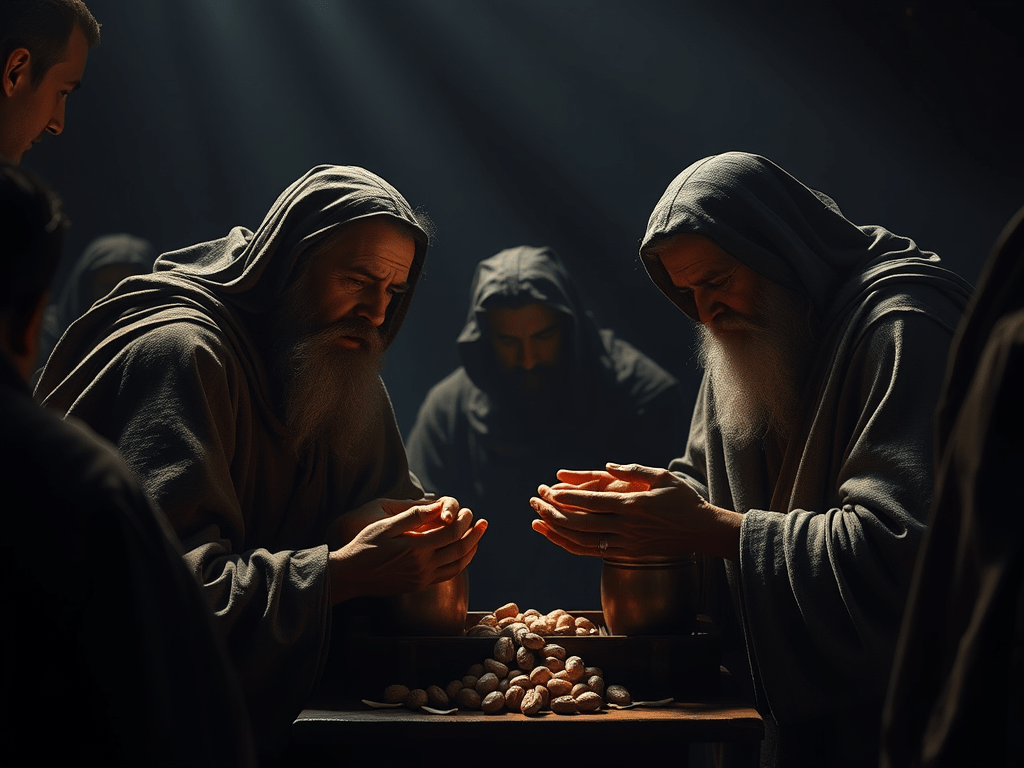
1 Samuel 2:13–16 (13)The custom of the priests with the people was that when any man offered sacrifice, the priest’s servant would come, while the meat was boiling, with a three-pronged fork in his hand, (14)and he would thrust it into the pan or kettle or cauldron or pot. All that the fork brought up the priest would take for himself. This is what they did at Shiloh to all the Israelites who came there. (15)Moreover, before the fat was burned, the priest’s servant would come and say to the man who was sacrificing, “Give meat for the priest to roast, for he will not accept boiled meat from you but only raw.” (16)And if the man said to him, “Let them burn the fat first, and then take as much as you wish,” he would say, “No, you must give it now, and if not, I will take it by force.”(ESV)
The text is very precise about what happens. The sons of Eli take what they want. They take it early. They take it by force if resisted. This isn’t ignorance of the law. It’s contempt for it.
Sacrifice was designed to remind both priest and people that provision comes from God and is handled on His terms. Eli’s sons invert that logic. They treat sacred provision as compensation owed to them for service rendered.
This is how spiritual authority begins to monetize trust. The moment leadership treats provision as payment rather than stewardship, abuse is no longer far behind. What belongs to God becomes leverage over people.
⚒️ Anvil: “God Is Still Being Served”
1 Samuel 2:17 Thus the sin of the young men was very great in the sight of the Lord, for the men treated the offering of the Lord with contempt.(ESV)
Scripture doesn’t soften its language. “The sin of the young men was very great.” Why?
Because worship was still happening. Sacrifices were still being offered. Rituals continued. The system functioned. That’s the danger.
Financial corruption inside religious systems rarely announces itself as theft. It announces itself as necessity, sustainability, or reward. The logic sounds reasonable: God’s work requires resources. But Scripture draws a hard line between provision for service and exploitation of trust.
When leadership justifies taking because “the work must continue,” it places itself between God and the people. That position is never neutral.
🔥 Ember: Followers Fund What Flatters Them
1 Samuel 2:17 Thus the sin of the young men was very great in the sight of the Lord, for the men treated the offering of the Lord with contempt.(ESV)
Micah 3:11 Its heads give judgment for a bribe; its priests teach for a price; its prophets practice divination for money; yet they lean on the Lord and say, “Is not the Lord in the midst of us? No disaster shall come upon us.”(ESV)
The people continue to bring offerings. They know what’s happening. They resent it. But they adapt. Why?
Because participation feels easier than confrontation. As long as something meaningful is still received—status, belonging, reassurance—people rationalize the cost. They learn to overlook excess, excuse entitlement, and silence discomfort.
Financial corruption survives not only because leaders take, but because followers keep giving. Provision becomes permission.
🌿 Covenant Triumph: God Withdraws from Exploited Worship
1 Samuel 4:3–11 (3)And when the people came to the camp, the elders of Israel said, “Why has the Lord defeated us today before the Philistines? Let us bring the ark of the covenant of the Lord here from Shiloh, that it may come among us and save us from the power of our enemies.” (4)So the people sent to Shiloh and brought from there the ark of the covenant of the Lord of hosts, who is enthroned on the cherubim. And the two sons of Eli, Hophni and Phinehas, were there with the ark of the covenant of God. (5)As soon as the ark of the covenant of the Lord came into the camp, all Israel gave a mighty shout, so that the earth resounded. (6)And when the Philistines heard the noise of the shouting, they said, “What does this great shouting in the camp of the Hebrews mean?” And when they learned that the ark of the Lord had come to the camp, (7)the Philistines were afraid, for they said, “A god has come into the camp.” And they said, “Woe to us! For nothing like this has happened before. (8)Woe to us! Who can deliver us from the power of these mighty gods? These are the gods who struck the Egyptians with every sort of plague in the wilderness. (9)Take courage, and be men, O Philistines, lest you become slaves to the Hebrews as they have been to you; be men and fight.” (10)So the Philistines fought, and Israel was defeated, and they fled, every man to his home. And there was a very great slaughter, for thirty thousand foot soldiers of Israel fell. (11)And the ark of God was captured, and the two sons of Eli, Hophni and Phinehas, died.(ESV)
Eventually, the system collapses. The ark is treated like a tool. Victory is assumed. God doesn’t respond.
This is the final consequence of treating sacred trust as leverage: God removes His presence while the structure remains intact. Worship continues, but power is gone. Confidence remains, but protection is withdrawn.
Scripture is ruthless here. God doesn’t honor worship funded by exploitation. He doesn’t empower institutions that confuse entitlement with calling.
From the beginning, financial corruption didn’t begin with excess. It began with authority believing it deserved what belonged to God.
Where This Leaves the Reader
Eli’s sons didn’t invent greed. They inherited access and abused it.
Their sin wasn’t wanting provision. It was believing that sacred trust existed to serve them.
From the beginning, financial scandal in God’s house has never been about money alone. It has been about authority forgetting who the resources belong to—and who pays the price when they’re misused.
The pattern hasn’t changed. Only the scale has.
[⚓ Floatie] [✒️ Forge] [⚒️ Anvil] [🔥 Ember] [🌿 Covenant Triumph]
This post follows the Forge Baseline Rule—layered truth for the discerning remnant.




 Walking With Christ
Leave a comment