
(Part 1 of 3)
⚓ Floatie: The Fall of Obedience
Genesis 4:7 If you do well, will you not be accepted? And if you do not do well, sin is crouching at the door. Its desire is contrary to you, but you must rule over it.(ESV)
Obedience was never meant to be a leash; it was meant to be a lifeline. From the very beginning, God’s instructions existed to protect communion, not to police it. The law was not a wall between God and man—it was a doorway showing how to walk in His presence safely. When humanity began treating that doorway as a barricade, obedience fell from alignment to performance.
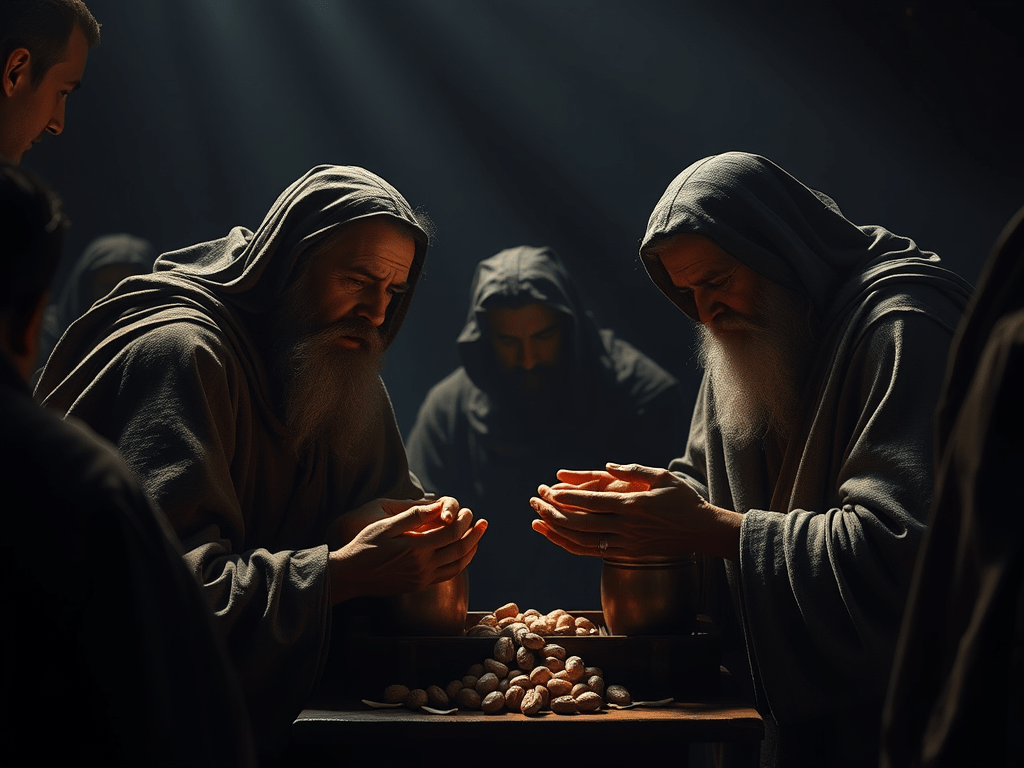
It started long before the Pharisees and their endless rules. The fall of obedience began with Cain and Abel—two brothers who both offered sacrifices, but only one whose heart was aligned. Abel’s obedience flowed from gratitude; Cain’s, from pride. One offered to honor God, the other to impress Him. God accepted Abel’s gift not because of what he brought, but because of why he brought it.
When God corrected Cain, He didn’t condemn him. He invited him back into alignment: “If you do well, will you not be accepted?” The warning that followed—“sin is crouching at the door”—shows that misaligned obedience doesn’t just miss the mark; it opens the door for rebellion.
✒️ Forge: The Drift Begins
After the Garden, humanity’s instinct was to add layers between ourselves and the holy. When Adam told Eve, “Don’t even touch it,” he meant well. But that extra fence gave the serpent room to twist truth into doubt. Fear tried to protect what only faith can preserve. The same pattern played out for Israel: God gave commands as guardrails for holiness; people turned them into ladders to prove righteousness.
The Law of Moses was meant to reveal God’s character—justice, mercy, faithfulness. But over time, people multiplied laws to define holiness so precisely that they no longer needed intimacy to find it. The Pharisees inherited that system and perfected it. They built fences around fences, believing that the tighter the rule, the safer the soul. What they didn’t see was that the heart inside those fences was suffocating.
Note: I can’t point fingers here without turning one back at myself. Every time I set extra boundaries to control outcomes—rules that make me feel safer but not necessarily more surrendered—I repeat Adam’s mistake. Fear disguised as wisdom still distances me from trust.
⚒ Anvil: Recognizing the Drift
How do we recognize when our obedience has drifted? The answer is usually in the motive.
- When obedience becomes a way to earn approval, it’s drifting.
- When we measure righteousness by comparison, it’s drifting.
- When our actions are driven by fear of punishment rather than love of God, it’s drifting.
The Israelites feared breaking the Law, but they stopped fearing breaking God’s heart. Their sacrifices became empty transactions—obligations that purchased appearance instead of intimacy. Through the prophets, God cried out, “For I desire steadfast love and not sacrifice, the knowledge of God rather than burnt offerings” (Hosea 6:6)(ESV).
That same cry echoes today. We may not bring lambs to the altar, but we still bring offerings of time, service, and tithes. When those gifts become proof of holiness instead of fruit of relationship, we’ve built the same altar Cain did.
Note: This isn’t a critique of the Church at large—it’s a mirror for me. I’ve served from pride before. I’ve given with mixed motives. God’s correction is the same gentle invitation He gave Cain: “If you do well—if you realign—you’ll be accepted.” The door is still open.
🔥 Ember: The Weight of Misused Obedience
The saddest part of Israel’s story isn’t that they broke the Law—it’s that they kept it without love. Legalism breaks the same way every other sin does: from the inside out. It starts with good intention—protecting purity—but ends by protecting power. The Law, meant as a light, became a weapon. The Pharisees used it to burden others, to profit from piety, and to claim superiority in God’s name. But Jesus shattered their illusion, declaring, “Woe to you, scribes and Pharisees, hypocrites! For you tithe mint and dill and cumin, and have neglected the weightier matters of the law: justice and mercy and faithfulness. These you ought to have done, without neglecting the others.” (Matthew 23:23)(ESV)
We read those words as history, but they’re warning labels for us. Whenever obedience becomes about control or reputation, we’ve traded alignment for advantage. The law of love has always been the true measure of obedience.
🌿 Covenant Triumph: Returning to Alignment
The fall of obedience wasn’t about rules—it was about relationship. The moment humanity began obeying for God instead of walking with Him, the connection was lost. Every added fence, every extra rule, every “don’t even touch it” widened the gap. But God never stopped reaching across it. Every law, every prophet, every act of discipline was His way of calling us back: “Be holy, for I am holy.” Not perfect, but aligned.
We obey not to earn His favor but because we already have it. Obedience isn’t the price of love—it’s its proof.
And when we drift, the answer is still the same as it was in Eden, as it was in Genesis 4: Return. Realign. Rule over the sin that crouches at the door—not by strength, but by surrender.
Coming next:
Part 2 — The Restoration of Obedience.
We’ll explore how Jesus redefined obedience through perfect alignment and how His surrender unlocks our freedom to walk with God again.
[⚓ Floatie] [✒️ Forge] [⚒️ Anvil] [🔥 Ember] [🌿 Covenant Triumph]
This post follows the Forge Baseline Rule—layered truth for the discerning remnant.





 Walking With Christ
Leave a comment