
(Part 2 of 5)
⚒️ Anvil: The Test of the Hammer
Yesterday we traced love back to its shape—covenantal, deliberate, and forged by God’s own faithfulness. Today we bring that love to the anvil, where truth and testing strike together to reveal what’s genuine and what’s merely pretending.
Proverbs 17:3 The crucible is for silver, and the furnace is for gold, and the Lord tests hearts.(ESV)
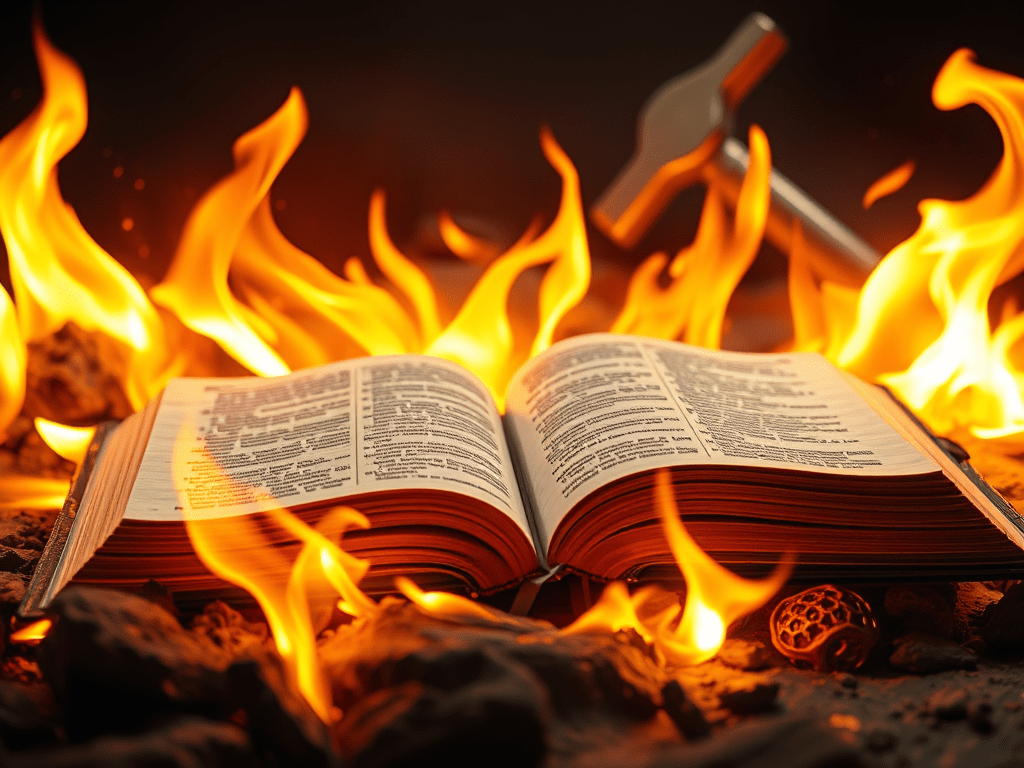
The forge formed the outline; the anvil proves the integrity. Under heat and hammer, love’s true nature is exposed. Every promise must be struck until it rings clear, because counterfeit metals always betray a dull sound. Testing doesn’t destroy love—it distinguishes it.
On the anvil, words give way to endurance. Covenantal love does not hide behind poetry; it steps into friction. Pressure reveals alloy. If the heart is mixed with self-interest, the strike will show it. God’s goal is not to shatter us but to refine us until the surface gleams with honesty.
You can hear the hammer in ordinary life:
- In marriage, when conversation turns from romance to logistics and the easy laughter fades.
- In friendship, when loyalty costs convenience and silence would be simpler.
- In church, when serving feels one-sided and gratitude never comes.
Those are the clangs that echo through the workshop of grace. Each one asks the same question—will you still choose covenant when the glow is gone?
And when the hammer falls, the first impurities to rise are almost always the counterfeits of love.
Metrics of Covenant Love
Love may begin invisible, but it leaves evidence. When covenant love is alive, you can measure its heat by five simple marks:
- Truth: honest, unvarnished speech; love never manipulates. (Ephesians 4:25)
- Cost: willingness to lose something for another’s good. (John 15:13)
- Consistency: alignment between word and action over time. (1 Corinthians 13:7)
- Repair: confession and restitution when harm occurs. (Psalm 51; Luke 19:8)
- Freedom: space for each person to obey God without control or fear. (Galatians 5:13)
Where these marks appear, covenant love is working; where they fade, something foreign has entered the soil.
Counterfeits of Love: False Forms in the Fire
Romans 12:9 Let love be genuine. Abhor what is evil; hold fast to what is good.(ESV)
False love doesn’t always announce itself as evil; it often mimics virtue until pressure demands sacrifice. Then its coating burns off. Here are the most common forgeries that appear on the anvil.
1. Politeness Without Truth
Peacekeeping instead of peacemaking. It avoids confrontation to preserve comfort. It feels gentle but leaves people bound in silence.
A pastor tells a couple, “Let’s not stir conflict; time will heal it,” but time only hardens it. A friend smiles through offense rather than risk honesty, and both souls grow distant. Neither is mercy—it’s fear with good manners.
Question: Does my kindness protect truth or hide it?
2. Service Without Sincerity
Good deeds performed to control perception. Generosity becomes theater—done for leverage, not love. A volunteer who serves so others will notice, a spouse who helps just enough to keep peace, a leader who sacrifices publicly but resents privately—all of them hammer dents into the covenant and call it devotion.
Question: Would I serve the same way if no one ever knew?
3. Romance Without Repentance
Affection that worships emotion while rejecting holiness. It loves the feeling of being needed, not the responsibility of being faithful. It whispers, “God wants me to be happy,” when what it really means is “God will excuse my disobedience.” It builds altars to chemistry and calls them soulmates. When repentance never accompanies affection, love rots into idolatry.
Question: Does my affection draw this person toward God or toward me?
4. Loyalty Without Boundaries
Devotion that excuses sin in the name of faithfulness. It calls fear “commitment” and silence “honor.” A parent shields an addicted child from consequence, a congregant defends a fallen leader rather than demand accountability, a spouse hides abuse behind vows. That is not love; that is captivity painted with virtue.
Question: Am I protecting someone from consequence rather than leading them to repentance?
This is just a short list of examples. Each counterfeit shines like real metal until it’s tested. Then it bends, cracks, or corrodes. Real love survives the same heat that exposes falsehood because it shares God’s composition—truth and grace fused together.
Psalm 11:5 The Lord tests the righteous, but his soul hates the wicked and the one who loves violence.(ESV)
Counterfeit love eventually becomes violent—not always with fists, but with neglect, manipulation, or emotional debt. It demands worship but gives no safety. It uses the word love as armor for fear. That’s why God tests hearts—not to humiliate, but to heal. A heart mixed with false love can still be purified if it submits to the fire.
Even the counterfeit can become real if it surrenders to the flame.
A heart pretending to love can learn the rhythm of truth once it stops performing and lets the hammer fall. The forger and the faithful stand side by side on the same anvil—one resisting the blows, the other yielding to them. The difference is not in their history, but in their surrender.
Isaiah 42:3 a bruised reed he will not break, and a faintly burning wick he will not quench; he will faithfully bring forth justice.(ESV)
The Mercy Hidden in the Heat
The sound of the hammer is not the sound of failure; it is the rhythm of mercy. God’s testing is not punishment—it’s preservation. Each strike drives out the air bubbles of hypocrisy and draws impurities to the surface where grace can scrape them away.
If love never met resistance, we’d mistake sentiment for substance forever. Pain has permission to reveal what comfort cannot. That’s why seasons of dryness or disappointment are not wasted—they are inspection periods where the Master Smith holds the piece to the light and says, “Now I can see what needs healing.”
Love that endures the furnace learns a different kind of joy. It doesn’t celebrate sparks; it celebrates staying power. The mature heart learns to thank God for the blows that kept it from breaking later. Faithfulness under fire is not glamorous, but it is glorious—it carries the ring of eternity.
Tomorrow Part 3: The Weeds That Choke Love
The piece is proven, but even tempered steel can rust if neglected. Once the heat subsides, a quieter danger creeps in—the corrosion that forms not from falsehood but from exposure and time. Tomorrow we’ll lay the finished work on the bench, inspect for the first flecks of decay, and learn how to guard genuine love before the weeds take root.
[⚓ Floatie] [✒️ Forge] [⚒️ Anvil] [🔥 Ember] [🌿 Covenant Triumph]
This post follows the Forge Baseline Rule—layered truth for the discerning remnant.




 Walking With Christ
Leave a comment