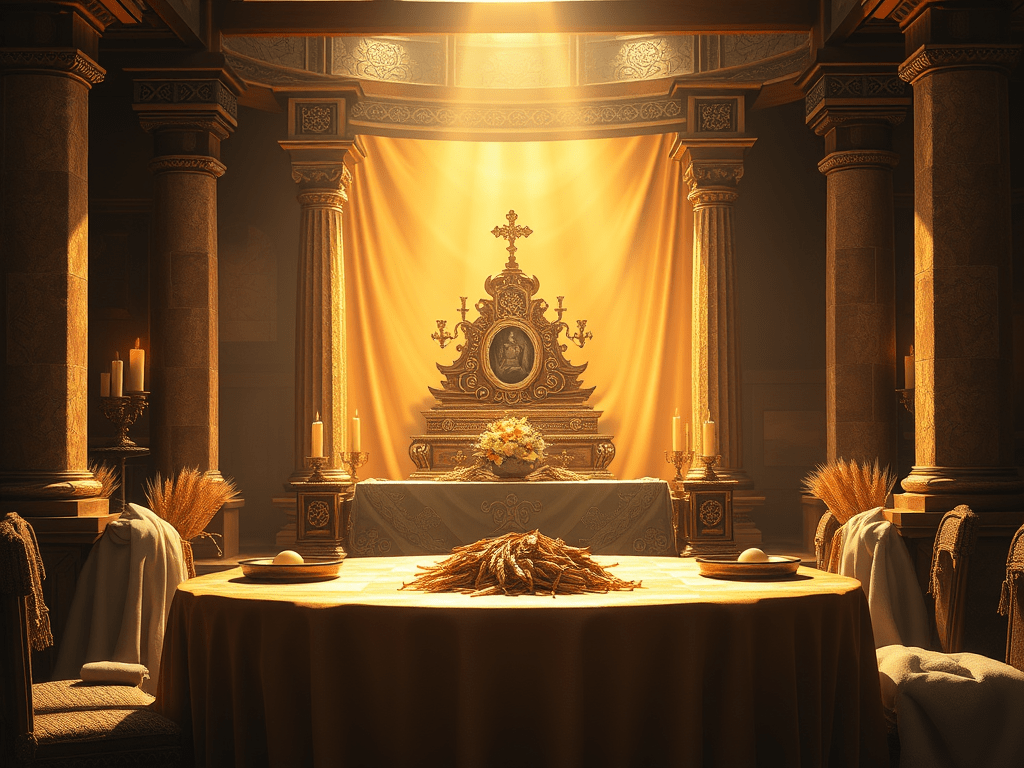
⚓ Floatie: From Table to Altar
Leviticus 20:26 You shall be holy to me, for I the Lord am holy and have separated you from the peoples, that you should be mine.(ESV)
Clean and Unclean: Covenant on the Altar and the Table
God never called His people to be clean because cleanliness was inherently good. He called them to be clean because He is holy. Clean and unclean were never about nutritional science or moral superiority. These categories were designed to teach Israel how to discern what belonged to God and what did not—and by extension, what could be offered on His altar and what could not.
But this story doesn’t begin in Leviticus.
It begins with Cain and Abel.
✒️ Forge: Theological Framework
When we talk about clean versus unclean, we’re really talking about covenantal separation. The distinction was never just about food—it was about identity, offering, and relational posture. The altar was the dividing line. If it could be placed on God’s altar, it was clean. If it couldn’t, it wasn’t. That logic traces back to the very first recorded offerings in Scripture. Not sin offerings—but worship offerings. Voluntary expressions of honor. The original altar moment.
Cain and Abel: The First Altar Test
Genesis 4:3-5 tells us that Cain brought an offering of the fruit of the ground, and Abel brought the firstborn of his flock and of their fat portions. The Lord regarded Abel’s offering, but not Cain’s.
Many have argued that God rejected Cain because it wasn’t a blood sacrifice. But these were not sin offerings. They were offerings of honor, gratitude, and loyalty. In that category, grain was acceptable later in the Law, so it’s not the substance that caused the rejection—it was the posture.
Cain gave something. Abel gave his first and best.
God’s response makes this clear: “If you do well, will you not be accepted?” (Gen. 4:7). God wasn’t punishing the material of the offering. He was confronting the motive behind it. Cain sought validation, not communion. Abel gave in faith. Cain gave for show.
This matters because the same standard was applied later under Moses.
Noah: A Turning Point in Dietary Distinction
After the flood, God expanded humanity’s diet. In Genesis 9:3, He said, “Every moving thing that lives shall be food for you. And as I gave you the green plants, I give you everything.”(ESV)
This was a massive shift from Eden, where humanity had only been permitted to eat plants. Now, in a post-judgment world, survival was permitted over separation.
But even here, the distinction remained:
- Noah brought seven pairs of clean animals onto the ark (Gen. 7:2).
- After the flood, Noah built an altar and sacrificed only clean animals (Gen. 8:20).
Clean animals were for worship. All animals were for food. The category remained, even if the permission widened.
This introduces a second level of discernment: just because something is allowed doesn’t mean it’s worthy of the altar.
Mosaic Codification — When the Table Became a Test
Leviticus doesn’t invent the clean/unclean system. It codifies it. God gave Israel a structured way to separate the holy from the common. Animals that could be offered were the same animals that could be eaten. This tied the table to the altar.
If you could not put it before the Lord, you could not put it in your mouth.
That dietary boundary became an identity marker. While the nations consumed anything, Israel ate only what their God deemed acceptable. This made the people a living parable of discernment.
And it meant their worship didn’t start at the temple. It started at the dinner table.
Christ, the Fulfillment of Cleanness
Jesus fulfills the clean/unclean laws not by erasing them but by embodying what they always pointed to: internal holiness. In Mark 7:19, He declared all foods clean—not because food was ever defiled in itself, but because the real defilement comes from the heart.
And yet, the standard didn’t lower. It elevated.
What once could be identified by hoof and cud now must be discerned by motive and fruit. God still doesn’t accept everything we put on His altar. He never has. He accepts what comes in faith, from a surrendered heart. Whether blood or bread, whether finances or time—the principle remains: posture determines acceptability.
⚒️ Anvil: Application and Challenge
- Are you offering God what’s first and best, or what’s leftover and convenient?
- Are you bringing worship to the altar or validation to the stage?
- Is your spiritual table set by preference, or by discernment?
Cain lives on in every heart that brings an offering expecting applause. Abel lives on in every heart that offers trust.
And that is where this progression ends—right back at the beginning. The pattern from Leviticus to Calvary was never about meat. It was never about food. It was always about faith.
Cain brought what was allowed. Abel brought what was worthy.
The difference between clean and unclean was never the animal. It was always the altar of the heart.
🔥 Ember: My Witness
When I first saw this pattern, it shook me. I realized I’d offered God far more Cain than Abel. Convenient worship. Hollow devotion. Performance disguised as reverence. But God has never needed my product. He’s only ever asked for my posture. And posture is proven by the offering.
🌿 Covenant Triumph: The Table and the Cross
Clean and unclean is no longer a list of animals. It’s a question of alignment.
The true table is not kosher or forbidden. It’s covenantal. And the final offering was not placed on an altar—it was the altar.
“Take, eat. This is My body.”
In Christ, we no longer guess at what is clean. We follow the One who fulfilled all righteousness.
And that’s the only thing that has ever made us acceptable.




 Walking With Christ
Leave a comment