John 14:27 Peace I leave with you; my peace I give to you. Not as the world gives do I give to you. Let not your hearts be troubled, neither let them be afraid.(ESV)
Hebrews 12:29 for our God is a consuming fire.(ESV)
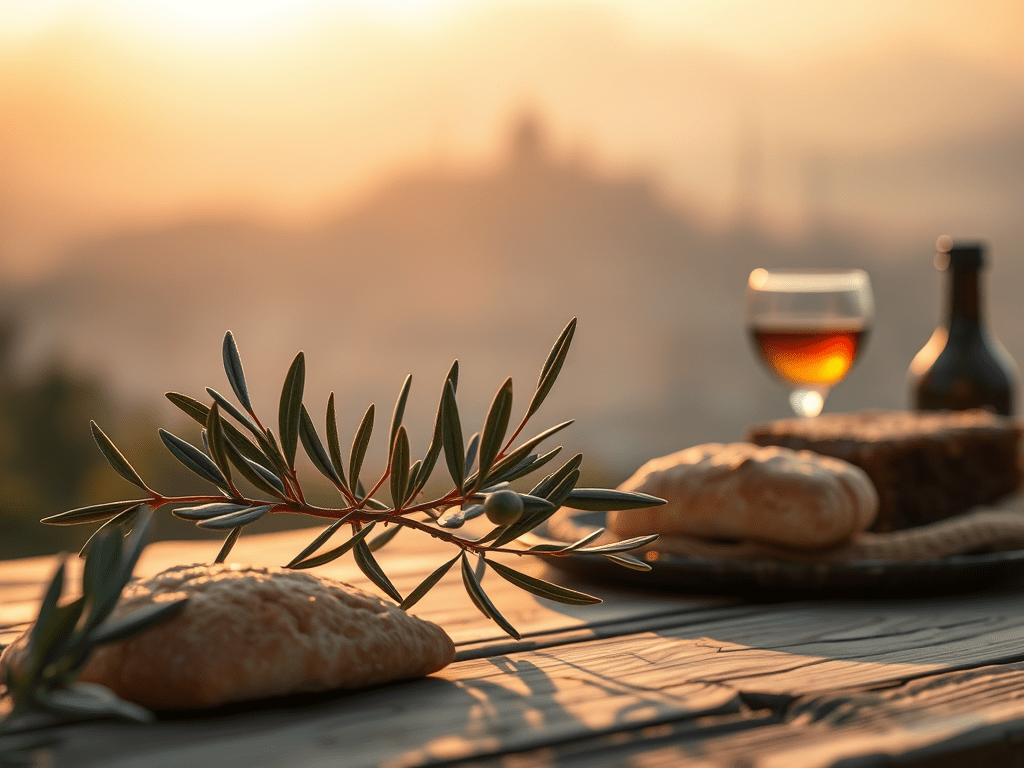
The table is set.
Bread and wine.
Two kings.
One valley.
But before we eat, we need to understand the table.
Not just what is on it, but why it had to be those elements.
1. The Olive Branch and the Illusion of Peace
Across cultures and centuries, the olive branch has symbolized peace. It appears early in Scripture—a dove returns to Noah with one in its beak, signaling the end of judgment.
But olive branches don’t grow into peace on their own. Olives must be beaten from the tree, crushed, and pressed.
The olive branch is not peace. The olive branch is a symbol of surrender. It says: “I have been crushed, and I yield.”
Peace isn’t soft. Peace isn’t passive. Peace follows surrender—or judgment.
And nowhere is that clearer than on the Mount of Olives.
2. Peace Through Death
The Mount of Olives is more than a geographic high point. It is a graveyard. It is the prophetic launching point for the return of Christ.
According to Zechariah 14:4, when Jesus returns, He will stand on the Mount of Olives.
Zechariah 14:4 On that day his feet shall stand on the Mount of Olives that lies before Jerusalem on the east, and the Mount of Olives shall be split in two from east to west by a very wide valley, so that one half of the Mount shall move northward, and the other half southward.(ESV)
The mountain of peace will be ripped open. Not to destroy peace, but to reveal what false peace has hidden.
This moment isn’t the beginning of war—it’s the end of resistance. Christ isn’t starting a war when He returns. He’s ending the war humanity has waged against God since Eden.
This is why true peace is not earthly. It is eternal, and it has a name: Jesus.
3. Peace Was Never Promised to the Earth—Only Through Christ
When the angels announced Jesus’ birth, they declared:
Luke 2:14 Glory to God in the highest, and on earth peace among those with whom he is pleased!(ESV)
They didn’t say peace to men. They said peace on earth, and goodwill toward men.
That was not a promise of ease, wealth, or health. It was an announcement: the King of Peace had come. The One through whom the world could stop fighting.
The declaration was not that men would never face trial—it was that the path back to peace had returned to the earth, wrapped in flesh.
That peace is not circumstantial. It is covenantal. It does not promise earthly comfort. It promises eternal restoration.
The prosperity gospel teaches that peace can be achieved by material gain. But Christ teaches that peace comes through the cross.
4. The Valley Was Never Neutral
If the Mount of Olives is the mountain of judgment, and Jerusalem is the city of peace,
then the Kidron Valley is the threshold between the two.
In the morning, as the sun rises in the east, the Mount of Olives casts its shadow westward.
The valley is covered in the shadow of death.
In the evening, as the sun sets behind Jerusalem, the city casts its shadow eastward.
The valley is covered in the shadow of peace.
The same ground feels like death in the morning, and peace in the evening.
But when Jesus returns, that illusion will end. The mountain will split. The false peace will be pierced. And the valley will be revealed for what it truly is:
The valley of the shadow of death—where peace can only be purchased by blood.
5. Bread and Wine: The Elements of War and Covenant
Let’s return to the table.
Bread and wine.
Why not meat? Why not honey? Why not something celebratory?
Because these two elements each carry the weight of transformation.
And not just transformation—refinement.
Bread:
- The grain is harvested, crushed, and ground to powder.
- It is mixed, shaped, and finally baked in fire.
- The bread must be unleavened — without yeast, without corruption, without pride.
Wine:
- The grape is crushed, and its juice is set aside.
- It is left to ferment over time, changing by the forces God already placed on its skin.
- The wine becomes potent—sometimes too potent, and must be cut with water to be usable.
Both are born in crushing. Both are completed through discernment:
- Bread must not burn in the fire.
- Wine must not rot in the waiting.
One is quick and violent. The other is slow and transformative.
6. The Yeast Was Never the Enemy
Some ask, “Why unleavened bread but fermented wine?”
The answer lies in the source of the yeast.
Bread does not naturally carry yeast. To rise, something foreign must be added. Yeast becomes a symbol of sin, pride, or false teaching.
But the grape carries its yeast on the skin. Fermentation isn’t contamination. It is design.
Jesus’ body is unleavened. Perfect. Sinless. Free of any foreign corruption.
His blood is fermented. Not from sin. But from crushing. From time. From the inner life being drawn out and transformed.
Bread = purity through fire.
Wine = covenant through waiting.
7. Two Tables, One Decision
We have all been invited to the table. But we must understand this: what the Lord creates, the enemy counterfeits.
There is another table. It is lavish. Beautiful. Overflowing with promises of comfort, health, and wealth. It glitters. It seduces. It looks like favor.
But the food is hollow. The taste is addictive. It feeds the flesh and starves the soul.
At that table, the body will swell—but only in decay. The soul will shrink—becoming a husk. And though laughter fills the room, it echoes like a funeral dirge.
This is the table of false peace. This is the table of indulgence without surrender.
You won’t find bread that sustains. You won’t find wine that redeems. Only crumbs that enslave and drink that deceives.
So you must choose: Not just what table you sit at. But which king prepared it.
Because in the valley of the shadow, there are only two kings. And only one of them died for you.
The fire is coming.
And the fermentation is already underway.



 Walking With Christ
Leave a comment