
Genesis 3:7 Then the eyes of both were opened, and they knew that they were naked. And they sewed fig leaves together and made themselves loincloths.(ESV)
Before there was idolatry. Before there was murder. Before there was law. There was a leaf.
And not just any leaf — a fig leaf. Sewn into coverings by the trembling hands of Adam and Eve. A makeshift sacrament of shame. The first human attempt to fix what had been broken by sin. This is where the pattern begins.
⚓ Fig Leaves: The First Religion
In the moment their eyes were opened, Adam and Eve didn’t run to God. They didn’t repent. They didn’t seek mercy. They didn’t cry out in repentance.
They tried to hide. They tried to cover themselves. They tried to look presentable again.
This was the first act of religion — not in the sense of true worship, but in the sense of man attempting to reach God on his own terms.
The fig leaf represents self-righteousness.
It was not just a symbol of shame — it was a declaration: “I can cover myself. I can make this right.”
But fig leaves wither. And God, in His mercy, rejected their effort and did something far more sobering.
Genesis 3:21 And the Lord God made for Adam and for his wife garments of skins and clothed them.(ESV)
The first death in history wasn’t Cain killing Abel. It was God killing an innocent animal — a creature incapable of sin — to provide a true covering. This was the first sacrifice. The first prophetic action pointing to the cross. God didn’t remove the consequence. He covered the shame — but at the cost of blood.
✒️ The Problem with Fig Leaves
Fig leaves dry. They wither. They don’t stretch. They don’t last. They address the symptom — shame — but not the cause — sin. The fig leaf was not a repair. It was a mask.
This is why God rejected it. Not because it wasn’t clever. But because it wasn’t redemptive.
⚒️ The Prophetic Transformation
Genesis 3:21 And the Lord God made for Adam and for his wife garments of skins and clothed them.(ESV)
God didn’t offer an improved version of man’s solution.
He replaced it entirely.
- A life was taken.
- Blood was spilled.
- A substitute died in innocence to cover the guilty.
This wasn’t just a better garment — it was the beginning of substitutionary atonement. The fig leaf was man’s offering. The skin was God’s sacrifice. God repurposed the idea of covering, not to affirm man’s efforts, but to foreshadow Calvary. The fig leaf introduced the pattern. God’s intervention defined it: Only blood can cover sin.
✒️ The Fig Tree and the Temple: A Judgment Enacted
Mark 11:13–14 (13)And seeing in the distance a fig tree in leaf, he went to see if he could find anything on it. When he came to it, he found nothing but leaves, for it was not the season for figs. (14)And he said to it, “May no one ever eat fruit from you again.” And his disciples heard it.(ESV)
Mark 11:15 And they came to Jerusalem. And he entered the temple and began to drive out those who sold and those who bought in the temple, and he overturned the tables of the money-changers and the seats of those who sold pigeons.(ESV)
Mark 11:20 As they passed by in the morning, they saw the fig tree withered away to its roots.(ESV)
This is not a disconnected miracle. It is a prophetic act of judgment — not just on a tree, but on a system. The fig tree had leaves but no fruit. Just like Adam and Eve. Just like the temple. Jesus curses the tree. Then cleanses the temple. Then the disciples find the tree withered.
This is not storytelling out of order. This is divine literary and theological symmetry. The fig tree is the symbol of Israel’s self-righteous appearance — full of religious leaves, but barren of spiritual fruit. The temple, once a place of covenant, had become a marketplace. Jesus wasn’t angry at the tree or the economy. He was indicting the entire system of performative righteousness — the legacy of the fig leaf.
🔥 The Transformation of the Symbol
So what does God do? He doesn’t destroy the fig entirely. He repurposes it. Throughout Scripture, the fig tree also appears as a sign of peace and prosperity.
Micah 4:4 but they shall sit every man under his vine and under his fig tree, and no one shall make them afraid, for the mouth of the Lord of hosts has spoken.(ESV)
What began as a symbol of shame is reclaimed as a sign of restoration.
- The leaf that once failed to cover becomes a prophetic shadow of the veil that would be torn.
- The tree that once bore no fruit becomes the soil into which redemption is planted.
- The first sacrifice becomes the first chapter of the gospel.
God doesn’t just erase shame. He transforms the symbols of shame into declarations of hope.
🔥 What This Means for Us
The fig leaf was the first sacrament of self-righteousness. The fig tree became a prophetic metaphor for God’s people — both in failure and in redemption. And both are now part of a greater story — one where even the human instinct to hide becomes a canvas for divine mercy.
God didn’t just redeem man. He redeemed the symbols. He redeemed the leaf. He redeemed the tree. He redeemed the very pattern of religion that had failed us — by making Himself the only way back.
🌿 Closing Reflection
The first altar was built with skins. The final altar was a cross. The first death was a silent animal. The last sacrifice was the Lamb of God.
What began with a fig leaf ends with a torn veil. And every step in between is the sound of a holy God turning man’s shame into sacred ground.
The fig leaf was man’s attempt to cover sin. The fig tree was God’s metaphor for the soul of His people. And the cross — the true tree — was where both were redeemed.
[⚓ Floatie] [✒️ Forge] [⚒️ Anvil] [🔥 Ember] [🌿 Covenant Triumph]
This post follows the Forge Baseline Rule—layered truth for the discerning remnant.
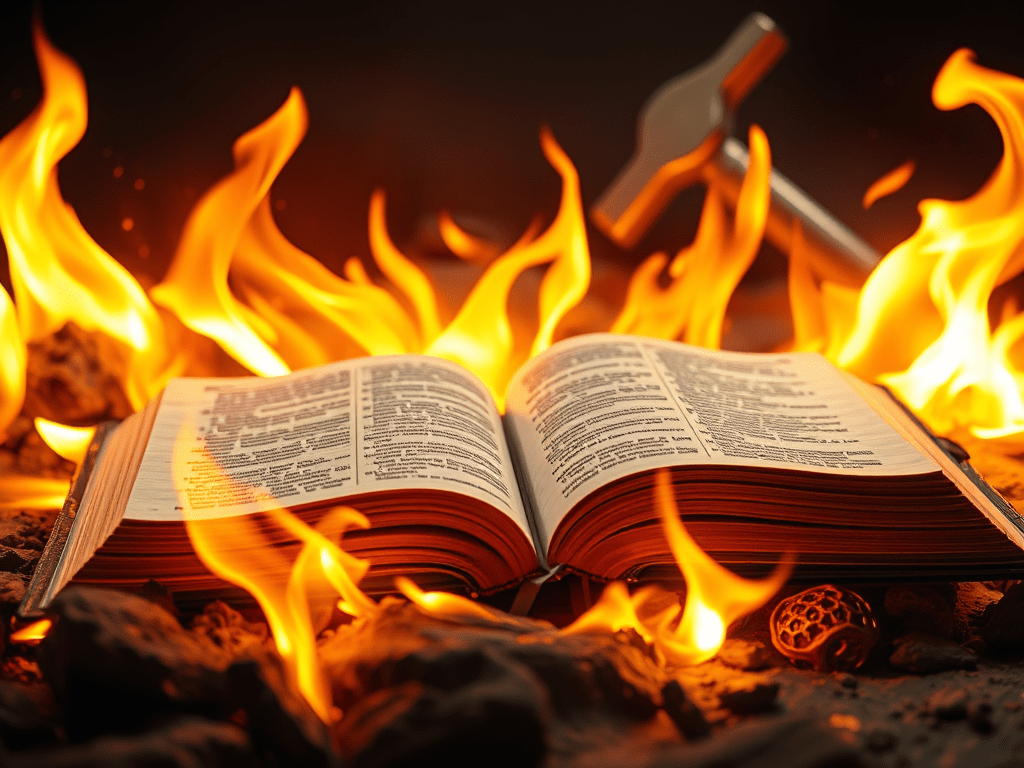
If you read this far and want something funny, take a look at the image for this post. The two are sewing fig leaves together but obviously have clothes on. AI has an issue with anything close to nudity or the appearance of nudity. This was just the best of the images created.


 Walking With Christ
Leave a comment