Genesis 6:14 Make yourself an ark of gopher wood. Make rooms in the ark, and cover it inside and out with pitch.(ESV)
Exodus 25:10 They shall make an ark of acacia wood. Two cubits and a half shall be its length, a cubit and a half its breadth, and a cubit and a half its height.(ESV)
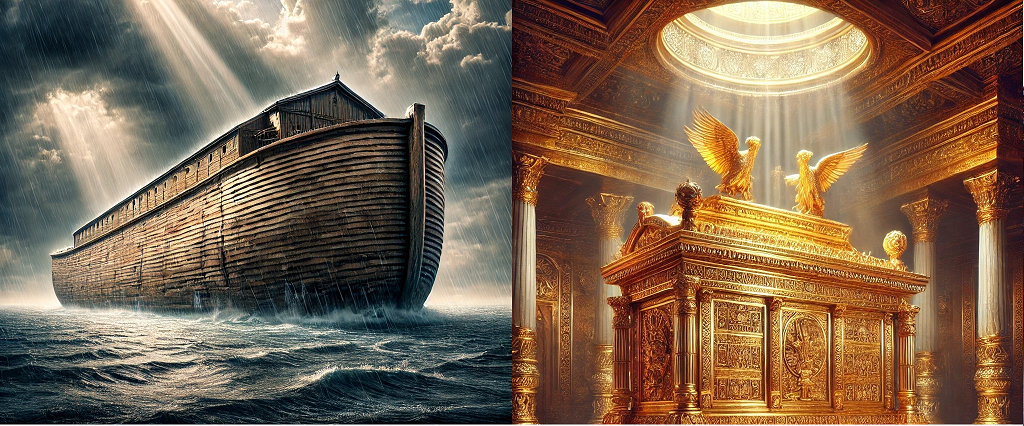
The bible speaks about two arks. The fact that we use the same English word for both might lead on to believe that these are the same in context. If we look at the Hebrew words in both verses, we learn that they are certainly not the same.
In Exodus, the Hebrew word for ark is “aron” which typically refers to a chest of container. The Hebrew word used in Genesis for Noah’s ark is “tebah” which typically means chest or container. Wait, I know I just said that these words translate to different things and then gave the exact same English approximation. This is almost like the English word for love. The Greek language has five different words that all mean love. The difference between them is the context and the deeper underlying meaning for each word.
Let me be a bit more clear. Hebrew has a lot of words that can be translated as chest of container. Each one has slightly different meaning with most being for mundane things. It’s almost like calling everything a bowl or pan in the kitchen. “Keli” is a vessel or container like what Rebekah used to draw water. These vessels can become ritually unclean. “Sunduq” is a box, chest, container, or even coffin (which was a specific type of container) that is primarily used for storage of things not considered to be sacred.
Aron is a holy container. It can actually be any container that has something holy put into it. Any reference to the Ark of the Covenant is aron. The treasure chests in the temple were aron. Joseph and King Saul were both placed in aron. Joseph’s remains being in an aron links back to God’s promise of future deliverance when Joseph could be buried properly in the promised land. Joseph’s coffin creates a bit of symbolic overlap with tebah because it points to resurrection and hope beyond death. Aron vessels require active participation through worship, sacrifice, and obedience to the law.
Tebah is only used in two places in the bible. The ark that Noah built is symbolically a coffin. Noah, et al, was placed in the ark and shut in by God while the rest of the earth was washed away. The flood represented the judgement of God and the death of the old, sinful world. In this case, judgement had come for everything that was outside of the ark or tebah. God put His holy remnant inside of the box for a time to protect it. Noah and those with him had to die to the old world so that the coffin could also become a womb where humanity could be reborn.
The world was essentially lawless between Adam and Moses. The lack of guardrails, so to speak, allowed humanity to drift so far from God that starting over was the best option. Judgement came and cleared the land but could not remove the root of sin as evidenced by the actions of Noah after the flood. He first built an alter and gave thanks. Then he grew a vineyard and got drunk. A new kind of garden of Eden. Different garden, same sin nature. This shows that human effort, even with a fresh start, will not solve the sin problem. The fact that Noah, a man declared righteous by God, still sinned after the flood truly underscores the biblical truth that human beings cannot achieve salvation or maintain righteousness on their own. This points to the need for a savior who can conquer sin completely.
Christ is the answer. Just as Noah was saved because he was inside the ark, believers are saved in Christ. Christ is the tebah. The Ark of the Covenant contained the law, but Jesus fulfilled the law perfectly and became the ultimate mercy seat where atonement is made. Just as the high priest sprinkled blood on the aron’s mercy seat, Jesus’ blood covers sin once and for all. Jesus is the aron.
In case anyone was wondering:
The other use of the word tebah was the basket that Moses was placed in as his mother pushed him into the river. Moses was plucked from the water then used to bring the children of Israel out of captivity. Both instances of tebah required passive human participation because Noah nor Moses could save themselves. Both instances are also associated with water which points to the necessary cleansing power of water while also showing that baptism alone can’t remove sin.
Hello,
Who am I?

I’ve walked a path I didn’t ask for, guided by a God I can’t ignore. I don’t wear titles well—writer, teacher, leader—they fit like borrowed armor. But I know this: I’ve bled truth onto a page, challenged what I was told to swallow, and led only because I refused to follow where I couldn’t see Christ.
I don’t see greatness in the mirror. I see someone ordinary, shaped by pain and made resilient through it. I’m not above anyone. I’m not below anyone. I’m just trying to live what I believe and document the war inside so others know they aren’t alone.
If you’re looking for polished answers, you won’t find them here.
But if you’re looking for honesty, tension, paradox, and a relentless pursuit of truth,
you’re in the right place.
If you’re unsure of what path to follow or disillusioned with the world today and are willing to walk with me along this path I follow, you’ll never be alone. Everyone is welcome and invited to participate as much as they feel comfortable with.
Now, welcome home. I’m Don.
Let’s connect
Join the journey!
Stay updated with our latest posts by joining our newsletter.
 Walking With Christ
Leave a comment