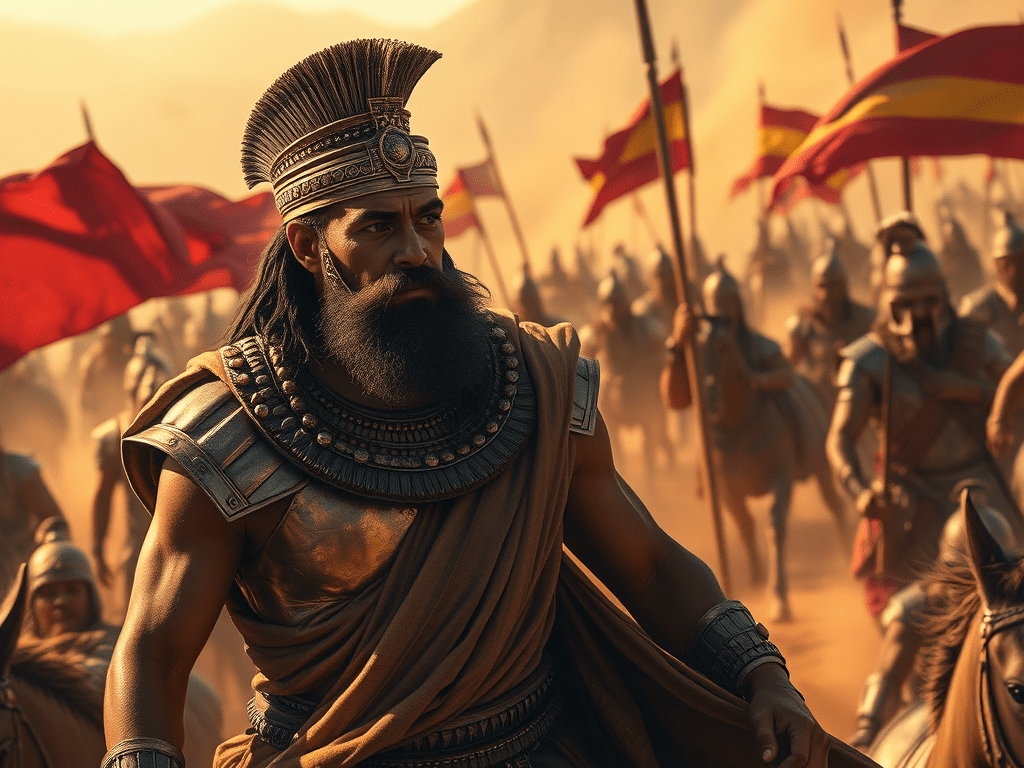
Let’s talk about Moses, but not the Moses most people know.
I was having a great conversation with my wife the other day when she told me something that I never really knew. Needless to say, it sparked my curiosity so I had to do a bit of research.
The bible is one of the best historical books of all time, but it doesn’t give a complete history. In fact, the parts of Moses’ life while he was living as an Egyptian are pretty sparse in biblical terms. That doesn’t mean that we don’t know anything about that period.
Josephus was an exceptionally well known and respected historian who wrote extensively about the extra-biblical Hebrew traditions. In Antiquities of the Jews (Book II, Chapter 10), Josephus gives a good description of Moses leading and Egyptian army in battle against the Ethiopians. It was a great victory in a brilliant campaign that saw Moses simply bypass the fortified cities to cut off their supply lines and wait for them to surrender. It’s also written that the Ethiopian princess, Tharbis, fell in love with Moses and that led to the peace treaty and the two getting married.
Two points here.
1. The bible does not speak much about these years of Moses because that was never the focus of the story. Focusing on giving a detailed history of the life of Moses would have distracted from the relationship he had with God and risked people thinking that his greatness had something to do with his worldly power rather than on his spiritual identity.
2. Extra-biblical stories can help to give us a more complete view of historical events or even deeper insights into what we read in the bible, but they are simply evidence that supports the truth of the bible and should never be placed ahead of the bible in terms of importance. The bible was written and is structured to highlight God’s goodness at all times. Much like archeological evidence, we can easily misinterpret ancient evidence because of our modern lens that we must use to understand the past. To date, there has never been found any archeological evidence that disproves the bible or biblical narratives. However, the same cannot be said for ancient manuscripts or scrolls and it’s important that we remember that people of antiquity are just as prone to errors, intentional or otherwise, as the people of today are.
If anyone is interested, the Antiquities of the Jews is available in English for free through Project Gutenberg. You can read it online or download it to read offline. There are several formats to choose from. The language is along the lines of the King James translation of the bible without the thy’s and thou’s. The translation itself was published in 1737 by William Whiston. The structure is more modern than the KJV but will still feel archaic to most readers.
To my wife,
Never underestimate your own knowledge and power to change the world. You knew something that I didn’t, and I’m proud of you for having the curiosity and desire to learn and dig deeper. I love your heart for the gospel. Never forget that I’ve learned so much from you, what it means to be human, a man, a husband, a father, and a friend. You’ve led me more than you will ever know.
Hello,
Who am I?

I’ve walked a path I didn’t ask for, guided by a God I can’t ignore. I don’t wear titles well—writer, teacher, leader—they fit like borrowed armor. But I know this: I’ve bled truth onto a page, challenged what I was told to swallow, and led only because I refused to follow where I couldn’t see Christ.
I don’t see greatness in the mirror. I see someone ordinary, shaped by pain and made resilient through it. I’m not above anyone. I’m not below anyone. I’m just trying to live what I believe and document the war inside so others know they aren’t alone.
If you’re looking for polished answers, you won’t find them here.
But if you’re looking for honesty, tension, paradox, and a relentless pursuit of truth,
you’re in the right place.
If you’re unsure of what path to follow or disillusioned with the world today and are willing to walk with me along this path I follow, you’ll never be alone. Everyone is welcome and invited to participate as much as they feel comfortable with.
Now, welcome home. I’m Don.
Let’s connect
Join the journey!
Stay updated with our latest posts by joining our newsletter.

 Walking With Christ
Leave a comment