Exodus 33:18-23 (18)Moses said, “Please show me your glory.” (19)And he said, “I will make all my goodness pass before you and will proclaim before you my name ‘The Lord.’ And I will be gracious to whom I will be gracious, and will show mercy on whom I will show mercy. (20)But,” he said, “you cannot see my face, for man shall not see me and live.” (21)And the Lord said, “Behold, there is a place by me where you shall stand on the rock, (22)and while my glory passes by I will put you in a cleft of the rock, and I will cover you with my hand until I have passed by. (23)Then I will take away my hand, and you shall see my back, but my face shall not be seen.”(ESV)
Another science lesson. I’m such a nerd.
The normal household incandescent light bulb makes light. Duh. How? Electricity flows between two wires that are connected by what’s called a filament. This filament is weaker that the wires it connects. The electricity flowing over the filament causes the filament to heat up. This heating process puts off light in a process called thermal emission. A bulb that is rated for 60 watts will put out less light than a bulb rated for 100 watts because the filament is thinner in the 60 watt bulb and heats less intensely.
What happens when we push more electricity through the bulb than it’s rated for? The filament gets too hot and melts. The bulb burns out.
The electricity coming from the power grid is far more than any bulb, or any other electronic device in our houses, could handle. To manage this we have to put regulators in the system to keep the power level low enough for common electric components to use without getting burned out. It actually takes a very tiny amount of electricity to get most light bulbs to light up.
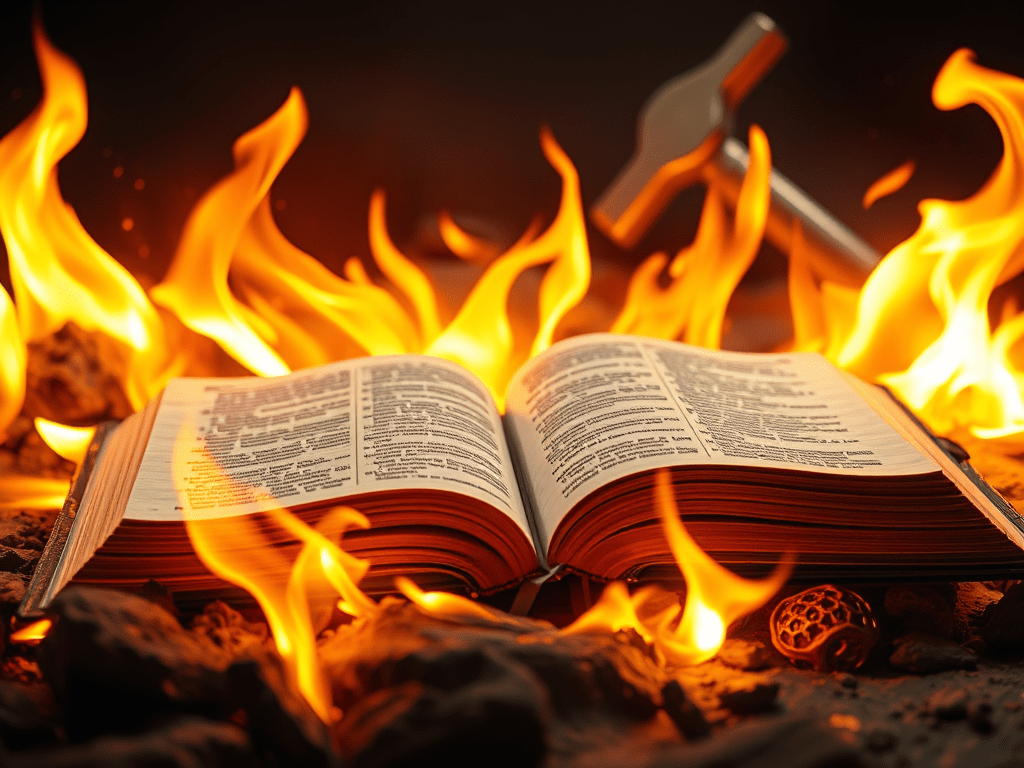
This verse in Exodus is almost like God telling Moses that seeing His full glory would be like our light bulbs being hit with millions of lightning bolts all at once with no filter.
Let’s carry on just a bit more.
If a lightbulb filament were to be heated up to operating temperature without the glass part of the bulb protecting it, the heat would cause a reaction between the filament material and the oxygen in the air in a process called oxidation. The build up of oxygen molecules on the filament would make it brittle and cause it to break fairly quickly. To increase the lifespan of the bulb, the manufacturer puts the two wires and filament inside the glass bubble and seals that bubble with a near vacuum to keep oxygen out. In a pure vacuum the filament has absolutely nothing to react with that would weaken it and thus, a normal lightbulb should last in incredibly long time depending on the filament material. Unfortunately for us, manufacturers figured this out and wanted to be able to sell more lightbulbs in the future.
Did you know that the lifespan of a lightbulb, barring power surges and physical damage, can be predicted to within minutes. This is because the manufacturer of the bulb uses pretty precise quality control measures on the materials and then add a very tiny but exact amount of gas inside the glass. This gas inside the glass, typically argon or krypton, will interact with the filament each time the bulb is turned off as it cools. The gas can delay the evaporation of the filament based on the quality of the tungsten filament and the amount of gas in the glass.
God created the same mechanism in man.
Genesis 6:3 Then the Lord said, “My Spirit shall not abide in man forever, for he is flesh: his days shall be 120 years.”(ESV)
Here is an interesting thing though, if a lightbulb is never turned on it will never burn out. It’s also not very useful. If one is turned on and left on then it will take much, much longer to burn out. When one is constantly turned on and off that causes the filament to experience much more physical stress because of the many heating and cooling cycles. The standard incandescent light bulb might only last 750 hours because of the on\off cycles. One that is left on continuously is estimated to last up to 5,000 hours.
Where am I going?
We are called to be on fire for the Lord. We are called to be a light to the world. We are called to be a constant and steady light. One that never goes out. If we experience constant fluctuations where we are on fire then not that adds physical and spiritual stress to our lives which ultimately shortens our lifespan.
Matthew 5:14-16 (14)You are the light of the world. A city set on a hill cannot be hidden. (15)Nor do people light a lamp and put it under a basket, but on a stand, and it gives light to all in the house. (16)In the same way, let your light shine before others, so that they may see your good works and give glory to your Father who is in heaven.(ESV)
Let your little light shine.

Hello,
Who am I?

I’ve walked a path I didn’t ask for, guided by a God I can’t ignore. I don’t wear titles well—writer, teacher, leader—they fit like borrowed armor. But I know this: I’ve bled truth onto a page, challenged what I was told to swallow, and led only because I refused to follow where I couldn’t see Christ.
I don’t see greatness in the mirror. I see someone ordinary, shaped by pain and made resilient through it. I’m not above anyone. I’m not below anyone. I’m just trying to live what I believe and document the war inside so others know they aren’t alone.
If you’re looking for polished answers, you won’t find them here.
But if you’re looking for honesty, tension, paradox, and a relentless pursuit of truth,
you’re in the right place.
If you’re unsure of what path to follow or disillusioned with the world today and are willing to walk with me along this path I follow, you’ll never be alone. Everyone is welcome and invited to participate as much as they feel comfortable with.
Now, welcome home. I’m Don.
Let’s connect
Join the journey!
Stay updated with our latest posts by joining our newsletter.


 Walking With Christ
Leave a comment